
Introduction
This dead cells review covers everything a potential buyer needs to know before spending money on one of the most acclaimed roguelike games of the past decade. Developed by Motion Twin and first released in 2018 after an Early Access period, this indie title has maintained a dominant position in the genre through consistent updates, platform expansions, and high-quality DLC. Whether you’re eyeing the PC version or the popular Nintendo Switch edition, this breakdown covers gameplay, performance, DLC value, and how it holds up against the current best in the genre.
By Prime Games Arena | Gaming Expert & PC Performance Specialist
⚡ Quick Summary
- Dead Cells is a roguelike-metroidvania hybrid built around fast, fluid combat with deep build customization across hundreds of weapons and mutations
- The Nintendo Switch version delivers strong performance in both handheld and docked modes, making it one of the best portable roguelikes available
- The Return to Castlevania DLC adds substantial content — new biomes, bosses, and weapons — and is worth the extra cost for both new and returning players
- Critic scores sit consistently in the high 80s to low 90s on Metacritic, backed by strong Reddit community sentiment across all platforms
- Against competitors like Hades, Blasphemous, and Rogue Legacy 2, this title holds its own in almost every category
What Is Dead Cells? A Game Overview
Dead Cells is a roguelike-metroidvania hybrid developed by French indie studio Motion Twin. The game entered Steam Early Access in 2017 before its full 1.0 release in August 2018 and has since been ported to Nintendo Switch, PlayStation 4, PlayStation 5, Xbox One, Xbox Series X|S, and iOS.
The game fuses two genre mechanics: the procedurally generated, run-based structure of a roguelike with the interconnected level exploration typical of metroidvania titles. Each run generates a new layout through familiar biomes, and death resets most progress — but permanent unlocks accumulate over time, giving players a sense of long-term growth.
The Developer Behind It — Motion Twin
Motion Twin is a Paris-based cooperative studio known for unconventional development practices — the team operates as a worker-owned collective where all employees receive equal pay. After the success of this title, Motion Twin handed ongoing development to Evil Empire, a studio formed by former Motion Twin developers, which has since managed all major DLC releases and balance updates.
Roguelike, Metroidvania, or Both?
The genre hybrid debate matters for buyers comparing options across the roguelike games landscape. Dead Cells leans harder into roguelike mechanics than most metroidvania titles — there is no persistent map to backtrack through. Instead, the metroidvania influence shows through gate-locked paths, hidden rooms, and the gradual unlock of new routes as players collect permanent abilities across multiple runs. This hybrid structure is what separates it from pure roguelikes like Slay the Spire and positions it uniquely within the broader roguelike game genre.
Combat System, Weapons, and Build Depth
The combat system is the single strongest element of this release. Motion Twin built every mechanic around responsiveness — attacks connect cleanly, enemies telegraph moves fairly, and the environment becomes a tactical resource rather than simple background.
Weapon Types and Mutation System
The game offers over 100 weapons split across melee, ranged, shield, and throwable categories. During each run, players collect Scrolls of Power that increase a chosen stat category — Brutality, Tactics, or Survival — and these stats scale specific weapons and mutations. The mutation system, layered on top of weapon selection, creates build synergies that emerge organically during a run rather than being locked into a predetermined loadout. This is where the game’s replayability lives — no two runs play identically.
Biome Structure and Exploration Design
Each biome is procedurally generated within a handcrafted tile set, meaning the layout changes between runs while the general aesthetic and enemy pool remain consistent. The game offers multiple branching paths through its level structure, letting players choose between risk-heavy and safer routes depending on their current build strength. Environmental storytelling is present but minimal — lore is delivered through scattered notes and NPC dialogue rather than cutscenes.
Difficulty, Boss Cells, and Accessibility
The base game is genuinely challenging but fair. After completing the main storyline, players unlock Boss Cells — difficulty modifiers that increase enemy aggression, add new mechanics, and restrict certain tools. Five Boss Cells exist, each adding a measurable spike in challenge. For players who find the standard difficulty steep, an Assist Mode was added in a 2020 update, offering adjustable options for damage reduction, slowing game speed, and enabling revival after death. Prime Games Arena recommends enabling Assist Mode for first-time roguelike players rather than abandoning the game in early frustration.
Playing on Nintendo Switch — Performance and Feel
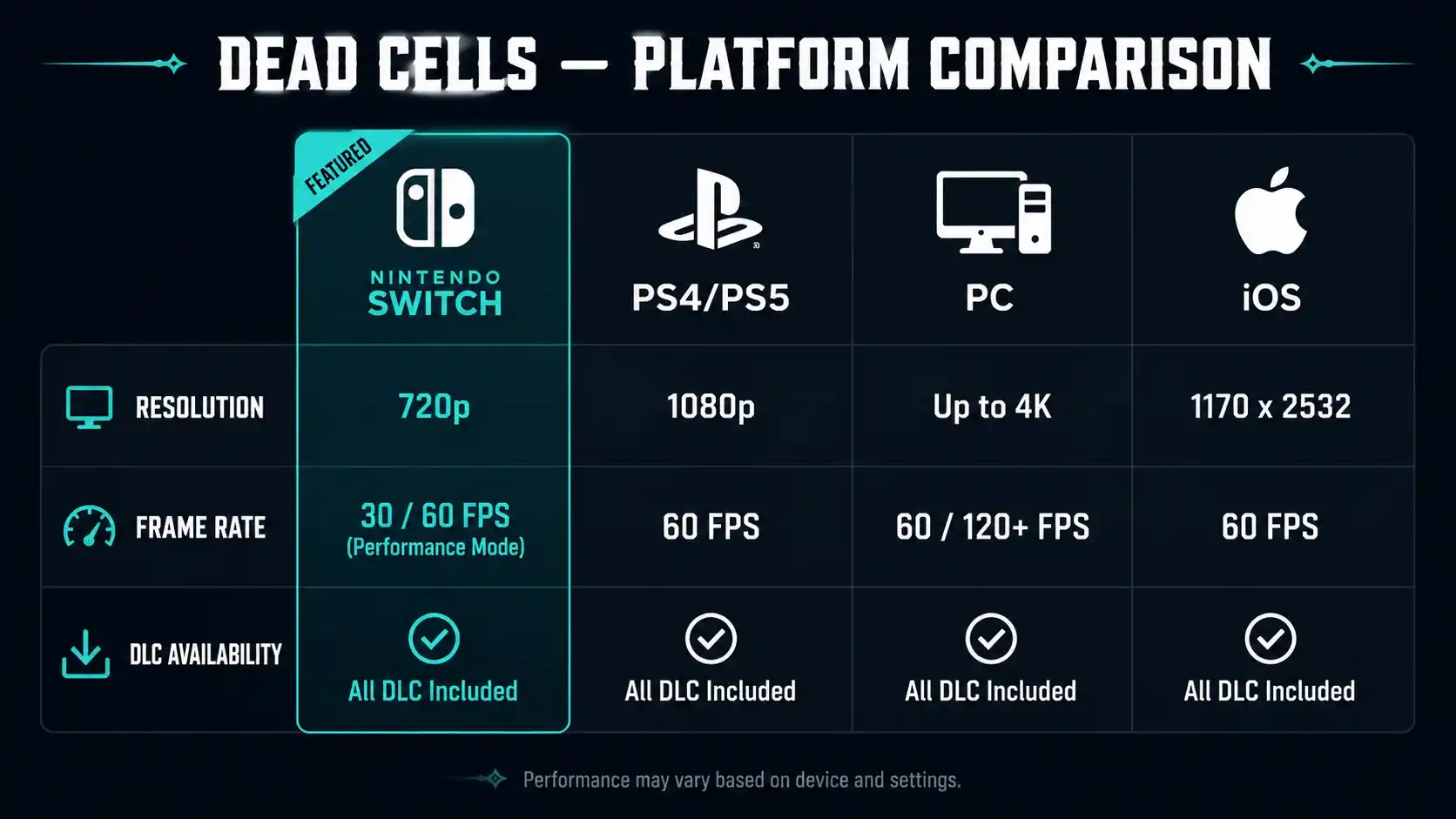
The Nintendo Switch version of the dead cells game is widely regarded as one of the best portable adaptations of any roguelike title currently available. Evil Empire and Motion Twin worked closely on Switch optimization, and the results reflect that attention.
PC players wondering how this game will perform on their own system can use our What FPS Can I Get on My PC? guide to estimate expected frame rates before purchasing.
Frame Rate and Visuals — Handheld vs. Docked Mode
In our testing, the Switch version maintains a consistent 60fps in both handheld and docked modes under normal gameplay conditions. Visual quality drops slightly in handheld — running at 720p compared to 1080p docked — but the pixel art style holds up cleanly at both resolutions. Load times between biomes are slightly longer than the PC version but remain acceptable given the hardware difference.
For PC users looking to reduce loading times in games like Dead Cells, our SSD vs HDD for Gaming: Which Is Better in 2025? guide explains the real-world differences.
Controls and Input Feel on Switch
The game plays well with Joy-Cons, though the Pro Controller is noticeably more comfortable during extended sessions. The smaller analog stick on the Joy-Con can make diagonal movement less precise during fast combat sequences. Touch screen support exists in handheld mode for menu navigation but is not used during active gameplay. Nintendo Switch dead cells builds feel tight and responsive regardless of input method.
Platform Comparison at a Glance
| Platform | Resolution | Frame Rate | Touch Support | DLC Available |
| Nintendo Switch | 720p / 1080p | 60fps | Limited | Yes |
| PS4 / PS5 | 1080p / 4K | 60fps | No | Yes |
| PC | Up to 4K | Uncapped | No | Yes |
| iOS | Adaptive | 60fps | Yes | Yes |
Return to Castlevania DLC — What’s New and Is It Worth It?
The Return to Castlevania expansion, released in March 2023, is the largest and most ambitious DLC the game has received. It brings a collaboration with Konami’s iconic Castlevania franchise, adding dedicated biomes, exclusive weapons, and appearances from beloved characters including Alucard, Richter Belmont, and Death.
What the DLC Adds to the Base Game
The expansion introduces two new biomes — the Defiled Necropolis and Dracula’s Castle — each with unique enemy sets and environmental design faithful to the Castlevania aesthetic. Over a dozen Castlevania-themed weapons are added, including the iconic Vampire Killer whip. The collaboration is structurally integrated rather than bolted on — it connects to the existing biome routes and feels like a natural extension of the base game rather than a disconnected mode.
Is the Castlevania Expansion Worth the Extra Cost?
For new players, purchasing the Complete Edition bundle — which includes the base game and all DLC — is the recommended entry point. The price-to-content ratio across the full bundle is exceptional by any genre standard. For returning players who already own the base game, the expansion offers three to five additional hours of new content per playthrough cycle, with unique boss encounters that rival the base game’s best fights. Based on our gameplay experience, the Return to Castlevania DLC is among the best video game crossover expansions released in recent years.
Honest Strengths and Weaknesses
What Motion Twin Got Right
- Combat feedback is among the sharpest in the roguelike genre — hits feel impactful and movement is immediately responsive
- Build variety is genuinely deep — even after 50+ hours, new weapon and mutation combinations emerge
- Pixel art direction ages exceptionally well, with fluid animation that holds up against modern titles
- Post-launch support from Evil Empire has been consistent, with multiple free updates adding content over several years
- The Assist Mode addition makes the game meaningfully more accessible without simplifying the core experience
Where the Experience Can Frustrate
- Run repetition becomes noticeable after the 30–40 hour mark as the biome pool becomes familiar
- The narrative is virtually nonexistent by modern indie game standards — players seeking a story-driven roguelike should look elsewhere
- Some early platform versions launched with performance inconsistencies, though patches have resolved most reported issues
- Pricing for the full DLC bundle can feel steep for budget-conscious buyers during non-sale periods
Pros and Cons at a Glance
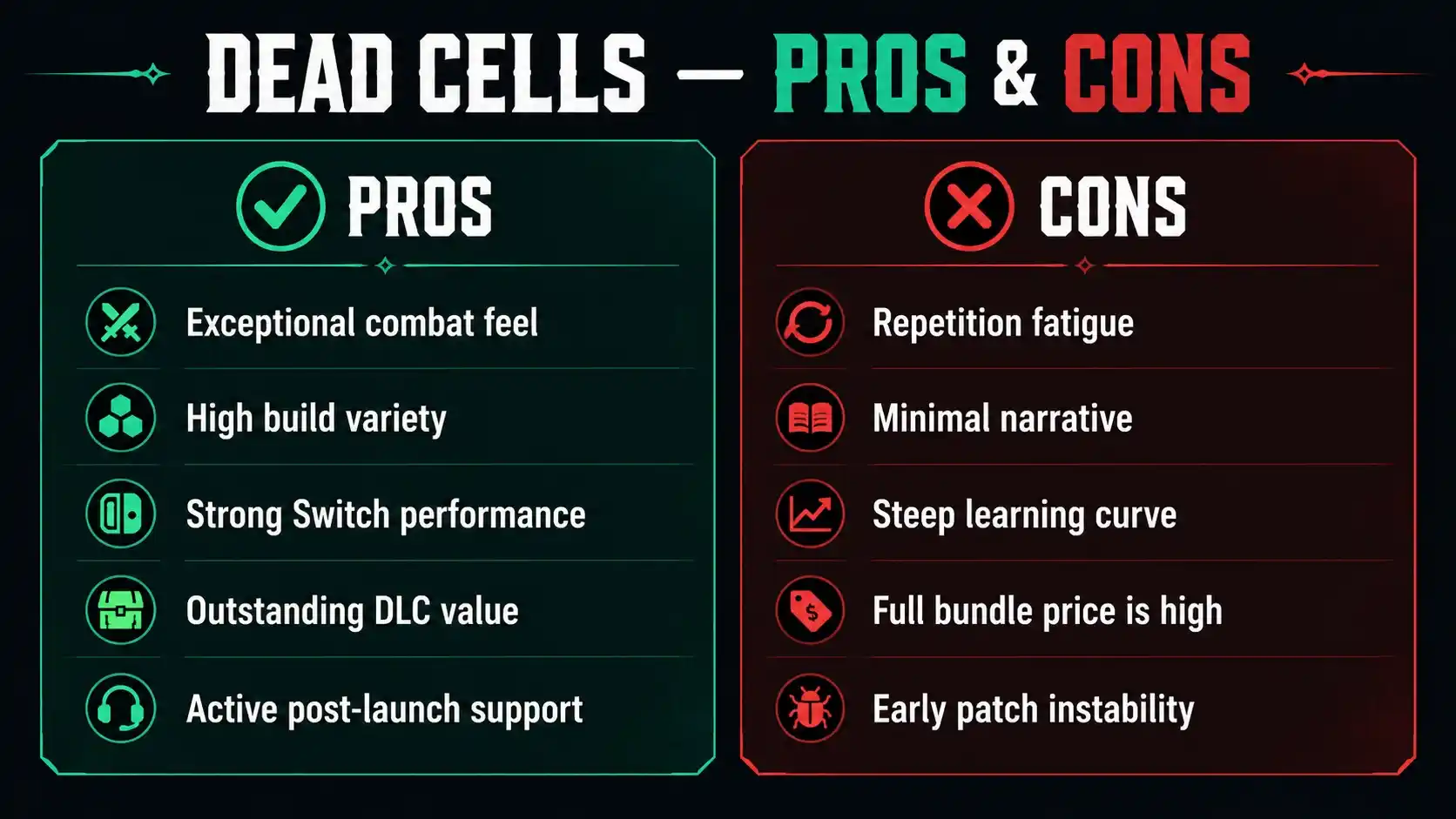
| Pros | Cons |
| Exceptional combat feel | Repetition fatigue after many hours |
| High build and weapon variety | Minimal narrative depth |
| Strong Switch performance | Steep initial learning curve |
| Outstanding DLC value | Full bundle price is high outside sales |
| Active long-term post-launch support | Early patch instability on some platforms |
How This Game Compares to Top Roguelikes
Dead Cells vs. Hades — Which One Should You Play?
If you’re still comparing top-rated action games and roguelikes, explore our Complete Game Reviews Hub for additional recommendations and detailed game breakdowns.
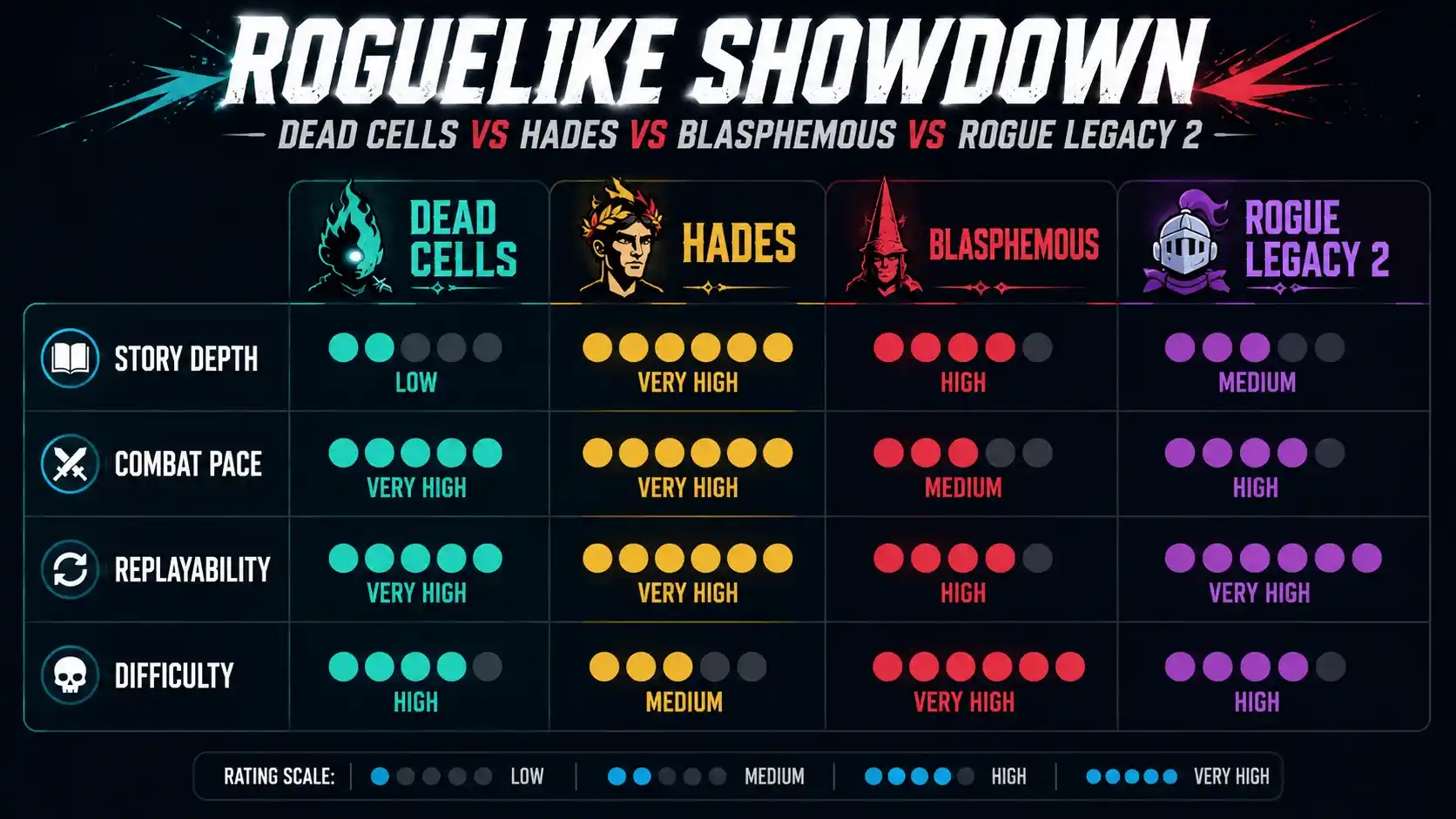
Hades, developed by Supergiant Games, is the most direct comparison point for genre newcomers. Where this title prioritizes pure combat mastery and build variety, Hades wraps its roguelike loop in a dense narrative with fully voiced characters and story progression that advances between runs. Combat in Hades is fast but more forgiving. Players who want a compelling story alongside their roguelike gameplay should choose Hades. Players who want the deepest, most mechanically demanding combat system in the genre should choose this title.
Dead Cells vs. Blasphemous
Blasphemous, developed by The Game Kitchen, is a dark gothic platformer that shares surface-level aesthetics with this game but plays very differently. Blasphemous is a traditional metroidvania — no roguelike elements — with slower, more deliberate combat and a strong emphasis on religious dark fantasy atmosphere and lore. The difficulty in Blasphemous is often more punishing and less forgiving than here. Players choosing between the two should prioritize Blasphemous for atmosphere and story, and this title for action variety and replayability.
Dead Cells vs. Rogue Legacy 2
Rogue Legacy 2 by Cellar Door Games shares the roguelike-platformer DNA but takes a different approach to progression. Where this game resets nearly everything between runs, Rogue Legacy 2 builds persistent upgrades between runs through a family legacy system, making it more approachable for casual players. This title rewards skill mastery; Rogue Legacy 2 rewards persistence.
Feature Comparison
| Feature | Dead Cells | Hades | Blasphemous | Rogue Legacy 2 |
| Genre | Roguelike-Metroidvania | Roguelike Action RPG | Dark Platformer | Roguelike RPG |
| Story Depth | Low | High | Medium | Medium |
| Combat Pace | Very Fast | Fast | Medium | Medium |
| Replayability | Very High | Very High | Medium | High |
| Switch Version | Yes | Yes | Yes | Yes |
| Difficulty | High | Medium-High | Very High | Medium |
Critical Scores and Community Reception
Across all platforms, this roguelike game has received consistently strong scores from major outlets. The title sits in the high 80s to low 90s on Metacritic across PC, Switch, and console versions, reflecting rare cross-platform critical consistency. IGN praised the combat loop and replayability as standout qualities at launch and in post-DLC coverage. GameSpot similarly highlighted the tight controls and build depth as primary strengths.
Reddit communities focused on roguelike games regularly cite this title as the recommended entry point for newcomers to the genre. The dead cell switch version specifically receives consistent praise in Nintendo Switch gaming subreddits for its portable performance and control adaptation. Negative community feedback tends to focus on later-run repetition and the minimal story, which aligns with the honest weaknesses identified above.
How Long Does Dead Cells Take to Beat?
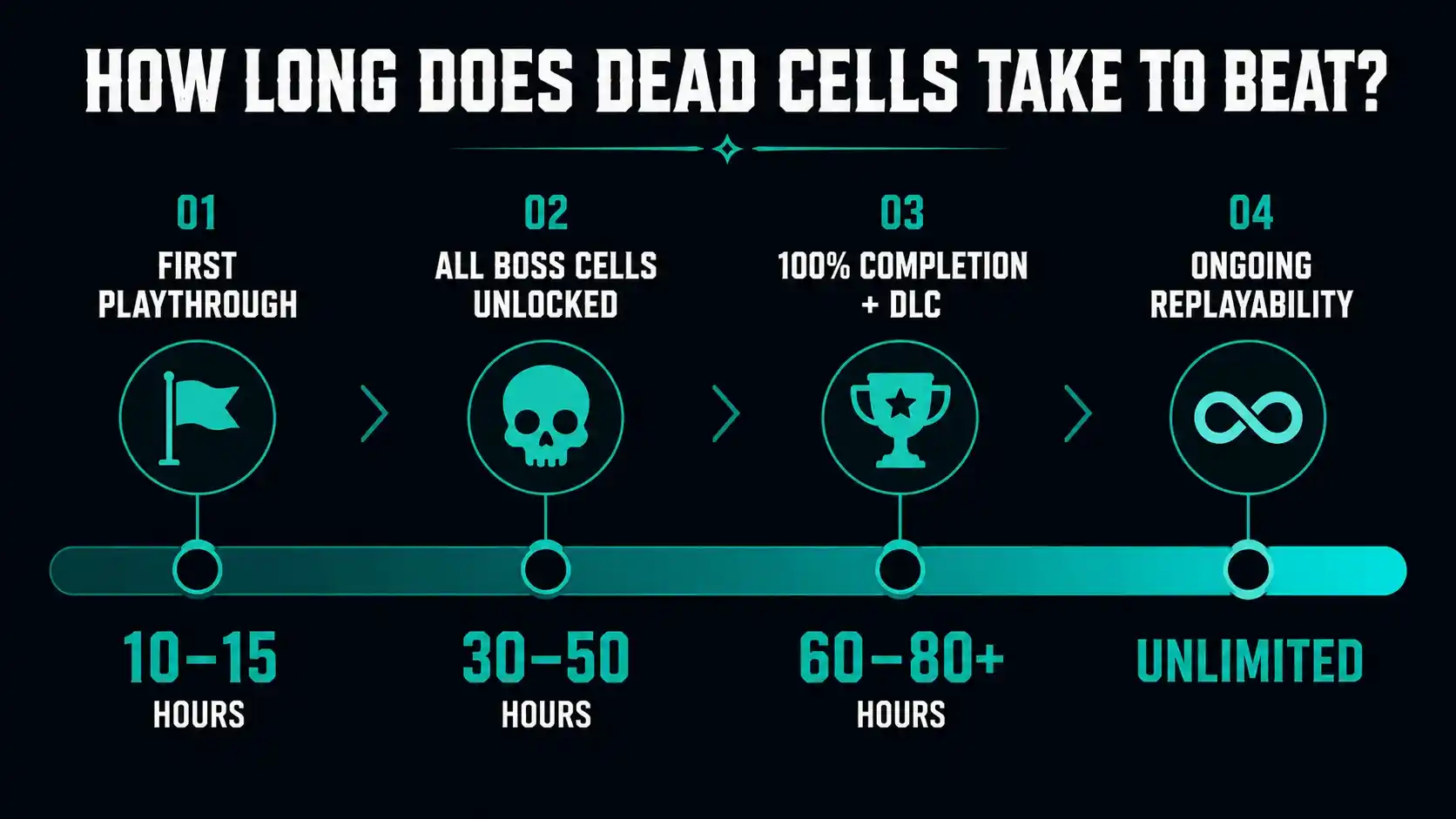
Completion time varies significantly depending on player goals:
- Casual first playthrough (reaching credits): 10–15 hours
- Unlocking all Boss Cells (full difficulty progression): 30–50 hours
- 100% completion including all DLC content: 60–80+ hours
- Ongoing replayability: Indefinite — the build variety sustains long-term play without a defined endpoint
Players new to roguelike games will likely spend more time in the 10–15 hour range before completing their first full run, given the genre’s inherent learning curve.
Is This Game Still Worth Buying in 2025?
Yes — with some context. For players new to the roguelike genre, this title remains one of the clearest recommendations available across any platform. The core combat has not been surpassed by most entries released since 2018, and the content volume — especially with the Complete Edition bundle — provides exceptional value per dollar.
Players using older hardware should also check out our guide to the Best Games for Low End PC in 2026, which includes several highly optimized indie titles that deliver excellent performance without demanding system requirements.
Genre veterans who have completed multiple high-difficulty runs will find diminishing returns unless they pursue the highest Boss Cell challenges or the Castlevania expansion content. Platform choice should be driven by lifestyle: the Nintendo Switch version for portable play, PC for maximum performance, and PS5 for 4K visual quality.
Outside of sale periods, the full bundle carries a higher price point than some competing roguelike titles. Watching for seasonal sales on the Complete Edition is the optimal purchasing strategy for budget-conscious buyers.
Final Verdict
Rating: 9 / 10
Motion Twin and Evil Empire built one of the most mechanically refined action games in the roguelike genre. The combat system, build variety, and long-term replayability are genuine genre benchmarks. The Nintendo Switch version specifically delivers a portable experience that few games in the genre can match.
The primary limitations — minimal narrative and late-game repetition — are real but not deal-breakers given the depth of the core loop. The Return to Castlevania DLC adds meaningful content that justifies revisiting even for players who have logged significant hours in the base game.
Best for: Action-focused players, roguelike newcomers, Nintendo Switch owners seeking a standout portable title
Skip if: Strong narrative is a priority, repetitive runs frustrate you quickly, or turn-based gameplay is preferred
Conclusion
Few games in the roguelike genre have demonstrated the staying power that this dead cells review set out to assess. Seven years after its initial release, the core combat remains as sharp as any modern entry, the DLC expansions have added genuine depth rather than superficial content, and the Nintendo Switch version continues to be one of the most recommended portable gaming experiences available. The Complete Edition bundle — base game plus all DLC — is the definitive entry point for any platform and represents one of the best value packages in current indie gaming.
New to PC and console gaming? Visit The Ultimate Gaming Guide Hub for performance tips, hardware advice, walkthroughs, and game recommendations.
Frequently Asked Questions
Q1: What exactly is Dead Cells and what genre does it belong to?
Dead Cells is a roguelike-metroidvania hybrid developed by Motion Twin. It combines procedurally generated, run-based progression with interconnected level design and permanent ability unlocks, placing it in a distinct hybrid space between pure roguelikes and traditional metroidvania titles.
Q2: Is the Nintendo Switch version a good way to experience this game?
Yes. The Switch version runs at a consistent 60fps in both handheld and docked modes and is considered one of the best portable adaptations of any roguelike game currently available. The Pro Controller is recommended for extended sessions over Joy-Cons.
Q3: How long does it take to finish the game from start to credits?
A casual first playthrough reaching the credits takes approximately 10–15 hours. Full Boss Cell progression extends playtime to 30–50 hours, while 100% completion including all DLC content can reach 60–80+ hours.
Q4: Is the Return to Castlevania expansion worth buying?
Yes. The expansion adds two new biomes, over a dozen Castlevania-themed weapons, and multiple new boss encounters that integrate naturally into the base game’s structure. The Complete Edition bundle is the recommended purchase for new players.
Q5: Which is better for a genre newcomer — this dead cells review subject or Hades?
Both are excellent starting points, but they serve different preferences. Hades offers a richer narrative and slightly more forgiving combat. This title offers deeper mechanical complexity and greater build variety. Players prioritizing story should start with Hades; players prioritizing action depth should start here.
Q6: Is the game beginner-friendly or only suitable for experienced players?
The base difficulty is high but fair. An Assist Mode added in 2020 allows newcomers to reduce damage, slow gameplay speed, and enable revival — making the experience accessible without removing the core challenge.
Q7: What platforms is the game available on?
The game is available on PC (Steam, GOG), Nintendo Switch, PlayStation 4, PlayStation 5, Xbox One, Xbox Series X|S, and iOS. All versions support the Return to Castlevania DLC and other major expansions.


One Response