What Is Source of Madness About?
Source of Madness takes place in the Loam Lands, a nightmarish world corrupted by the light of a blood moon. Players take on the role of an Acolyte — a chaos magic wielder tasked with ascending the Tower of Madness at the heart of the world. The core narrative revolves around a faction called the Tormented, eldritch creatures born from the moon’s influence, which players must fight through to progress.
The Story and Setting Explained
The lore of Source of Madness draws heavily from Lovecraftian horror traditions — themes of unknowable cosmic forces, grotesque transformations, and environments that feel inherently hostile to human presence. The Loam Lands are structured across multiple biomes, each more disturbing than the last, pushing players deeper into visual and mechanical discomfort.
Much of the game’s atmosphere is inspired by the themes of Lovecraftian horror, a subgenre centered on cosmic dread, unknowable entities, and humanity’s insignificance in the universe.
Fans of unsettling psychological horror should also check out our DreadOut Game Review: Is This Horror Game Worth Playing? and Layers of Fear Review: Is the 2023 Remake Worth Playing?, both of which explore different approaches to atmospheric horror and player tension.
Key setting elements include:
- The Blood Moon — the central lore force corrupting the world and driving enemy generation
- The Tower of Madness — the final objective across all runs, acting as the narrative anchor
- The Acolyte — a customizable protagonist class tied to chaos magic disciplines
- The Tormented — the enemy faction, whose forms are never the same twice due to AI-driven generation
The story does not deliver cutscene-heavy narrative. It is environmental and contextual — experienced through world design and enemy behavior rather than traditional dialogue systems.
Is Source of Madness a Metroidvania?
Source of Madness is frequently tagged as a metroidvania due to its side-scrolling format and gothic aesthetic, but the classification is inaccurate. A true metroidvania requires an interconnected map where new abilities unlock previously inaccessible areas. Source of Madness does not follow this structure. It is a roguelite platformer — runs are randomized, death resets progress, and the world regenerates between attempts. The metroidvania label is a genre mismatch that has contributed to some player disappointment on initial purchase.
Source of Madness Gameplay — How Does It Actually Play?
Source of Madness is built around a magic-only combat system, procedural world generation, and permadeath. Each run starts fresh, with players selecting spells and building a chaos magic loadout that evolves through the run.
Combat System and Magic Mechanics
Unlike most action platformers, Source of Madness removes conventional weapons entirely. Combat is driven exclusively through chaos spells, which function across a range of mechanics:
- Projectile spells — standard long-range magic attacks
- Area-of-effect spells — crowd control options for multi-enemy situations
- Close-range burst spells — high damage, high risk
- Passive enchantments — applied to the Acolyte’s form for run-long bonuses
Spell combinations are the core of the build system. Players unlock new spell types as they progress through runs, creating evolving synergy potential. Based on our gameplay experience, early investment in mobility-enhancing spells significantly improves survival rates in mid-to-late biomes where enemy density spikes sharply.
The AI-Generated Enemies — What Makes Them Unique?
Source of Madness uses machine learning to procedurally generate enemy bodies and movement behaviors, meaning no two enemies look or move identically across different playthroughs. This is not cosmetic variety — the AI engine generates body proportions, limb configurations, and behavioral patterns that directly affect how each enemy attacks and navigates terrain.
This system is one of the game’s most genuinely innovative features. In our testing, enemies in the same biome across two separate runs behaved differently enough to require adjusted spell approaches — something fixed enemy design cannot replicate.
Players interested in experimental horror experiences may also enjoy our Observer: System Redux Review – Is It Worth Playing?, another game that blends disturbing visuals, psychological themes, and unique technological concepts.
Roguelite Progression Loop
Understanding what carries between runs is critical for long-term engagement:
What resets on death:
- Current spell loadout
- In-run currency
- Biome progress
What carries over:
- Unlocked upgrade tree nodes (meta-progression)
- Discovered spell types added to the pool
- Achievement and trophy progress
The upgrade tree provides enough persistent progression to keep early runs feeling rewarding. However, Prime Games Arena recommends front-loading exploration of the upgrade tree during the first 3–5 runs to establish a meaningful foundation before harder biomes become the primary challenge.
Source of Madness Review — Honest Verdict
Source of Madness is a good game for a specific type of player, but not a universally great one. The core loop is functional and the atmosphere is genuinely impressive, but the experience has clear ceiling points.
What Source of Madness Does Well
If atmosphere is your main priority, our Death’s Door Review: Is This Indie Adventure Worth Playing? and Lost in Random: The Eternal Die Review, Gameplay & Info cover other visually distinctive indie adventures with memorable world design.
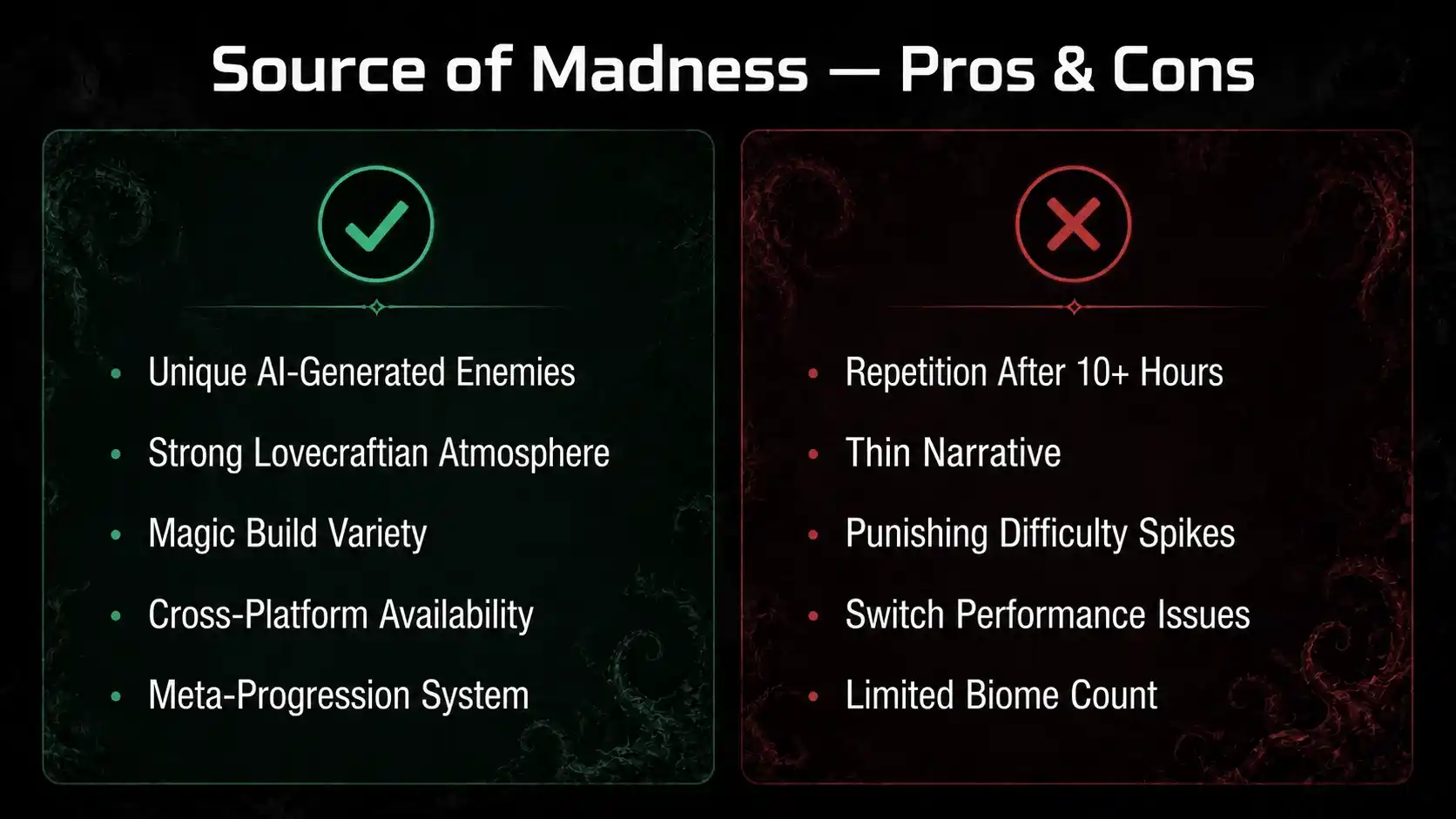
- Atmosphere — The hand-painted visual style combined with the AI-generated enemy horror creates a consistently unsettling aesthetic that few roguelites match
- Enemy variety — The machine learning system ensures visual and behavioral freshness across early runs in a way that scripted enemy design cannot replicate
- Sound design — Audio work is strong, with creature sounds that feel genuinely non-human and environmental audio that reinforces the horror tone
- Build diversity — The magic system supports meaningfully different run strategies, from aggressive burst builds to passive attrition loadouts
Where Source of Madness Falls Short
- Repetition — After 10–15 hours, the novelty of AI-generated enemies fades and the limited biome count becomes noticeable
- Narrative thinness — The lore is interesting but the game delivers very little of it through active storytelling
- Difficulty spikes — Certain mid-game sections feel disproportionately punishing in ways that feel arbitrary rather than skill-based
- Switch performance — The Nintendo Switch version suffers from frame rate inconsistencies that undermine the combat’s responsiveness
Pros and Cons
| Pros | Cons |
| Unique AI-generated enemy system | Repetition sets in after extended play |
| Strong Lovecraftian atmosphere | Thin narrative delivery |
| Magic build variety per run | Punishing mid-game difficulty spikes |
| Available across all major platforms | Switch version has performance issues |
| Persistent upgrade tree meta-progression | Limited biome count for long-term players |
Source of Madness on PS5 and Switch — Platform Differences
Source of Madness launched on PC via Steam before Thunderful Publishing released console versions across PS5, PS4, Xbox Series X/S, and Nintendo Switch.
Players concerned about gaming performance may find our What FPS Can I Get on My PC? — How to Check, Estimate & Boost Your Frame Rate and How to Check If Your GPU Is Performing Well FPS & Health guides useful when comparing platform options.
Source of Madness PS5 Version
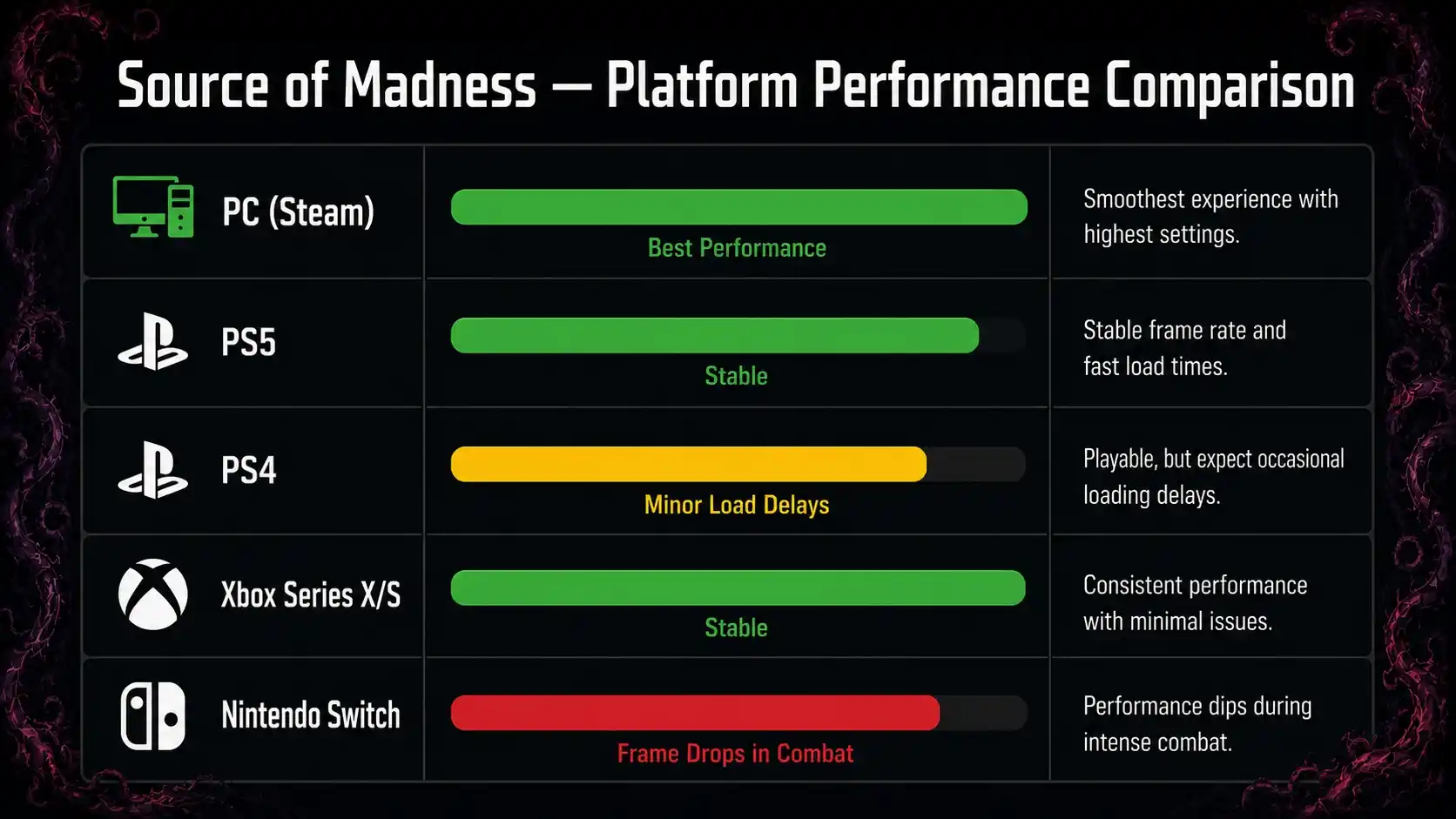
The PS5 version of Source of Madness runs at a stable frame rate with improved load times over the base PS4 version. Visual fidelity is consistent with the PC version at medium-high settings. DualSense adaptive trigger support is minimal — the game does not make meaningful use of the PS5 controller’s haptic capabilities beyond standard vibration. For players deciding between PS4 and PS5 versions, the PS5 version is the clear choice for performance consistency.
Source of Madness Switch Review
The Nintendo Switch version of Source of Madness is the most compromised release. In handheld mode, frame rate drops are noticeable during high-enemy-density encounters — which are frequent given the game’s AI-driven spawning. Docked mode performs more consistently but still shows occasional stutters during heavily loaded biome segments. The Switch version is playable but not the recommended entry point. Players with access to PC or PS5 should choose those platforms instead.
Source of Madness: Platform Comparison
| Platform | Performance | Recommended? |
| PC (Steam) | Best — stable FPS, highest settings | ✅ First choice |
| PS5 | Solid — consistent frame rate | ✅ Strong option |
| PS4 | Acceptable — minor load delays | ⚠️ Playable |
| Xbox Series X/S | Stable — comparable to PS5 | ✅ Strong option |
| Nintendo Switch | Inconsistent — frame drops in combat | ❌ Not recommended |
How Long Does It Take to Beat Source of Madness?
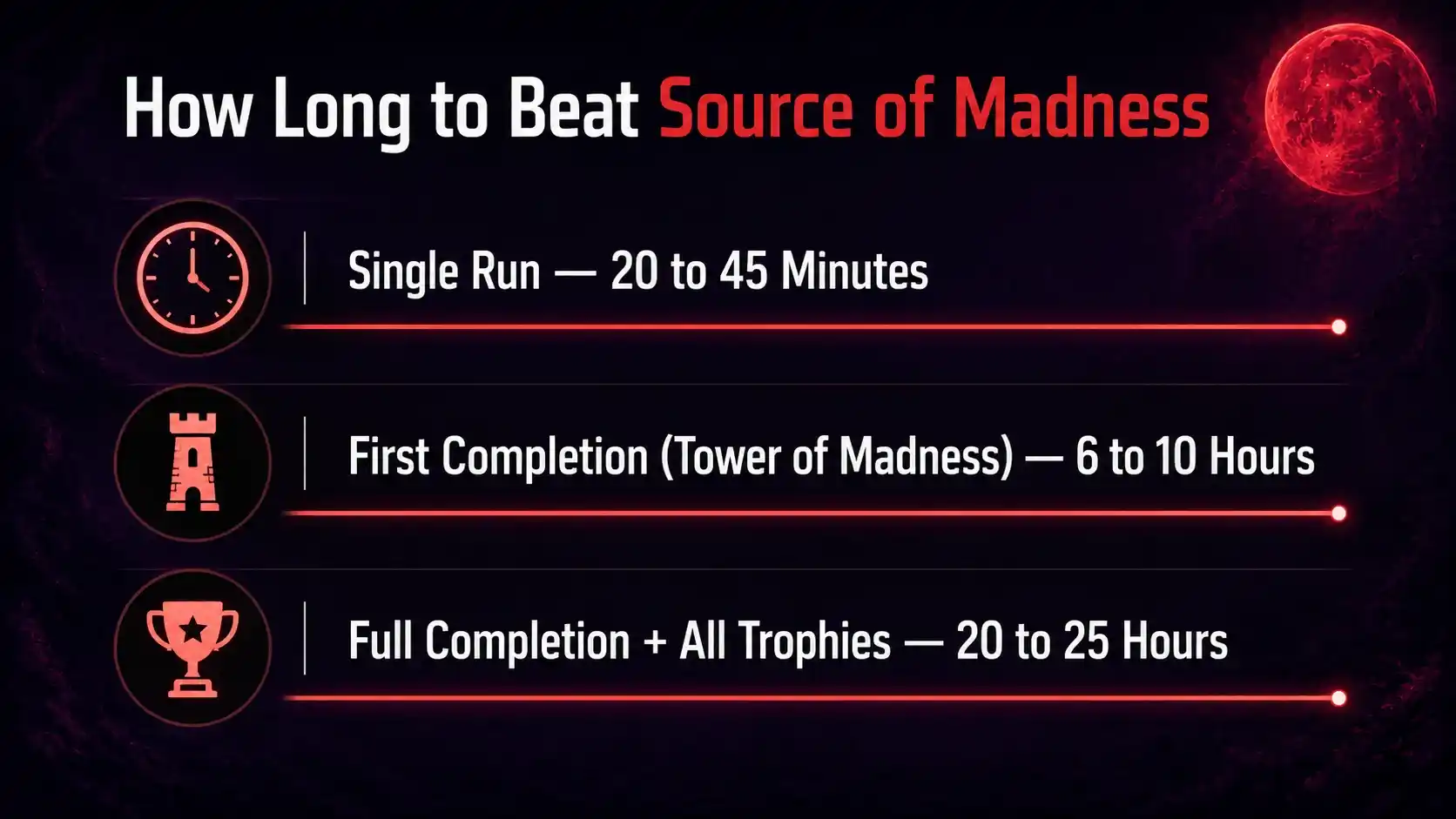
Source of Madness takes approximately 6–10 hours to reach the Tower of Madness for the first time, depending on build efficiency and familiarity with the roguelite loop. Individual runs average 20–45 minutes based on progression depth.
Full completion — including unlocking the upgrade tree, discovering all spell types, and clearing secondary objectives — extends the playtime to 15–25 hours. Trophy and achievement completion on PS5 and PS4 pushes toward the 25-hour mark due to run-specific challenge requirements.
Source of Madness Trophy Guide Overview
Source of Madness has a moderately challenging trophy list on PS5 and PS4. The list mixes progression-based trophies with skill and run-specific challenges.
Trophy Difficulty and Completion Tips
- Overall difficulty: 5/10 — accessible but time-consuming
- Most time-consuming: Upgrade tree completion trophies requiring multiple full runs
- Missable trophies: Some run-specific challenge trophies require intentional setup — do not ignore the trophy list early
- Platinum viability: Achievable without exceptional skill, but requires patience across 20+ hours
Key tips:
- Prioritize upgrade tree progression trophies by focusing upgrade currency on unlocking new nodes before optimizing existing ones
- Track run-specific challenge trophies actively — some require specific spell types or playstyle conditions that are easy to miss passively
- The PS5 version shares trophy progress with PS4 via cross-save on supported saves
Source of Madness Walkthrough Tips — Surviving the First Few Runs
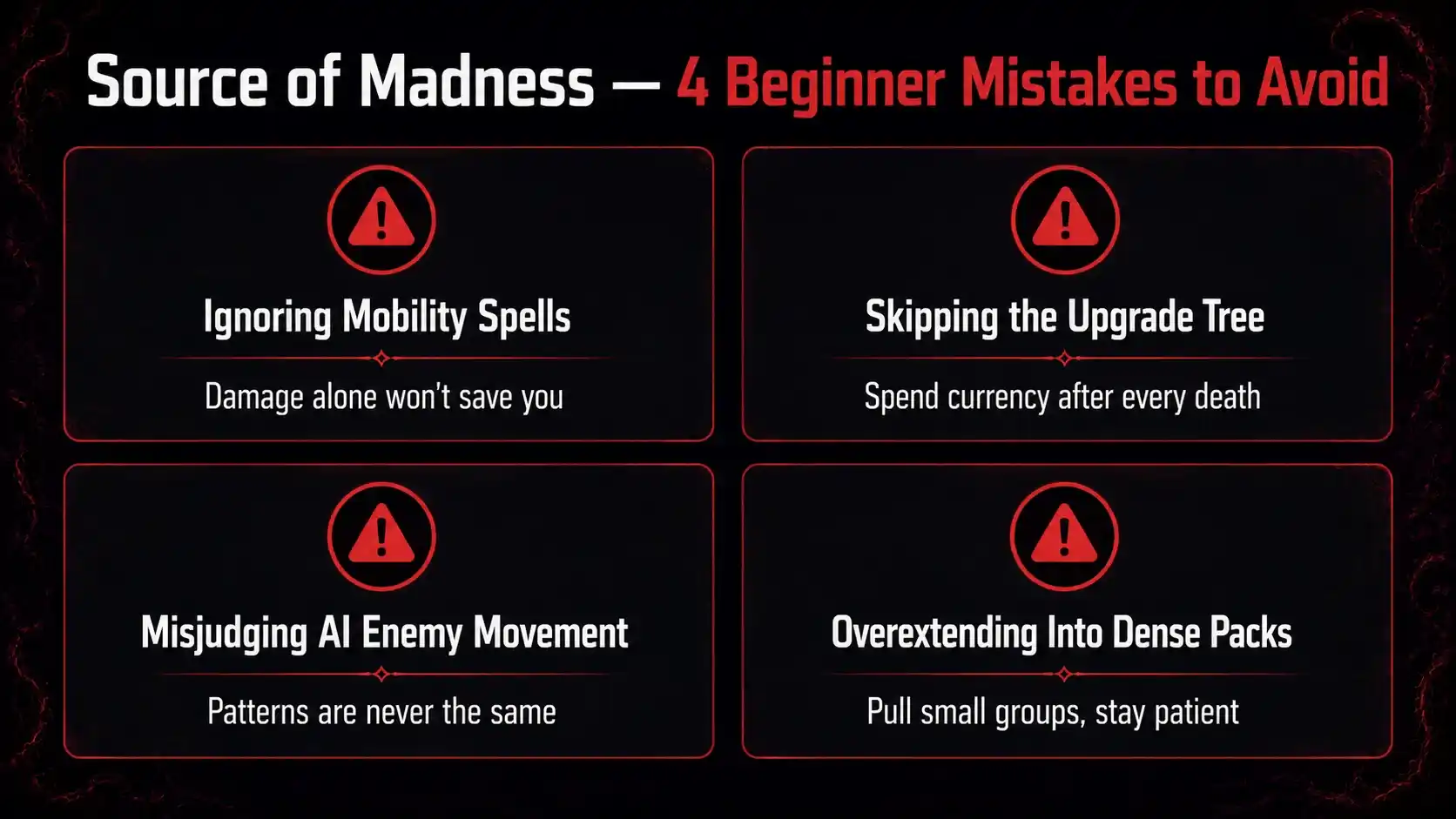
The first three runs in Source of Madness are the steepest part of the learning curve. Understanding foundational mechanics early prevents repeated early-game deaths.
Beginner Mistakes to Avoid
- Ignoring mobility spells — Players who focus entirely on damage spells early tend to die to enemy positioning rather than damage output
- Skipping the upgrade tree — Upgrade currency carries between runs; spending it immediately after each death is essential
- Misjudging AI enemy movement — AI-generated enemies have non-standard movement patterns. Assuming predictable attack arcs leads to repeated hits
- Overextending into dense packs — The game rewards patience. Pulling small groups rather than engaging full biome clusters dramatically improves survival rates
Best Early-Game Strategies
- Open with a projectile-heavy spell set for range safety
- Invest first upgrade points into health and recovery nodes over damage amplifiers
- Learn biome exit routes early — retreating to reset enemy positions is a legitimate and effective tactic
- Prioritize AI enemy observation in the first run rather than progression — understanding movement types before committing to aggressive play pays off in later runs
Will There Be a Source of Madness 2?
As of June 2026, no official Source of Madness 2 has been announced by developer Carry Castle or publisher Thunderful Publishing. The original game received post-launch updates and patches addressing performance and balance issues, but no sequel roadmap has been confirmed. Community interest in a follow-up exists, particularly around expanding the AI enemy generation system and adding deeper narrative content — areas the original game left partially unfulfilled.
Source of Madness Metacritic Score — What Critics and Players Say
Source of Madness holds a mixed reception on Metacritic. Critical reviews generally praised the game’s visual identity, AI enemy system, and atmospheric design while flagging repetition and thin narrative as the primary weaknesses. User scores align broadly with critical reception — positive for atmosphere and novelty, more divided on long-term engagement and value at full price.
Similar review discussions can be found in our Outlast 2 Reviews: Is It Worth Playing in 2025? and The Evil Within PS4 Review — Is It Still Worth Playing?, both of which examine horror games that divide opinion between critics and players.
The consensus across reviews is consistent: Source of Madness is a technically interesting roguelite that delivers a strong first impression but struggles to sustain that impression across 20+ hours of play. For players purchasing during a sale, the reception becomes considerably more favorable.
Conclusion
Source of Madness is a genuinely distinctive roguelite — its AI-generated enemy system and Lovecraftian atmosphere set it apart from the crowded side-scrolling action genre. The magic-based combat system offers real build variety, and the hand-painted visual style creates a horror tone few games in this category match.
However, Source of Madness is not without significant weaknesses. Repetition is the game’s largest long-term problem, the narrative remains underdeveloped, and the Nintendo Switch version underdelivers on performance. At full price, the game is best suited to players with an established love for roguelites. At a sale price, it is a strong atmospheric experience worth 10–15 hours of engagement.
Looking for more detailed game reviews across horror, RPG, indie, and action genres? Visit our Complete Game Reviews Hub for hundreds of in-depth reviews and buying guides.
Buy if: You enjoy dark atmosphere, magic build experimentation, and roguelite replayability. Wait for a sale if: You need narrative depth, consistent Switch performance, or long-term content variety.
Frequently Asked Questions
Q1: What is Source of Madness about?
Source of Madness is a dark fantasy roguelite set in the Loam Lands, a world corrupted by a blood moon. Players control an Acolyte wielding chaos magic to battle AI-generated eldritch creatures while ascending the Tower of Madness. The game emphasizes run-based progression over linear storytelling.
Q2: Is Source of Madness AI generated?
Yes — enemy bodies and movement behaviors in Source of Madness are procedurally generated using machine learning. This means enemies look and behave differently across every playthrough, making no two runs visually or mechanically identical.
Q3: Is Source of Madness a good game?
Source of Madness is a good game for roguelite fans who enjoy atmospheric horror and magic-based combat. It receives mixed reviews overall due to repetition after extended play and limited narrative content. It is best experienced at a sale price or as a shorter-session game rather than a long-term primary title.
Q4: How long does it take to beat Source of Madness?
A single run averages 20–45 minutes. First-time completion of the main objective takes approximately 6–10 hours. Full completion including all trophies and upgrade tree progression extends to 20–25 hours.
Q5: Is Source of Madness a metroidvania?
Despite common tagging, Source of Madness is not a metroidvania. It is a roguelite platformer with permadeath and procedurally generated runs. It lacks the interconnected map structure and ability-gated exploration that define the metroidvania genre.
Q6: Which platform version of Source of Madness is best?
PC via Steam and PS5 are the strongest versions. The Nintendo Switch version has notable frame rate inconsistencies during combat, particularly in handheld mode, and is not the recommended purchase option.
Q7: Will there be a Source of Madness 2?
As of June 2026, no sequel has been announced by developer Carry Castle or publisher Thunderful Publishing. No official roadmap or sequel confirmation is currently available.