Introduction
Demon’s Souls on PS5 is both a technical showcase and a historic moment for the soulslike genre. Originally developed by FromSoftware and released on PS3 in 2009, the game was rebuilt from the ground up by Bluepoint Games as a PlayStation 5 launch title in November 2020. This Demon’s Souls PS5 review covers everything you need to know — from visual performance and DualSense features to gameplay depth, difficulty, and how the remake holds up against modern titles like Elden Ring.Looking for more in-depth game reviews across RPGs, action adventures, PlayStation exclusives, and modern releases? Visit our Complete Game Reviews Hub for every review featured on Prime Games Arena.
By Prime Games Arena | Gaming Expert & PC Performance Specialist Last Updated: June 2025
⚡ Quick Summary
- Demon’s Souls PS5 is a ground-up visual remake by Bluepoint Games, not a remaster — every asset was rebuilt for PS5 hardware
- It features two performance modes, near-instant load times, and deep DualSense haptic and adaptive trigger integration
- The core gameplay is faithful to the 2009 original: unforgiving, methodical combat with a unique World Tendency system
- It is harder than Elden Ring for most new players due to stricter structure and harsher death penalties
- Best suited for players who enjoy challenging action-RPGs; Elden Ring veterans will adapt quickly
What Is Demon’s Souls on PS5?
Demon’s Souls PS5 is a complete visual remake of the 2009 PlayStation 3 exclusive originally developed by FromSoftware. Bluepoint Games — known for high-fidelity remakes including Shadow of the Colossus — rebuilt the game from scratch for PlayStation 5 hardware. Sony Interactive Entertainment published the title as a PS5 launch exclusive in November 2020.
It is important to clarify the terminology: this is a remake, not a remaster. A remaster upscales existing assets; a remake rebuilds them entirely. Every character model, environment, texture, and lighting system in the PS5 version was created from the ground up. The underlying gameplay structure, level layouts, and mechanical design remain faithful to the original.
The game is set in the kingdom of Boletaria, consumed by a mysterious fog that has awakened ancient demons. Players navigate five interconnected Archstone realms, each governed by a powerful Archdemon. The Nexus serves as the central hub for leveling up, upgrading equipment, and accessing the five worlds. There is no open world — this is a structured, linear experience by design, which directly shapes its difficulty and pacing. Players who prefer large-scale open-world RPGs may find the experience very different from titles discussed in our Skyrim vs Witcher 3: Which RPG Should You Play? guide, where exploration freedom plays a much larger role in progression.
Graphics and Visual Overhaul — How Does It Look on PS5?
The visual leap from the PS3 original to the PS5 remake is dramatic. Bluepoint rebuilt character models with significantly higher polygon counts, replaced flat lighting with dynamic systems, and added environmental detail that transforms Boletaria from a competent 2009 game into a genuinely stunning 2020 production.
Stone corridors now feature visible moisture and ambient fog. Enemy designs retain their original silhouettes but show far greater surface detail. The world looks appropriately oppressive and atmospheric — which is critical for a game built on tension and dread.
One notable controversy: a subset of long-time fans felt Bluepoint’s art direction shifted the color grading toward cooler, more cinematic tones, losing some of the murkier, grimier feel of the original. This is a legitimate aesthetic disagreement, though the new visuals are technically superior in every measurable way. Based on our gameplay testing, the remake’s atmosphere holds up extremely well — the new lighting in areas like the Tower of Latria is particularly effective.
Performance Mode vs. Cinematic Mode — Which Should You Use?
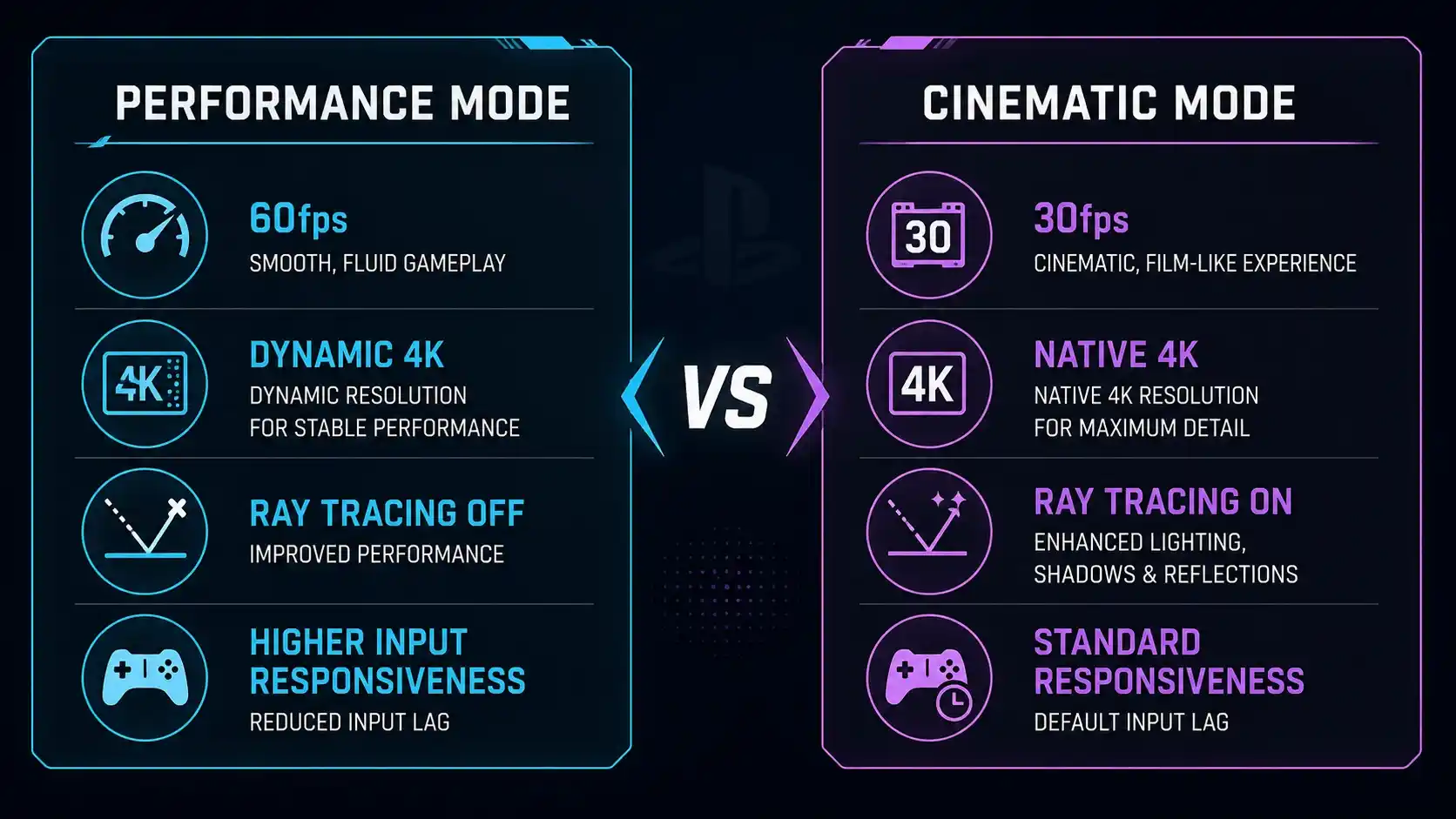
| Feature | Performance Mode | Cinematic Mode |
| Target Frame Rate | 60fps | 30fps |
| Resolution | Dynamic 4K | Native 4K |
| Ray Tracing | Off | On |
| Best For | Combat and gameplay | Screenshots and exploration |
| Input Responsiveness | Higher | Standard |
Prime Games Arena recommends Performance Mode for all active play. The 60fps output makes a material difference in soulslike combat where dodge timing and reaction windows are tight. Switch to Cinematic Mode only when you want to capture screenshots or appreciate environmental detail without enemies nearby.
PS5 Pro Enhancements
The PS5 Pro version of Demon’s Souls benefits from Bluepoint’s existing high-quality assets and the PS5 Pro’s enhanced GPU capabilities. On PS5 Pro, the game can run at higher sustained resolutions in Performance Mode with improved ray tracing stability compared to the base PS5. A dedicated PS5 Pro patch was not required for meaningful improvement — the Pro hardware handles the existing assets more comfortably than the base unit. Players on PS5 Pro will notice cleaner image quality in both modes, particularly in complex lighting environments like the Shrine of Storms.
DualSense Integration and PS5-Exclusive Features
Demon’s Souls PS5 is one of the stronger early demonstrations of the DualSense controller’s capabilities. The haptic feedback system maps meaningfully to in-game events. Weapon impacts carry distinct tactile signatures — a heavy greatsword strike feels noticeably different from a quick dagger attack. Blocking with a shield produces a sharp resistive pulse. Walking through shallow water or over stone surfaces generates subtle environmental feedback.
The adaptive triggers add further depth. Drawing a bow applies progressive tension through the R2 trigger, providing physical feedback for charge timing. Holding a heavy weapon with depleted stamina introduces slight resistance that mirrors the in-game penalty.
The PS5’s 3D audio system is well-implemented. Enemy audio cues — footsteps, weapon swings approaching from off-screen, distant growls in fog-filled corridors — are spatially accurate and genuinely useful for gameplay awareness. In our testing, 3D audio with a headset noticeably improved reaction time in ambush-heavy areas. These PS5-exclusive features are absent in the PS3 original and represent a meaningful upgrade beyond the visual rebuild alone.
Gameplay Mechanics — How Demon’s Souls Actually Plays
Demon’s Souls operates on the foundational soulslike combat loop: manage stamina, time your dodges, exploit enemy openings, and never overcommit. The combat is slower and more deliberate than Elden Ring — aggression without resource awareness is consistently punished.
Key mechanics at a glance:
- Stamina System: Every action — attack, dodge, block, sprint — costs stamina. Running dry leaves you fully exposed.
- Soul System: Enemies drop Souls used for leveling up and buying items. Dying means dropping all held Souls at the death location. Dying again before retrieval loses them permanently.
- Archstone Structure: Five distinct worlds accessed from the Nexus hub, each with multiple sub-areas leading to an Archdemon boss.
- Equipment Weight: Heavier armor reduces dodge speed and distance. Build decisions carry real mechanical weight.
- Magic and Ranged Builds: Fully viable — Demon’s Souls has one of the stronger magic systems in the soulslike genre and supports non-melee playstyles effectively.
The World Tendency System — Demon’s Souls’ Unique Mechanic
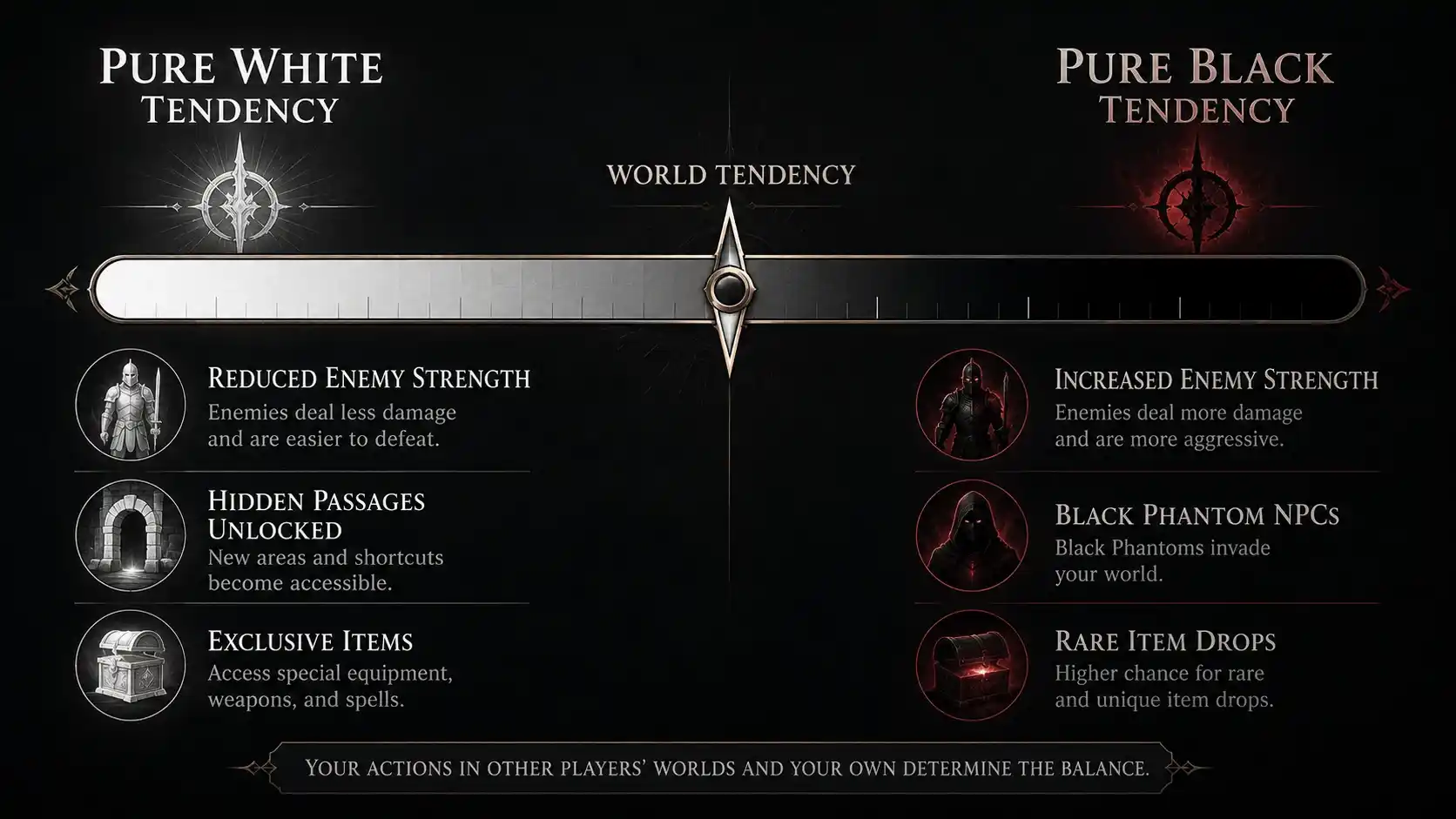
World Tendency is Demon’s Souls’ most distinctive — and most misunderstood — system. Each of the five Archstone worlds has a Tendency value that slides between Pure White and Pure Black based on player actions.
- Pure White Tendency: Achieved by defeating Archdemons and avoiding in-world deaths. Reduces enemy health and damage, unlocks exclusive items and NPC events, and reveals hidden passages.
- Pure Black Tendency: Achieved by dying in body form or invading other players. Increases enemy health and damage significantly but spawns unique Black Phantom NPCs that drop rare items.
The system is never explained in-game. Most first-time players stumble through it accidentally, missing content entirely. Understanding Tendency is essential for accessing certain boss fight variations, NPC questlines, and end-game items. This system has no direct equivalent in Dark Souls or Elden Ring, making it genuinely unique to Demon’s Souls.
Boss Design and Enemy Variety
Demon’s Souls features 16 boss encounters, ranging from mechanically straightforward to genuinely inventive. Standout fights include:
- Tower Knight: A multi-phase fight requiring strategic targeting of ankle weak points before the main attack window opens
- Flamelurker: An aggressive, high-damage boss that punishes passive play — widely considered the game’s hardest mandatory fight
- Old Monk: A unique PvP-integrated boss where another player can invade and take the boss role
Compared to Elden Ring’s boss roster, Demon’s Souls offers fewer encounters and less mechanical variety — but each boss has a clear conceptual identity. The design philosophy favors atmosphere and memorability over spectacle.
How Hard Is Demon’s Souls on PS5?
Demon’s Souls is deliberately hard — that is not a flaw but a design principle. For PS5 players new to the soulslike genre, the difficulty curve is steep in the early hours and flattens significantly once the core systems are understood.
The game does not include difficulty settings. Death is a core mechanic, not a failure state — the permanent Soul loss creates genuine stakes that shape decision-making throughout every play session.
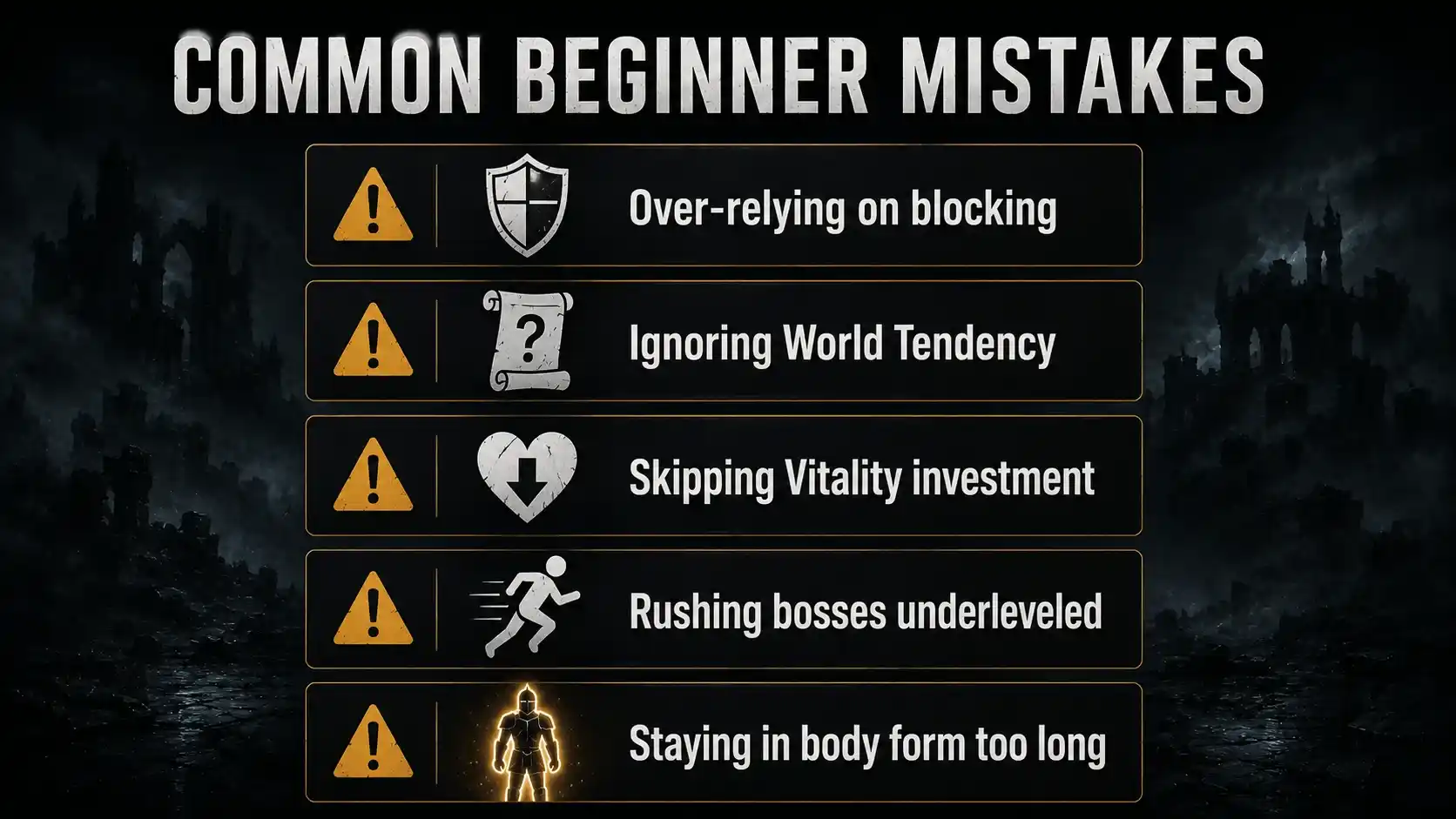
Common beginner mistakes that make the game feel unfairly hard:
- Relying on blocking instead of dodging — stamina drain from sustained blocking leads to guard breaks
- Ignoring the World Tendency system entirely, missing key items and build upgrades
- Not investing in Vitality early — low HP in Demon’s Souls is catastrophically punishing given the one-hit kill potential of many enemies
- Rushing bosses without first clearing the preceding area for Souls to level up
- Playing exclusively in body form — you have full HP but dying in body form worsens World Tendency; balancing this is a key skill to develop
Based on our experience completing multiple playthroughs, the game becomes significantly more manageable once the player understands stamina as a resource, respects enemy placement, and commits to a consistent build path.
Demon’s Souls PS5 vs. Elden Ring — A Fair Comparison
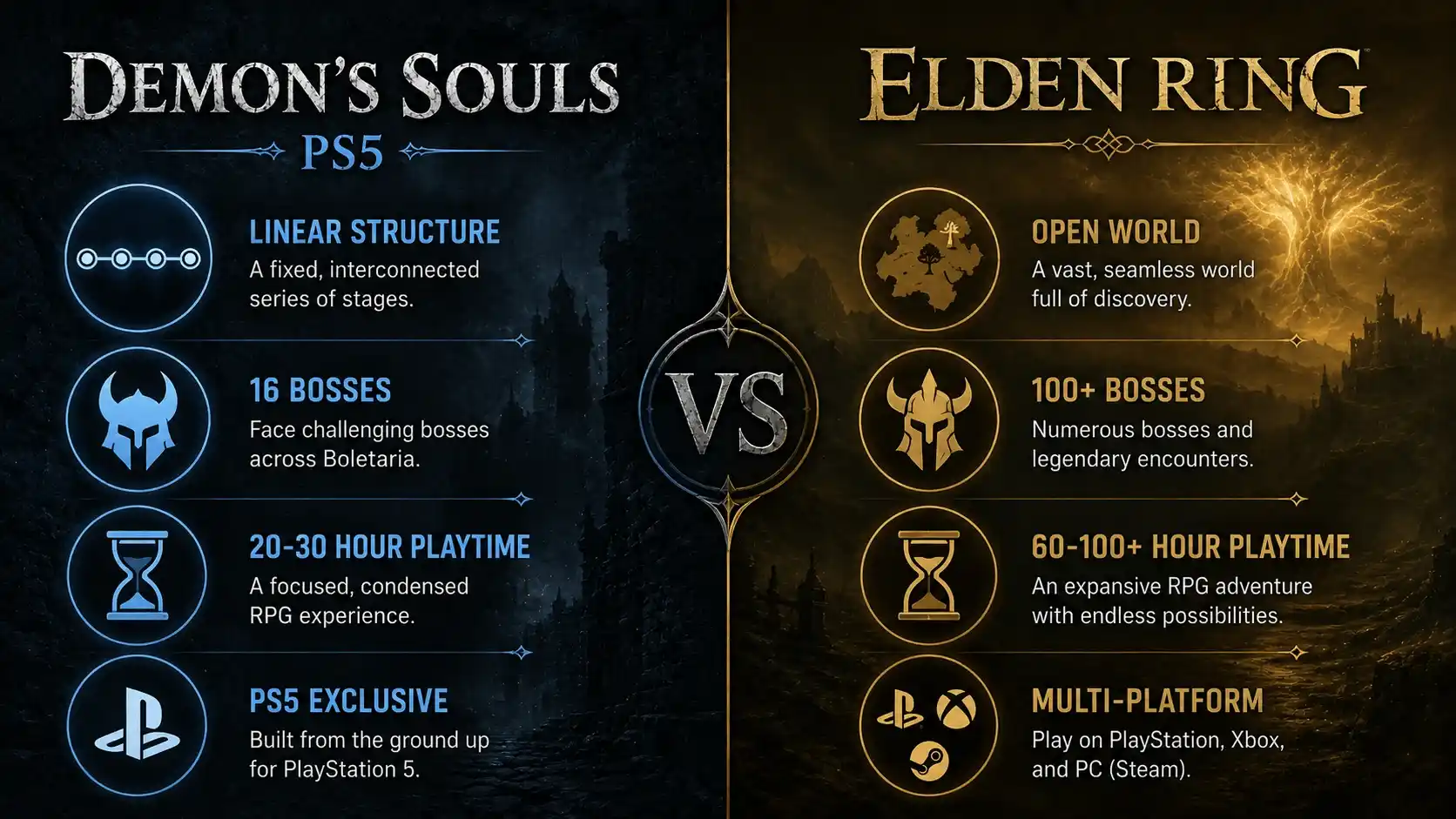
Demon’s Souls is the direct ancestor of the soulslike genre. The lineage runs: Demon’s Souls (2009) → Dark Souls (2011) → Dark Souls II/III → Bloodborne → Sekiro → Elden Ring (2022). Understanding this lineage contextualizes how the two games relate and where they diverge.
Players interested in maximizing performance before jumping into demanding action RPGs should also check our Best Settings for Elden Ring on Low End PC (Smooth FPS) guide and What FPS Can I Get on My PC? performance breakdown.
Key Gameplay and Design Differences
| Feature | Demon’s Souls PS5 | Elden Ring |
| World Structure | Linear Archstones (5 realms) | Open world (Lands Between) |
| Exploration Freedom | Structured, hub-based | Near-total player freedom |
| Difficulty for Beginners | High — steep early curve | High — but more escape valves |
| Build Variety | Good | Exceptional |
| Story Delivery | Environmental / minimal text | Lore-rich, expansive |
| Unique Systems | World Tendency | Spirit Ashes, Horse Combat |
| Boss Count | 16 | 100+ (including optional) |
| Game Length | ~20–30 hours | ~60–100+ hours |
| Release Year | 2020 (remake of 2009 original) | 2022 |
| Platform Availability | PS5 exclusive | PC, PS4, PS5, Xbox |
Is Demon’s Souls Harder Than Elden Ring?
For most players, yes — Demon’s Souls is harder, particularly in the early hours. The reasons are structural, not arbitrary. Elden Ring allows players to leave a difficult area, explore elsewhere, gather Runes, level up, and return stronger. Demon’s Souls does not offer that freedom. If a world’s early section is blocking progress, the options are to improve skill, optimize build, or grind in accessible areas — there is no open world to retreat into.
Additionally, Elden Ring’s Spirit Ash summons provide a genuine difficulty reduction option for struggling players. Demon’s Souls has no equivalent system. Death penalties in Demon’s Souls are harsher — losing all Souls plus shifting World Tendency negatively on a death in body form creates compounding consequences that Elden Ring does not replicate.
If you are new to the soulslike genre, Elden Ring is the more accessible entry point. Demon’s Souls rewards genre familiarity and is best experienced after developing foundational skills.
Is Demon’s Souls as Good as Elden Ring?
They are different experiences, not competing ones. Demon’s Souls is tighter, more atmospheric, and more focused. Elden Ring is broader, more accessible, and vastly more content-rich. Neither is objectively superior — they serve different player needs.
Demon’s Souls excels at: concentrated atmosphere, mechanical purity, and a sense of deliberate pacing. Elden Ring excels at: exploration, build depth, content volume, and accessibility for newcomers. Players who finish one will find the other immediately approachable and complementary, not redundant.
What’s New in the PS5 Remake vs. the Original PS3 Version
The PS5 version is a ground-up rebuild, not an emulation or upscale of the PS3 game. Key differences:
What changed:
- Complete visual rebuild — all assets, lighting, and environmental geometry are new
- Rerecorded and recomposed audio and music
- Near-instant load times replacing the PS3’s 30–60 second waits
- Updated UI and inventory management
- DualSense haptic and adaptive trigger support
What stayed the same:
- Core combat mechanics and stamina system
- All level layouts, enemy placements, and trap locations
- Boss patterns and World Tendency system
- Item and upgrade paths
Post-launch updates: Bluepoint released patches post-launch addressing balancing concerns, particularly around the Fractured Mode (a mirrored world available as a difficulty layer) and minor hitbox refinements. As of 2025, the game runs in a stable, well-patched state with no outstanding performance issues reported on either standard PS5 or PS5 Pro hardware.
One significant point for returning players: some veteran fans criticized the remake’s revised art direction, particularly the lighter color palette in certain areas and redesigned character faces. These changes are aesthetic rather than mechanical — the gameplay experience is identical.
Is Demon’s Souls PS5 Worth Playing in 2025?
Yes — Demon’s Souls PS5 remains worth playing in 2025, with appropriate expectations. Here is how it breaks down by player type:
For soulslike newcomers: Start with Elden Ring first. Its open world, Spirit Ash system, and broader build guidance make it a more forgiving entry point. Return to Demon’s Souls after completing Elden Ring — it will feel like a deliberate, concentrated companion piece.
For Dark Souls veterans: Demon’s Souls PS5 is essential. The World Tendency system, Archstone structure, and tighter pacing offer a genuinely distinct experience even for seasoned soulslike players. The PS5 rebuild makes it far more approachable than the PS3 original.
For players asking about PC or PS4 versions: Demon’s Souls PS5 is a PlayStation 5 exclusive. There is no PC version and no PS4 port. The original PS3 game was available through PlayStation Now but is no longer widely accessible. If you want to play Demon’s Souls, a PS5 is required.
Replay value: The World Tendency system, multiple build archetypes, New Game+ with scaling difficulty, and Pure White/Pure Black Tendency runs provide meaningful replayability beyond the initial 20–30 hour playthrough.
Fans of deep fantasy RPG progression systems may also enjoy our reviews of Metaphor: ReFantazio and Baldur’s Gate: Dark Alliance, both of which offer character-building depth through very different gameplay styles.
Pros and Cons of Demon’s Souls PS5
✅ Pros:
- Visually stunning rebuild that demonstrates what PS5-exclusive development can achieve
- Near-instant load times fundamentally improve the death-and-retry experience
- DualSense haptic and adaptive trigger integration among the best on PS5 at launch
- Faithful to the original gameplay — challenging, fair, and deeply rewarding
- World Tendency system adds genuine depth and replayability not found in later soulslike titles
- Tight, focused experience — no padding, no filler content
❌ Cons:
- PS5 exclusive — no PC version, no PS4 version, no multi-platform access
- Shorter than modern soulslike titles (20–30 hours vs. 60–100+ for Elden Ring)
- World Tendency system is never explained in-game — a barrier for new players
- Revised art direction divisive among long-time fans of the PS3 original
- No Spirit Ash equivalent — less accessible for players who struggle with difficulty
- Limited endgame content compared to Elden Ring’s post-story expansion options
Final Verdict — Demon’s Souls PS5 Review Score
If you’re exploring other highly regarded action-focused adventures, our Ghost of Tsushima Review & Rating and Kena: Bridge of Spirits Review provide additional recommendations for PlayStation players seeking memorable single-player experiences.
Score: 9 / 10
Demon’s Souls PS5 is an exceptional remake and one of the strongest launch titles in PlayStation history. Bluepoint Games delivered a faithful, technically impressive rebuild that respects the original’s design intent while fully modernizing its presentation. The DualSense integration, near-instant loading, and visual overhaul are not cosmetic upgrades — they materially improve the experience.
The PS5 exclusivity is its most significant limitation for audience reach. For PS5 owners, however, it is close to a must-play — particularly for anyone interested in soulslike games, the history of FromSoftware’s design philosophy, or PS5’s hardware capabilities as a showcase.
It is not the right starting point for genre newcomers. It is the right destination for genre veterans who want a concentrated, atmospheric, and mechanically pure soulslike experience.
Conclusion
Demon’s Souls PS5 is a technically accomplished, mechanically faithful remake that earns its place as a PS5 showcase title. Bluepoint Games rebuilt everything visually while preserving the core systems that made the 2009 original a genre-defining achievement. The near-instant load times, DualSense integration, and visual fidelity represent genuine improvements — not just aesthetic polish.
For players comparing it to Elden Ring: they are complementary experiences separated by 13 years of genre evolution. Demon’s Souls is harder, tighter, and shorter. Elden Ring is broader, more accessible, and more content-rich. Both are excellent. Demon’s Souls on PS5 remains worth playing in 2025 for any soulslike fan with access to a PlayStation 5.
FAQ
Q1: Is Demon’s Souls good on PS5?
Yes. Demon’s Souls PS5 is one of the strongest PlayStation 5 launch titles. Bluepoint Games rebuilt the game entirely for PS5 hardware, delivering outstanding visuals, near-instant load times, and full DualSense haptic and adaptive trigger support while keeping the challenging, rewarding gameplay intact.
Q2: Is Demon’s Souls harder than Elden Ring?
For most players, yes. Demon’s Souls is harder primarily due to its linear structure — there is no open world to retreat into when an area feels too difficult. Elden Ring provides more accessibility options including Spirit Ash summons and open-world level grinding. Demon’s Souls also has harsher death penalties tied to its World Tendency system.
Q3: Is Demon’s Souls PS5 a remake or a remaster?
It is a full remake. Bluepoint Games rebuilt all assets from scratch — character models, environments, lighting, and audio — using original level designs as the foundation. It is not an upscale or emulation of the PS3 original.
Q4: Does Demon’s Souls PS5 support PS5 Pro enhancements?
Yes. On PS5 Pro, the game benefits from the enhanced GPU, delivering improved resolution stability in Performance Mode and cleaner ray tracing in Cinematic Mode. The improvements are noticeable in complex lighting areas without requiring a dedicated Pro patch.
Q5: Is Demon’s Souls available on PC or PS4?
No. Demon’s Souls PS5 is a PlayStation 5 exclusive. There is no PC version and no PS4 port available. The original PS3 game was previously accessible through PlayStation Now, but the PS5 remake has no cross-platform release.
Q6: Should I play Demon’s Souls or Elden Ring first?
If you are new to the soulslike genre, start with Elden Ring. Its open world design and Spirit Ash summons make it more accessible. Demon’s Souls is better experienced after developing foundational skills — it rewards genre knowledge and offers a tighter, more atmospheric complement to Elden Ring’s broad scope.