Introduction
Outer Wilds is one of the most unconventional games released in the past decade — and one of the most misunderstood. Developed by Mobius Digital and published by Annapurna Interactive, this first-person space exploration game drops players into a handcrafted solar system with no objectives, no map markers, and no guidance. It launched in 2019 to critical acclaim and has since built a reputation as a genuinely singular experience. This Outer Wilds review covers everything: gameplay, story, platforms including the Switch version, age rating, and whether it is actually worth your time and money in 2025.
If you’re looking for more in-depth reviews and recommendations across every genre, visit our Complete Game Reviews Hub for a full collection of reviewed titles.
By Prime Games Arena | Gaming Expert & PC Performance Specialist Last Updated: June 2025
Quick Summary
- Outer Wilds is a first-person exploration mystery built around a 22-minute time loop — when the star goes supernova, everything resets
- The game has no combat, no quest markers, and no traditional progression systems — knowledge is the only currency
- It holds an Overwhelmingly Positive rating on Steam and an 85+ score on Metacritic, making it one of the most critically respected indie games of its generation
- Available on PC, PS4, PS5, Xbox, and Nintendo Switch — the Switch version is playable but technically the weakest port
- The Echoes of the Eye DLC (2021) expands the experience; the base game runs approximately 15–20 hours on a first playthrough
What Is Outer Wilds? — Game Overview
Outer Wilds is a first-person, open-world exploration and mystery game developed by Mobius Digital and published by Annapurna Interactive. It was released in May 2019 for PC and Xbox One, with PlayStation and Switch versions following in subsequent years. The game is set in a small, self-contained solar system where the player character — a new astronaut from the Hearthian species — is exploring for the first time.
Developer, Publisher, and Release Background
Mobius Digital is a small independent studio founded by Alex Beachum, who originally developed Outer Wilds as a student thesis project at the University of Southern California. That origin is significant: the game has the focused vision of a single creative idea pursued without compromise. Annapurna Interactive, known for publishing unconventional narrative games like What Remains of Edith Finch and Telling Lies, picked it up for commercial release.
The game launched on PC (via Epic Games Store initially) and Xbox One in May 2019. A Steam release followed in 2020. PlayStation 4 and PlayStation 5 versions launched in 2021, the same year the Echoes of the Eye DLC was released. The Nintendo Switch port arrived in 2023.
Genre — What Kind of Game Is Outer Wilds?
Outer Wilds is genuinely difficult to categorize. It is most accurately described as a first-person exploration mystery with puzzle-discovery elements and open-world navigation. It has no combat, no inventory management in any meaningful sense, and no RPG progression. Players who approach it expecting an action game or a traditional RPG will be confused.
The closest genre comparisons are exploration-puzzle games like Return of the Obra Dinn or The Witness — games where the puzzle is figuring out what the puzzle is. Outer Wilds resists genre labels by design. Understanding that upfront sets accurate expectations before playing.
What Do You Do in Outer Wilds?
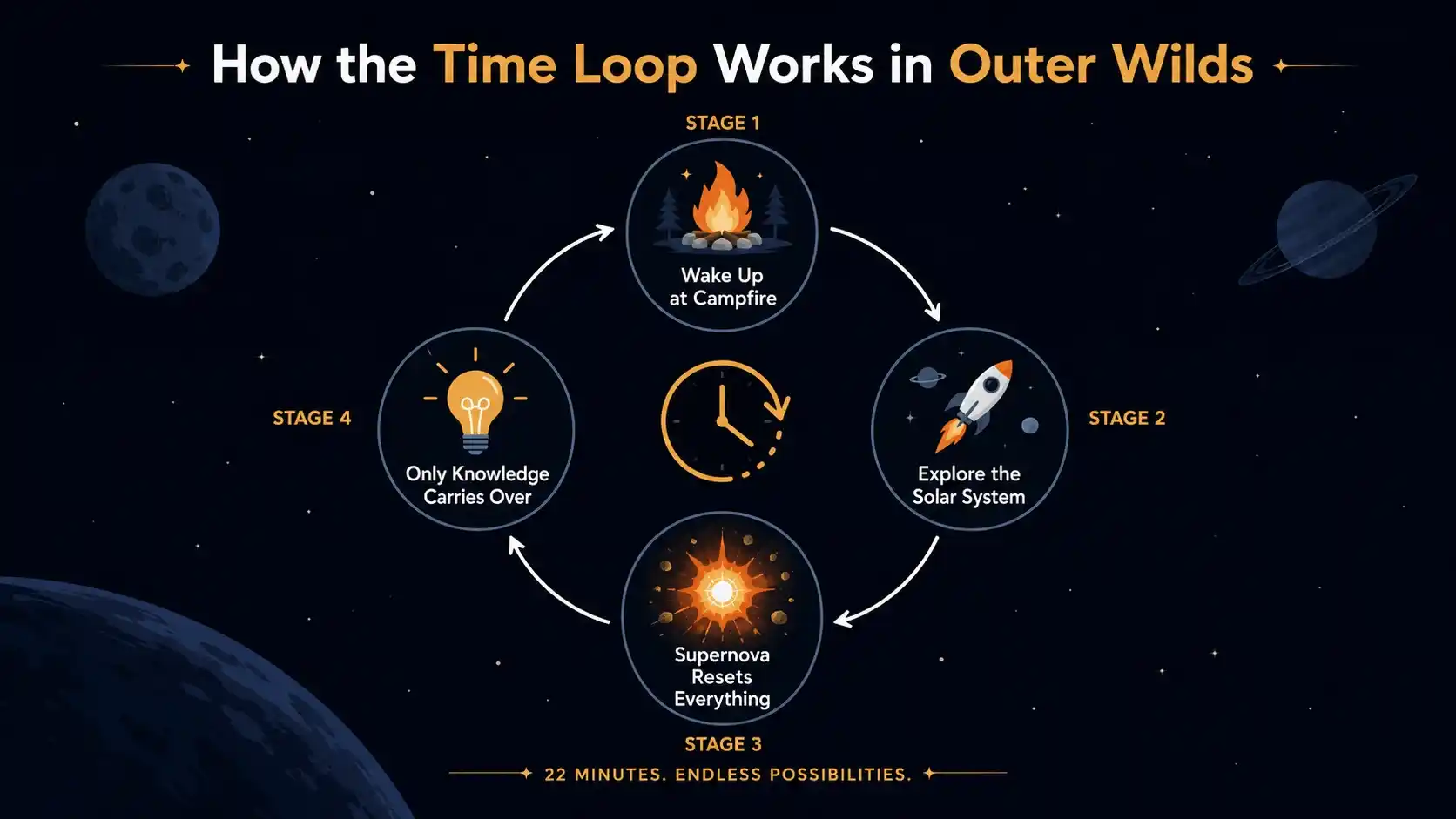
In Outer Wilds, you explore a solar system, gather knowledge, and piece together the mystery of an extinct alien civilization — all within repeating 22-minute loops. There is no combat, no level-up system, and no mission log. The game never tells you what to do next. Progress is entirely driven by what you learn, not what you collect.
The Time Loop Mechanic Explained
Every 22 minutes, the solar system’s sun completes its supernova cycle and destroys everything. The loop resets, and the player wakes up at their starting campfire. Nothing carries over between loops except the knowledge in the player’s head — and notes recorded in the in-game log.
This is not a punishing mechanic. It is the entire game design philosophy. The loop creates a natural pacing rhythm: each run is an expedition with a specific goal based on what you discovered last time. Death is not failure. It is a reset that lets you try a different angle, visit a different planet, or return to a location now that you know what to look for.
Exploration and Discovery Loop
The solar system in Outer Wilds contains approximately six unique planets and several smaller locations, each with distinct physics-driven environments. One planet has a surface constantly swallowed by sand flowing into its underground caverns. Another is a frozen world with geysers and ancient ruins hidden beneath the ice. A pair of twin planets orbits each other while trading surface material between them in real time.
All of these systems are simulated, not scripted. The sand flows whether you are there or not. The orbits continue in real time. This means the solar system functions as a clock, and accessibility of certain areas changes as time passes within each loop.
Progress is made by reading stone tablets left by the Nomai — an alien civilization that visited this solar system long before the Hearthians. Finding a Nomai note that references another location, traveling there, and discovering the next piece of the puzzle creates a self-directed mystery chain with no artificial prompt to guide it.
Core Activities and Player Goals
- Piloting your small spacecraft between planets using manual controls
- Investigating ruins, underground cave systems, and zero-gravity orbital structures
- Decoding the written history and scientific records of the Nomai civilization
- Identifying why the time loop is happening and what triggered it
- Locating the Ash Twin Project — the central mystery that connects every thread in the solar system
Based on our gameplay experience at Prime Games Arena, the most important mindset shift is accepting that disorientation is the intended starting state. The game is designed to feel overwhelming at first. The payoff comes from the moment a seemingly unrelated detail from three loops ago suddenly connects to something new.
What Makes Outer Wilds So Special?
Outer Wilds is special because it does something almost no other game does: it makes the act of understanding the reward, not the act of completing an objective. Here are the design elements that set it apart.
Few modern games trust players this much. Similar to the emotional storytelling found in GRIS Review: 7 Essential Reasons It Feels Magical, Outer Wilds relies on atmosphere, discovery, and player interpretation rather than traditional gameplay rewards.
- The solar system is a clock. Every planet changes over the 22-minute loop in ways that open and close routes. Some areas are only accessible at specific times. This creates dynamic puzzles without any traditional puzzle UI.
- Knowledge is the only currency. Unlike virtually every other game, no items, stats, upgrades, or resources carry over between loops. What you know is your only advantage.
- Emergent narrative without cutscenes. The entire story of the Nomai civilization is assembled by the player through exploration. There are no forced story beats, no cutscenes interrupting gameplay, no narrator explaining context.
- Physics-driven world design. Gravity, orbital mechanics, sand erosion, water pressure, and fire all operate as live simulations. They affect gameplay in real ways — not as aesthetic decoration.
- Emotional impact. In our assessment, Outer Wilds delivers one of the most genuinely affecting endings in games — not through spectacle, but through accumulated understanding. Players who complete the game often report an unusual emotional response that is difficult to describe without spoilers.
Outer Wilds Gameplay Review — Strengths and Weaknesses
Atmosphere, Sound Design, and Visual Identity
The visual style of Outer Wilds is intentionally hand-crafted and lo-fi. Planets feel like small dioramas — compact, dense with detail, and unlike the procedurally generated vastness of other space games. This is a deliberate design decision, and it works. Each planet has a distinct visual identity that makes navigation intuitive after a few visits.
The soundtrack, composed by Andrew Prahlow, is built around acoustic folk instrumentation. The player character plays a banjo at the campfire before launching. Hearing that same banjo theme evolve across the game’s runtime is one of its most quietly effective emotional tools. The audio design overall — from the silence of space to the atmospheric sound of each planet — is consistently excellent.
Storytelling and Narrative Design
The narrative spine of Outer Wilds is the Nomai civilization: who they were, why they came here, what they were trying to do, and what happened to them. Every piece of that story is delivered through environmental discovery. There are no NPCs who explain plot. There are no in-engine cutscenes that deliver revelations. Players assemble the story themselves from fragments scattered across the solar system.
Players who enjoy uncovering mysteries through environmental storytelling may also appreciate Firewatch, another narrative-driven experience that focuses on exploration and gradual discovery.
This approach creates an unusual relationship between player and narrative. Discoveries feel genuinely earned because they required real navigation and real problem-solving to reach. The ending of Outer Wilds is divisive in the sense that it requires players to have internalized what the game is about — players who reach it by following a guide often feel less than those who arrived through genuine exploration. That is intentional.
Accessibility and Difficulty Curve
The single biggest weakness of Outer Wilds as a product is its accessibility. There is no tutorial. There are no objective markers. There is no journal that tells you where to go next. Players who get stuck have only the in-game ship log — which records discoveries but offers no directional guidance — to consult.
Prime Games Arena recommends treating the first 45–60 minutes as acclimatization rather than gameplay. The game opens up dramatically once the loop mechanic clicks. Players who quit before that point — and many do — miss the experience entirely. A beginner mode or hint system would genuinely improve the game’s accessibility without compromising its design. As of 2025, no such system exists in the base game.
Outer Wilds — Pros and Cons
| ✅ Pros | ❌ Cons |
| Completely original game design with no direct comparisons | No guidance — some players disengage before the game opens up |
| Deeply rewarding narrative that respects player intelligence | Cannot be replayed with the same discovery experience |
| Physics-driven world that feels genuinely alive | Nintendo Switch version has resolution and frame rate compromises |
| Zero filler content — every area and detail is purposeful | 15–20 hours may feel short relative to price for some players |
| One of the strongest endings in games of the past decade | Extended stretches of directionless exploration frustrate some players |
| Echoes of the Eye DLC adds meaningful content | DLC shifts tone significantly — not universally liked |
How Long Is Outer Wilds?
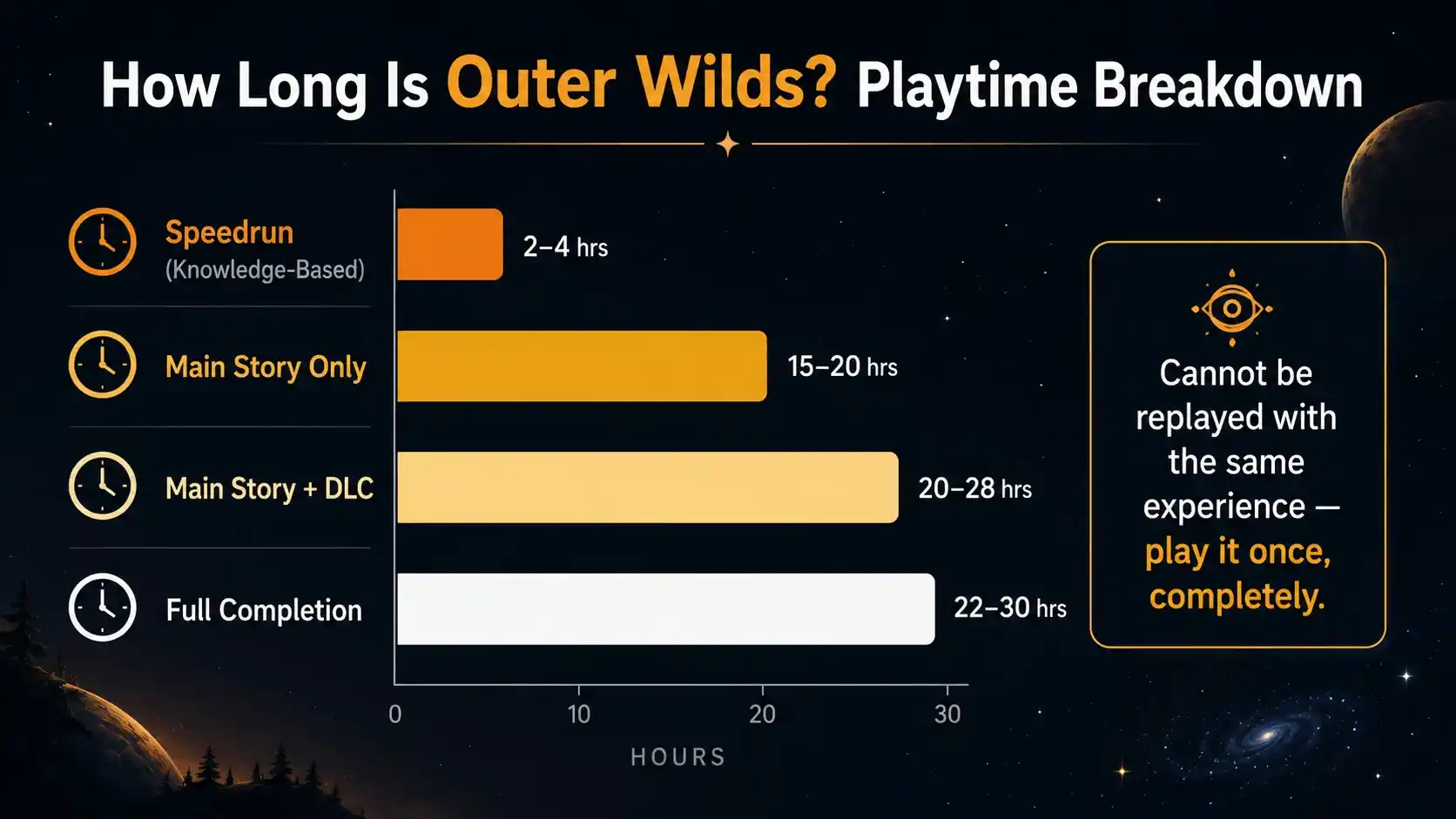
Outer Wilds is not a long game by conventional standards, but its length is appropriate for its design. Most first-time players complete the main experience in 15–20 hours. That figure varies significantly based on how much time is spent exploring freely versus pursuing specific leads.
| Completion Type | Estimated Time |
| Main story — first playthrough | 15–20 hours |
| Main story + Echoes of the Eye DLC | 20–28 hours |
| Full completion / all discoveries | 22–30 hours |
| Speedrun (knowledge-based) | 2–4 hours |
The game cannot be replayed in the traditional sense. The first playthrough is the definitive experience because the value of Outer Wilds is in not knowing what comes next. A second playthrough, while possible, does not recreate the discovery experience. This is not a flaw — it is a design statement. The game is built to be played once, completely, and remembered.
Outer Wilds Platform Review — Switch, PS4, PS5, and PC
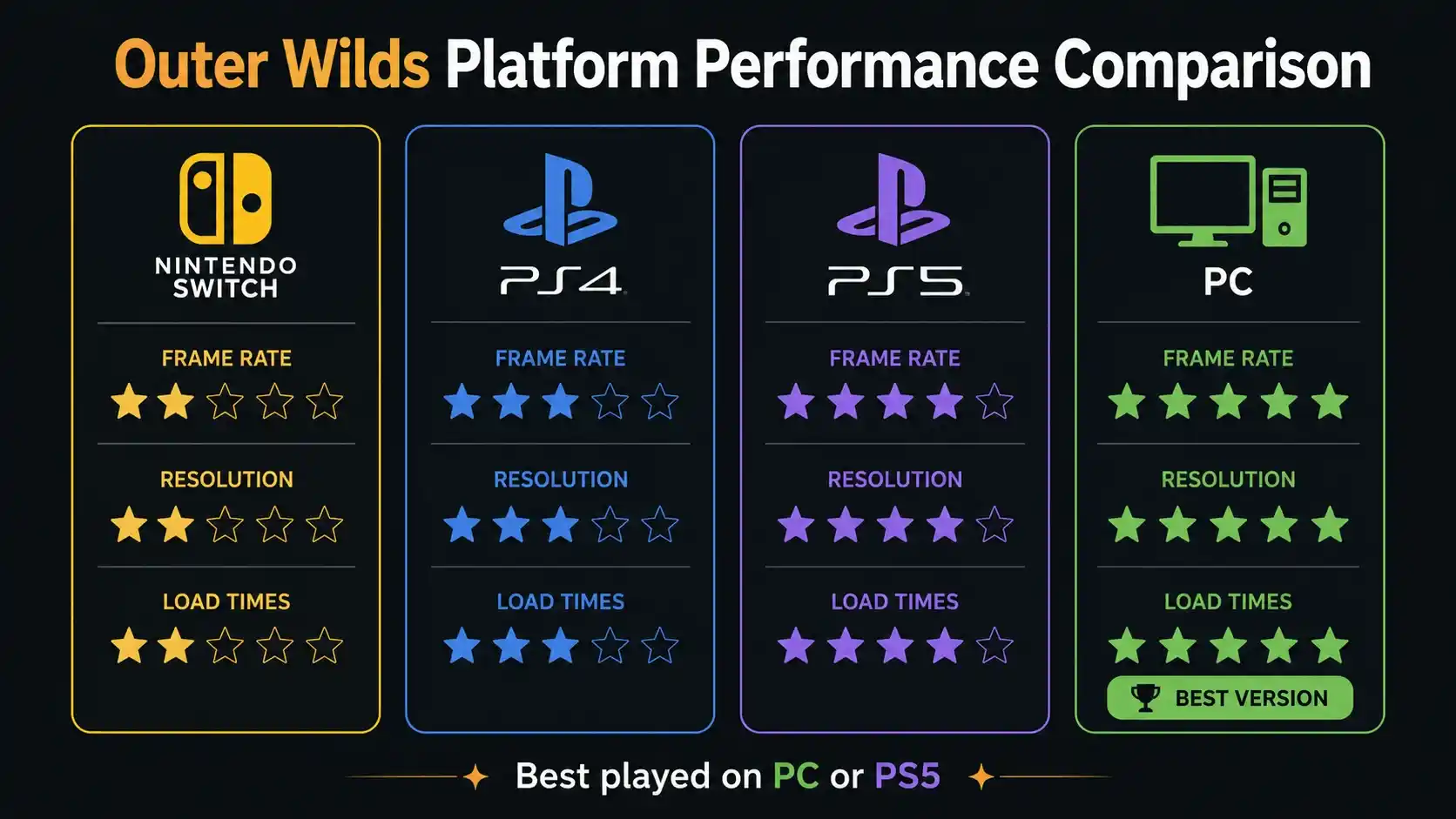
Outer Wilds on Nintendo Switch
The Nintendo Switch version of Outer Wilds is available but represents the weakest technical port. In handheld mode, the resolution drops noticeably and frame rate inconsistencies appear during complex scenes — particularly on planets with heavy particle effects like the Ash Twin. Docked mode improves stability but still falls short of other platforms.
The Switch version is a viable option for players who exclusively game on Nintendo hardware. For players with access to a PC, PS5, or Xbox Series, those versions offer a cleaner experience. In our testing, the Switch port is playable throughout but occasionally distracting in performance-heavy areas.
Outer Wilds on PS4 and PS5
The PS5 version of Outer Wilds benefits from fast SSD load times and a stable, smooth frame rate. The visual fidelity is faithful to the PC version. There is no dedicated PS5 native upgrade — the game runs via backward compatibility — but performance is strong regardless.
The PS4 version holds up well with only minor frame dips in the most demanding sequences. For PlayStation players, either version is a solid entry point, with PS5 being the preferred choice purely for load speed advantages.
Outer Wilds on PC (Steam)
The PC version on Steam is the technically optimal way to play Outer Wilds. It runs at full resolution with a stable frame rate on mid-range hardware. The system requirements are modest — a GTX 1060 or equivalent handles the game comfortably at high settings. Steam’s user review rating sits at Overwhelmingly Positive, reflecting consistent performance across a wide range of PC hardware configurations.
PC also offers the benefit of the modding community, which has produced accessibility-focused modifications and quality-of-life improvements for players who want additional guidance without full spoilers.
Outer Wilds Age Rating and Who Is This Game For?
Outer Wilds carries an ESRB rating of E10+ (Everyone 10 and older) and a PEGI rating of 7 in Europe. The content descriptors reference mild fantasy themes, very limited language, and thematic elements involving existential concepts — the nature of endings, the passage of time, and confronting inevitability.
Despite the mild official rating, the game’s themes are more emotionally sophisticated than the rating suggests. The subject matter — a universe ending, the mortality of civilizations, finding meaning in temporary existence — resonates more with older teens and adults.
This game is best suited for:
- Players who value story, atmosphere, and discovery over action or mechanical depth
- Fans of narrative puzzle games like Return of the Obra Dinn, The Witness, or What Remains of Edith Finch
- Older teens and adults who engage with philosophical and existential themes in games
- PC and console players looking for something genuinely different from mainstream releases
This game is likely not suited for:
- Players who require clear objectives, quest markers, or regular mechanical rewards
- Younger children, despite the E10+ rating — the emotional weight of the ending requires some maturity to process
- Players with a strong preference for action, combat, or RPG systems
Outer Wilds vs The Outer Worlds — What’s the Difference?
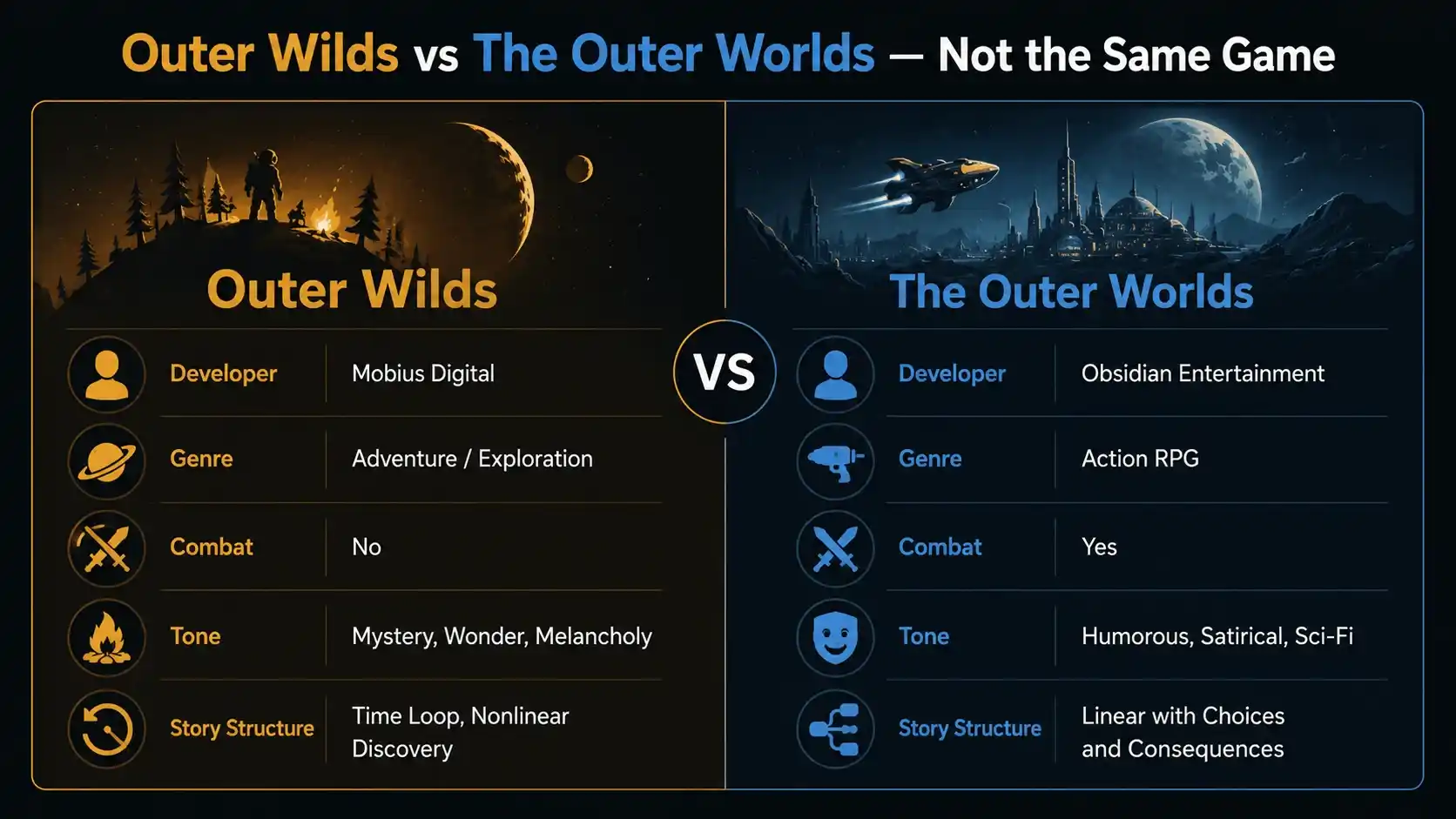
Outer Wilds and The Outer Worlds are two entirely separate games made by different developers with no shared universe, lore, or creative connection. The name similarity generates significant search confusion and has led many players to purchase the wrong game. Here is a direct comparison.
| Outer Wilds | The Outer Worlds | |
| Developer | Mobius Digital | Obsidian Entertainment |
| Publisher | Annapurna Interactive | Private Division |
| Genre | Exploration / Mystery | Action RPG / FPS |
| Combat | None | Central mechanic |
| Tone | Quiet, philosophical, emotional | Satirical, action-driven |
| Story structure | Player-assembled through exploration | Quest-based with dialogue trees |
| Platforms | PC, PS4/5, Xbox, Switch | PC, PS4/5, Xbox, Switch |
| Length | 15–20 hours | 25–40 hours |
The Outer Worlds is a narrative RPG in the tradition of Fallout: New Vegas, featuring branching quests, character builds, and gunplay. It is a good game in its own right, but it shares nothing with Outer Wilds beyond a similar name. If you are searching for one and finding information about the other, confirm the developer name before purchasing.
Will There Be an Outer Wilds 2?
As of June 2025, Mobius Digital has not announced an Outer Wilds 2 or any sequel to the original game. Developer comments over the years have consistently framed Outer Wilds as a complete, self-contained experience — a game that says everything it intended to say and does not require continuation.
The only official content expansion is Echoes of the Eye, released in September 2021. It adds a significant new area and a self-contained mystery to the base game, but it is a DLC rather than a sequel.
Community speculation about a sequel is active on r/outerwilds and other forums, but there is no confirmed production, announcement, or tease from Mobius Digital. Note also that The Outer Worlds 2, developed by Obsidian Entertainment, is a sequel to a different game entirely and has no connection to Outer Wilds.
Is Outer Wilds Worth It? — Honest Verdict
Outer Wilds is worth it for the right player. It is a rare creative achievement: a game designed entirely around the joy of discovery, built with no filler, no padding, and no compromise on its central design idea. For players who connect with it, it is frequently described as one of the best games they have ever played. For players who do not, it registers as a confusing, directionless experience that ends too quickly.
At its standard price point of approximately $24.99 USD (base game) plus $14.99 for the Echoes of the Eye DLC, the combined package offers strong value relative to its playtime density and the quality of the experience.
Prime Games Arena recommends Outer Wilds to:
- Any player willing to accept not knowing what to do as the starting condition
- Fans of games that respect player intelligence and reward patience
- Anyone looking for a game that will genuinely stay with them after the credits roll
If you enjoy unforgettable adventures that leave a lasting impression, you may also want to read our reviews of Death’s Door and Lost in Random: The Eternal Die, two games that combine strong atmosphere with memorable storytelling.
Common Beginner Mistakes to Avoid
- Expecting the game to direct you — it will not, ever. There are no waypoints and no hints unless you seek them out
- Quitting after the first loop — the first 30–45 minutes are the steepest confusion curve; the game changes dramatically once the mechanics click
- Treating it like a survival game — fuel and oxygen exist, but resource management is not the challenge
- Looking up a walkthrough too early — Outer Wilds is arguably the game most damaged by spoilers in the medium. Even a hint about which planet to visit next can reduce the impact of your own discovery
Conclusion
The Outer Wilds review verdict is straightforward: this is one of the most original and affecting games of its generation, and it is not for everyone. It demands patience, tolerance for confusion, and a willingness to let the game unfold on its own terms. Players who meet those conditions are rewarded with a narrative and design experience that very few games can match.
In terms of platform, PC and PS5 offer the best technical experience. The Nintendo Switch version is playable but not ideal. The Echoes of the Eye DLC is worth adding for the complete experience, though its tone shift is worth knowing about in advance.
If you are willing to let a game disorient you, challenge your assumptions about what games are supposed to be, and deliver a payoff built entirely from your own accumulated understanding — Outer Wilds is worth every minute.
Frequently Asked Questions
Q1: What is Outer Wilds about?
Outer Wilds is a first-person space exploration game where you navigate a handcrafted solar system trapped in a 22-minute time loop. The goal is to uncover the mystery of an ancient alien civilization called the Nomai and discover why the loop exists. Progress is made entirely through knowledge gathered across repeated loops.
Q2: Is Outer Wilds good for beginners or casual players?
It depends on patience. Outer Wilds has no combat and no quest markers, which makes it accessible in some ways but deeply disorienting for players expecting traditional guidance. Players who enjoy puzzle exploration and narrative mystery tend to connect strongly with it. Action-focused players often do not.
Q3: How long does it take to beat Outer Wilds?
Most first-time players complete the main story in 15 to 20 hours. Adding the Echoes of the Eye DLC extends that to approximately 20–28 hours. The game is designed to be short and dense rather than long.
Q4: Is Outer Wilds the same as The Outer Worlds?
No. Outer Wilds and The Outer Worlds are completely different games made by different developers. Outer Wilds is a quiet exploration mystery developed by Mobius Digital. The Outer Worlds is a satirical action RPG developed by Obsidian Entertainment. They share no connection beyond a similar name.
Q5: Is the Outer Wilds Nintendo Switch version worth playing?
The Switch version is playable but runs at reduced resolution and frame rate compared to PC and PS5. It is the weakest technical port. If you have access to another platform, PC or PS5 is recommended for the best experience.
Q6: Will there be an Outer Wilds 2?
No sequel has been announced as of June 2025. Mobius Digital has described the original as a complete, self-contained experience. The only additional content released is the Echoes of the Eye DLC from 2021. Note that The Outer Worlds 2 exists but is a sequel to a different game by Obsidian Entertainment.
Q7: What is the Outer Wilds age rating?
Outer Wilds is rated E10+ by the ESRB and PEGI 7 in Europe. It contains mild fantasy themes and some existential content but no graphic violence or mature language. Despite the rating, the game’s themes are emotionally sophisticated and resonate most with older teens and adults.