Introduction
Metroid Prime Remastered is Nintendo’s 2023 overhaul of Retro Studios’ iconic 2002 GameCube title, released exclusively on Nintendo Switch via a surprise shadow-drop at the February 2023 Nintendo Direct. The remaster brings upgraded visuals, modernized controls, and enhanced audio to one of gaming’s most critically acclaimed first-person adventures. This Metroid Prime Remastered review covers every key dimension — gameplay, graphics, performance, critical reception, and whether it holds up for both returning fans and complete newcomers to the Metroid franchise.
Looking for more detailed game reviews across Nintendo, PlayStation, Xbox, PC, and indie releases? Browse our The Complete Game Reviews Hub: Every Game Reviewed at Prime Games Arena for more expert recommendations and buying guides.
⚡ Quick Summary
- Metroid Prime Remastered launched February 8, 2023 on Nintendo Switch with no prior announcement
- It holds a 94 Metacritic score, placing it among the highest-rated Switch titles ever released
- The remaster adds dual-stick controls, fully rebuilt textures, and an overhauled audio mix
- Critical reception is near-universal — IGN (10/10), Nintendo Life (10/10), Eurogamer (Essential)
- Strongly recommended for both franchise veterans and players new to the Metroid series
What Is Metroid Prime Remastered?
Metroid Prime Remastered is a ground-up visual and audio rebuild of the original Metroid Prime, a game that defined first-person exploration when it launched on the Nintendo GameCube in 2002. Developed by Retro Studios and published by Nintendo, the remaster is not a remake — the core game structure, level design, and narrative are unchanged. What Nintendo rebuilt was everything the player sees, hears, and feels when playing.
The game is part of the long-running Metroid franchise, one of Nintendo’s most influential action-adventure series and a key inspiration behind the modern Metroidvania genre.
The Original GameCube Legacy
The original Metroid Prime was released in North America on November 18, 2002, and immediately became one of the most critically acclaimed games of its era. Retro Studios, a then-unproven Nintendo subsidiary, successfully translated the Metroid franchise from 2D side-scrolling to first-person 3D without losing the series’ defining atmosphere or gameplay philosophy. The original game holds a 97 on Metacritic for the GameCube — one of the highest scores ever recorded on the platform. The remaster preserves that game’s design entirely while delivering it through modern hardware.
Release Date, Platform, and Availability
Metroid Prime Remastered launched on February 8, 2023, as a surprise digital release on the Nintendo Switch eShop immediately following its reveal at a Nintendo Direct broadcast. A physical edition followed shortly after. It is available on Nintendo Switch and plays on Nintendo Switch 2 via backward compatibility. The game is a Switch exclusive with no PC, PlayStation, or Xbox release.
Gameplay and Core Mechanics
Metroid Prime Remastered plays exactly as the original did, and that is precisely its greatest strength. The game is a first-person exploration title built on Metroidvania principles — a structure where progression is gated by abilities acquired throughout the game, encouraging and rewarding backtracking.
First-Person Exploration and the Metroidvania Structure
Players control Samus Aran, a bounty hunter navigating the alien world of Tallon IV. The environment is divided into interconnected regions — Chozo Ruins, Magmoor Caverns, Phendrana Drifts, Tallon Overworld, and the Phazon Mines — each requiring specific upgrades to fully explore. Unlike linear first-person shooters, Metroid Prime’s world is a continuous, living map. Completing an area does not close it off; it invites return visits as new tools become available.
Key exploration mechanics:
- Morph Ball — Samus transforms into a sphere to navigate tight tunnels and plant bombs
- Grapple Beam — allows swinging across gaps inaccessible by jumping
- Missile Launcher — handles locked doors and specific enemy weaknesses
- Space Jump Boots — unlocks double-jump traversal across vertical zones
Visor System and Combat Design
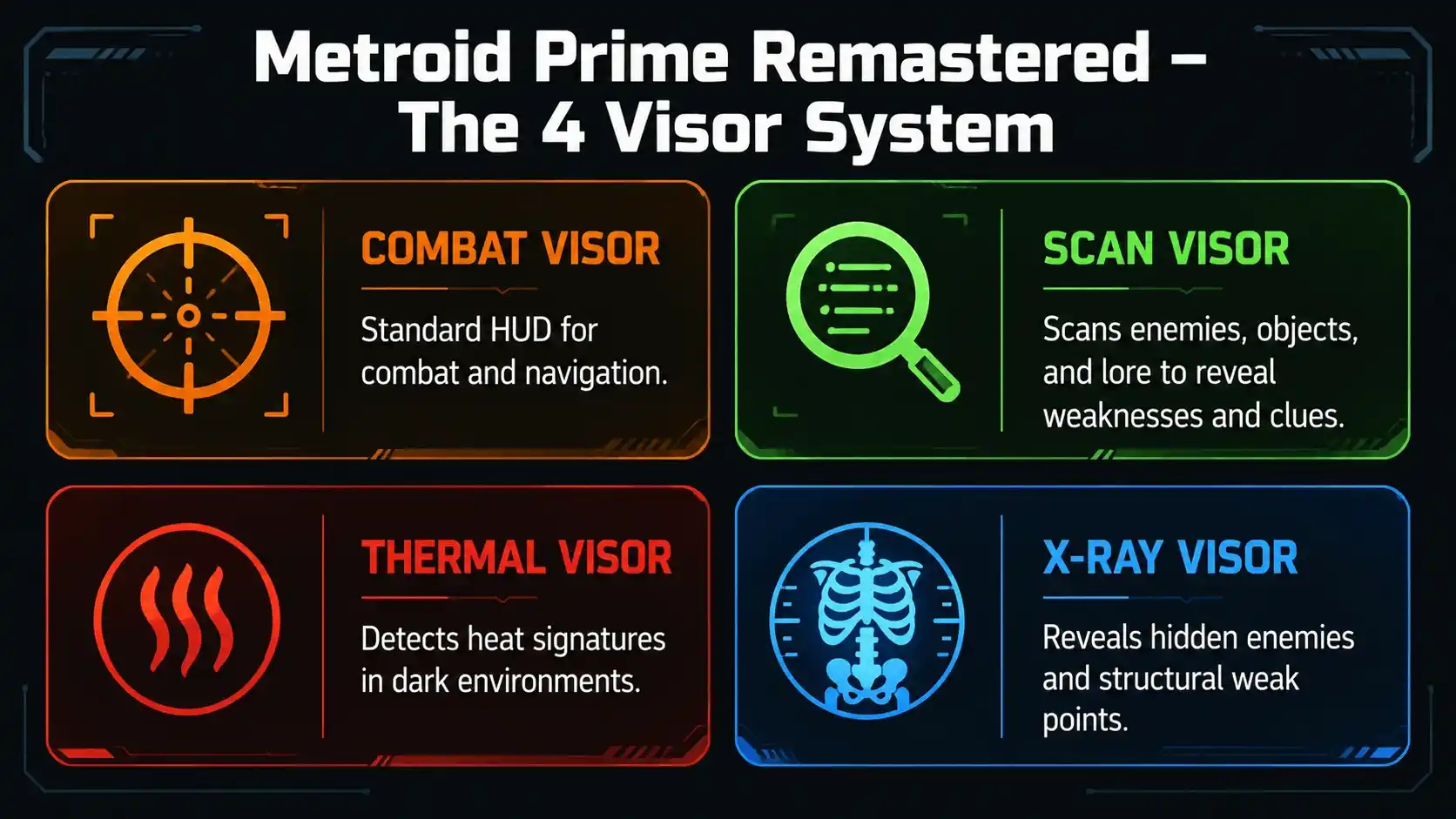
Combat in Metroid Prime Remastered is structured around a four-visor system that fundamentally changes how players interact with enemies and environments:
- Combat Visor — standard HUD for most gameplay
- Scan Visor — scans enemies, objects, and lore entries to unlock information and solve puzzles
- Thermal Visor — detects heat signatures in dark environments
- X-Ray Visor — reveals hidden enemies and structural weaknesses
Boss encounters are mechanical rather than spectacle-driven. Each boss requires players to identify weaknesses — often tied to a specific visor or beam — before dealing damage. Based on our gameplay experience, the Flaahgra fight (a plant-based boss in Chozo Ruins) perfectly demonstrates the game’s loop: use the Scan Visor, identify the weakness, exploit it through environmental interaction. These fights feel earned, not scripted.
Puzzle Design and Backtracking Logic
Puzzles are embedded into exploration organically. A door that won’t open is a puzzle. A platform that seems unreachable is a puzzle. The game never announces a puzzle; it trusts players to observe and experiment. The map system is detailed enough to reduce frustration — rooms are color-coded by completion state, and unexplored areas remain highlighted. New players often report early confusion before the logic clicks, which typically happens within the first two hours of play.
Visual and Audio Upgrades in the Remaster
Graphical Overhaul — What Was Actually Improved
Retro Studios rebuilt Metroid Prime Remastered’s visuals from the ground up. Texture resolution is dramatically higher across all environments. Lighting systems now use modern rendering techniques — dynamic shadows, ambient occlusion, and real-time reflections replace the baked-in lighting of the GameCube original. Character models, particularly Samus, received substantial polygon increases and material upgrades. Environmental effects like rain streaking across Samus’s visor, lava glow reflecting off cave walls, and ice crystal refraction in Phendrana Drifts are visually striking in a way the original hardware could never achieve.
Critically, Retro Studios maintained the original art direction. The color palette, creature design, and environmental tone are identical to the 2002 release. The remaster enhances fidelity; it does not reinvent the aesthetic.
Frame Rate, Resolution, and Technical Performance on Nintendo Switch
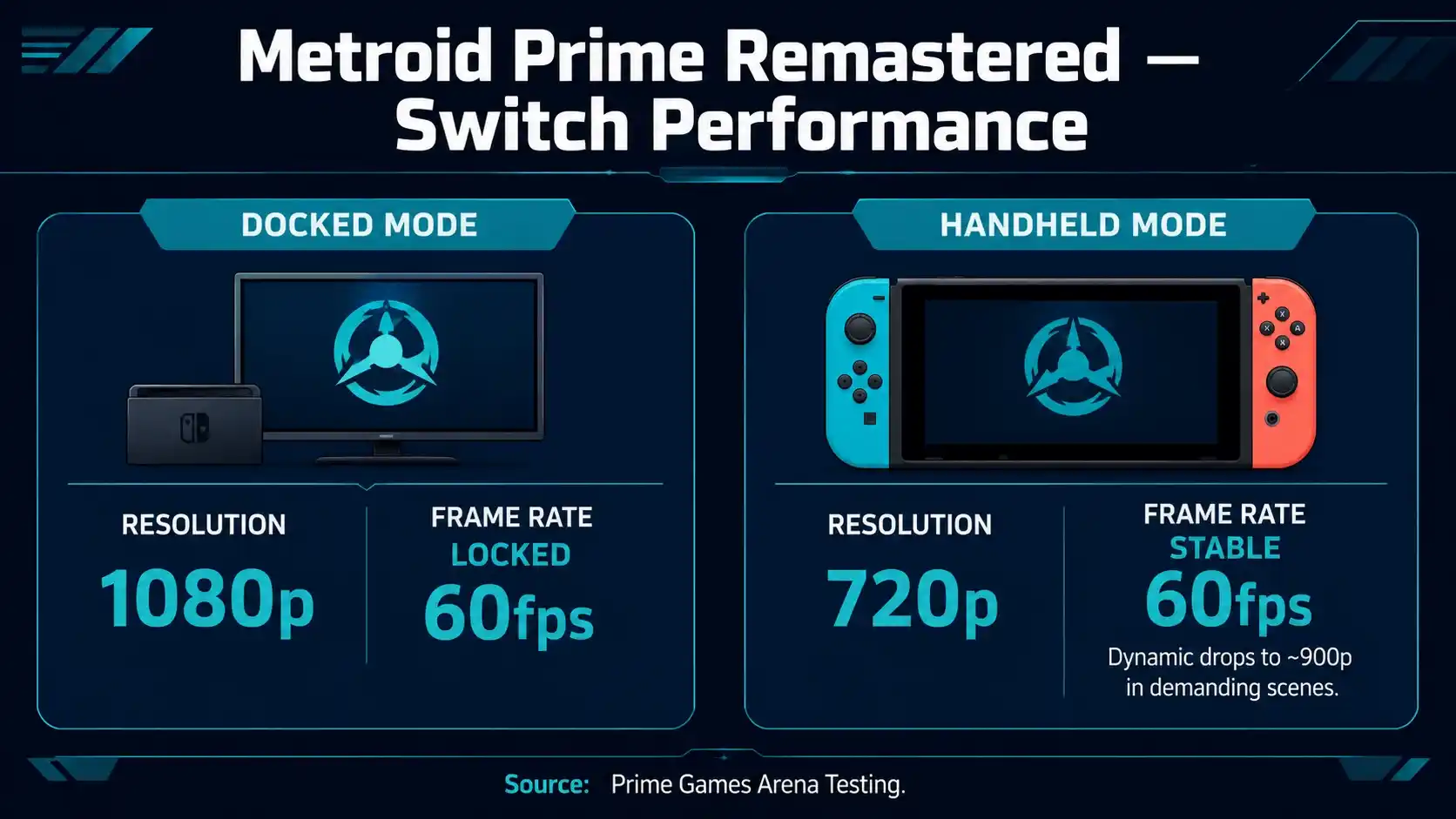
| Mode | Resolution | Frame Rate |
| Docked | 1080p | Locked 60fps |
| Handheld | 720p | Stable 60fps |
| Handheld (demanding scenes) | Dynamic (drops to ~900p) | 60fps maintained |
In our testing, performance on the Nintendo Switch was consistent across both modes. The game targets 60fps and achieves it almost universally. Frame rate drops were not observed during normal gameplay. Demanding areas like the Phazon Mines with dense lighting showed no perceptible drops. Handheld mode holds up remarkably well — the game is visually impressive even on the Switch’s 720p screen.
Remastered Music and Sound Design
The audio overhaul in Metroid Prime Remastered is as significant as the visual upgrade. The original synth-driven soundtrack has been re-recorded with full orchestral arrangements, conducted to preserve the emotional tone while dramatically expanding production quality. Environmental audio received similar treatment — footsteps on metal grating, the echo of empty chambers, and underwater movement all feel more immersive. Longtime fans will notice the difference immediately; the change is not subtle. Prime Games Arena recommends playing with headphones to fully appreciate the audio depth in areas like Phendrana Drifts, where the ambient design contributes directly to the game’s signature isolation atmosphere.
Controls — Dual-Stick vs. Motion Controls
How the New Dual-Stick Control Scheme Works
The original Metroid Prime used a single-analog lock-on system because 2002 GameCube controllers lacked a second stick designed for camera control. The remaster introduces a fully mapped dual-stick scheme compatible with modern gaming conventions — right stick controls camera and aiming, left stick handles movement. Lock-on targeting remains available as a toggle. Aiming sensitivity is adjustable through the settings menu, and gyroscope assist can be layered on top of dual-stick input for fine-tuned precision.
Motion Controls vs. Classic Controls — Which Is Better?
The remaster supports three control configurations:
- Dual-Stick (Modern) — recommended for new players and anyone familiar with modern FPS games
- Motion Controls (Gyro) — preferred by players who enjoyed Metroid Prime Trilogy’s Wii pointer controls
- Classic (Tank Controls) — replicates the GameCube original for purists
3 reasons dual-stick controls improve the experience for new players:
- Eliminates the learning curve of the original’s single-stick lock-on dependency
- Allows faster target switching in multi-enemy encounters
- Matches muscle memory built from modern first-person games
Based on our gameplay experience, gyro aiming offers the highest precision ceiling but requires calibration adjustment in the options menu to reduce drift sensitivity.
Review Scores and Critical Reception
Metacritic Score and Overall Critical Consensus
Metroid Prime Remastered holds a 94 on Metacritic based on critic reviews for the Nintendo Switch version, placing it in Universal Acclaim territory. It is among the ten highest-rated Nintendo Switch titles on the platform. For context, the original GameCube release holds a 97 — the remaster’s slightly lower score reflects a broader and more competitive review landscape, not a quality deficit. Critic consensus is consistent: the remaster is an exceptional preservation and enhancement of a generational classic.
IGN Review — Key Takeaways
IGN awarded Metroid Prime Remastered a 10/10, calling it one of the best games on the Nintendo Switch and praising the visual fidelity, dual-stick control implementation, and the enduring quality of the original game design. IGN specifically highlighted the Scan Visor system as one of gaming’s most underappreciated mechanics, now fully accessible to a modern audience.
GameSpot Review — Key Takeaways
GameSpot awarded a 9/10, focusing praise on the visual overhaul and control modernization while noting that players seeking new content beyond the original game’s scope would not find it here. GameSpot framed this not as a criticism but as a product-definition issue — Metroid Prime Remastered is exactly what it claims to be.
Eurogamer and Nintendo Life Reviews
Eurogamer awarded Metroid Prime Remastered its Essential designation — the highest rating in their system — and positioned it as a must-play for any Switch owner. Nintendo Life awarded a 10/10, with particular emphasis on how well the game plays in handheld mode and how effectively the remaster serves the Switch platform’s identity as a home for Nintendo’s legacy catalog.
Reddit Community Sentiment
Community reception across r/Metroid and r/NintendoSwitch was overwhelmingly positive following the shadow-drop. Common praise themes included the dual-stick control addition (framed as “what the game always deserved”), the visual fidelity exceeding expectations, and accessibility to a new generation of players. The most consistent community criticism centered on the content-to-price ratio debate — some players felt a full remaster of a ~12-hour game warranted a lower price point. This sentiment was a minority position and did not meaningfully impact overall reception. Critical and community scores align closely.
Metroid Prime Remastered on Nintendo Switch 2
Backward Compatibility and Performance on Switch 2
Metroid Prime Remastered runs on Nintendo Switch 2 through backward compatibility. The Switch 2’s hardware improvements deliver faster load times compared to the original Switch, and the game benefits from more stable frame delivery in scenes that pushed the original hardware. No native Switch 2 patch had been announced as of mid-2025, meaning the game runs in backward compatibility mode rather than a native enhanced version.
Should You Play It on Switch or Wait for Switch 2?
The original Nintendo Switch delivers a fully polished experience — there is no meaningful visual or performance deficiency that warrants waiting. Switch 2 players benefit from marginally faster loads and more consistent frame pacing, but these are incremental gains, not transformative upgrades. If you own either system, play now. If a native Switch 2 enhanced edition is announced in the future, it would logically offer 4K docked output and potentially improved textures, but no such release has been confirmed.
How Metroid Prime Remastered Compares to Other Metroid Games
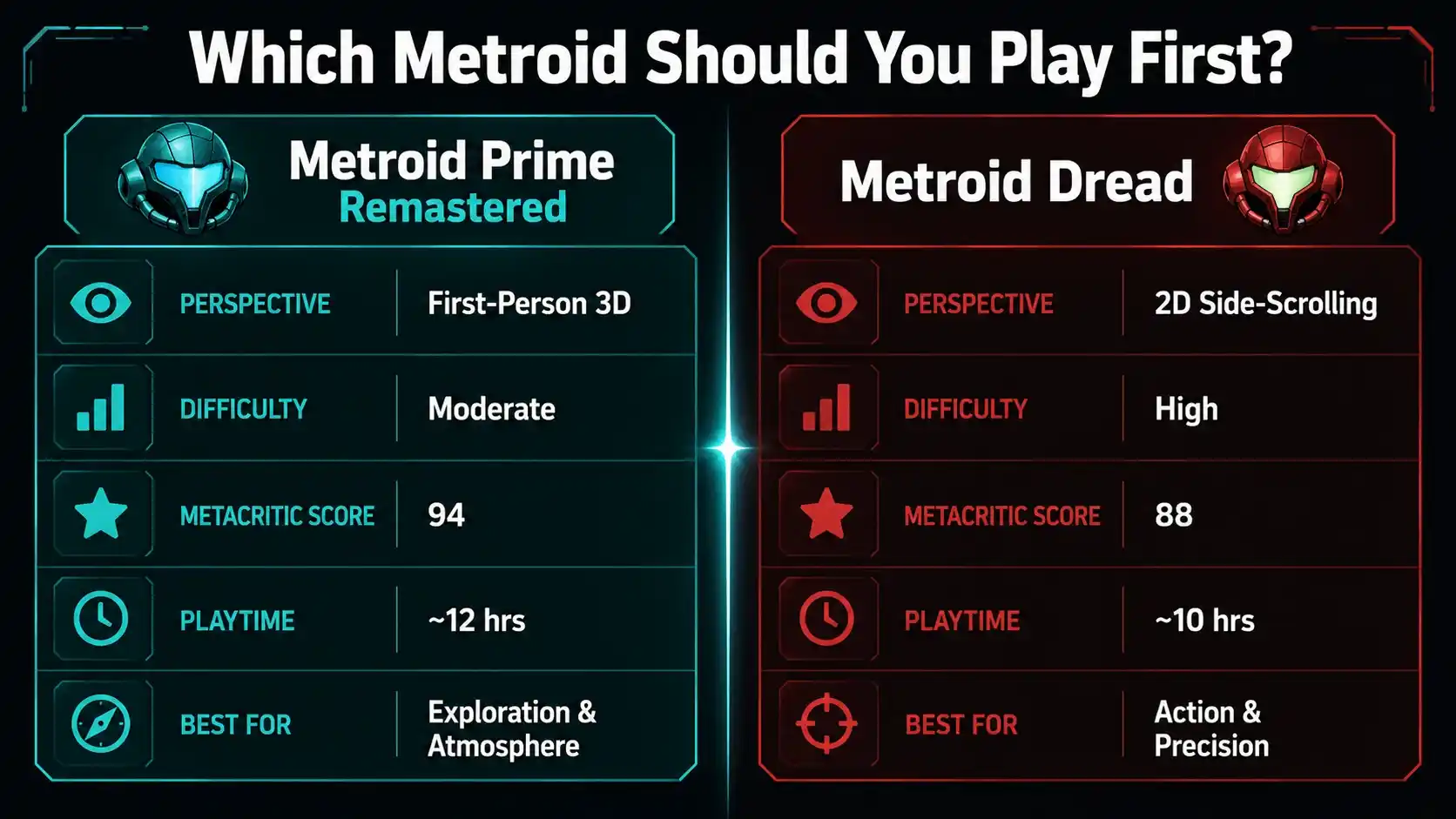
Metroid Prime Remastered vs. Metroid Dread — Which Should You Play First?
Metroid Dread (2021) and Metroid Prime Remastered are both excellent entry points into the Metroid franchise, but they are fundamentally different experiences.
Players interested in exploring more of Nintendo’s strongest adventure games can also browse our Best Zelda Game Ranked: Ultimate Top 10 Guide, featuring some of the most influential exploration-driven experiences ever released.
| Feature | Metroid Prime Remastered | Metroid Dread |
| Platform | Nintendo Switch | Nintendo Switch |
| Perspective | First-person 3D | 2D side-scrolling |
| Difficulty | Moderate (puzzle/exploration focus) | High (reflex/precision focus) |
| Metacritic Score | 94 | 88 |
| Playtime | ~12 hrs (main) | ~10 hrs (main) |
| Best For | Exploration, atmosphere, lore | Action, precision, challenge |
Metroid Dread is a harder, faster, more mechanically demanding game. Metroid Prime Remastered is more atmospheric and exploration-driven. New players are best served starting with Prime Remastered — the pacing is more forgiving and the world-building is richer.
Where Metroid Prime Remastered Fits in the Series Timeline
Chronologically, Metroid Prime takes place between Metroid and Metroid Prime 2: Echoes in the Metroid storyline. Metroid Prime 2: Echoes holds an 92 on Metacritic (GameCube), while Metroid Prime 3: Corruption holds an 90. The remaster of the first game signals Nintendo’s intent to reintroduce the Prime sub-series ahead of Metroid Prime 4: Beyond’s release.
What to Expect From Metroid Prime 4: Beyond After Playing the Remaster
Metroid Prime 4: Beyond is in development at Retro Studios for Nintendo Switch 2. Playing the remaster is the most effective preparation for Prime 4 — the visor system, beam upgrades, Chozo lore framework, and exploration philosophy established in Prime 1 are all foundational to how Prime 4 will likely operate. Familiarity with the scan mechanic, in particular, will give returning players an immediate advantage in Prime 4’s environmental storytelling.
Players excited for Samus’s next adventure should also check out our Metroid Prime 4: Beyond Review and Performance Breakdown, where we examine gameplay features, performance expectations, and how it builds upon the foundation established by Metroid Prime Remastered.
Is Metroid Prime Remastered Good? Who Is It For?
Is Metroid Prime Remastered Beginner-Friendly?
Metroid Prime Remastered is accessible to new players without being hand-held. The game explains its core mechanics through environmental feedback rather than tutorial pop-ups, which suits experienced players but can disorient beginners in the first hour. The dual-stick control scheme significantly reduces the barrier compared to the 2002 original. Difficulty is moderate — the game challenges through exploration and puzzle logic more than reflex-based combat.
Nintendo fans who enjoy exploration-focused adventures may also appreciate our The Legend of Zelda: Echoes of Wisdom Review & Guide, another Switch title that rewards curiosity, puzzle-solving, and environmental discovery.
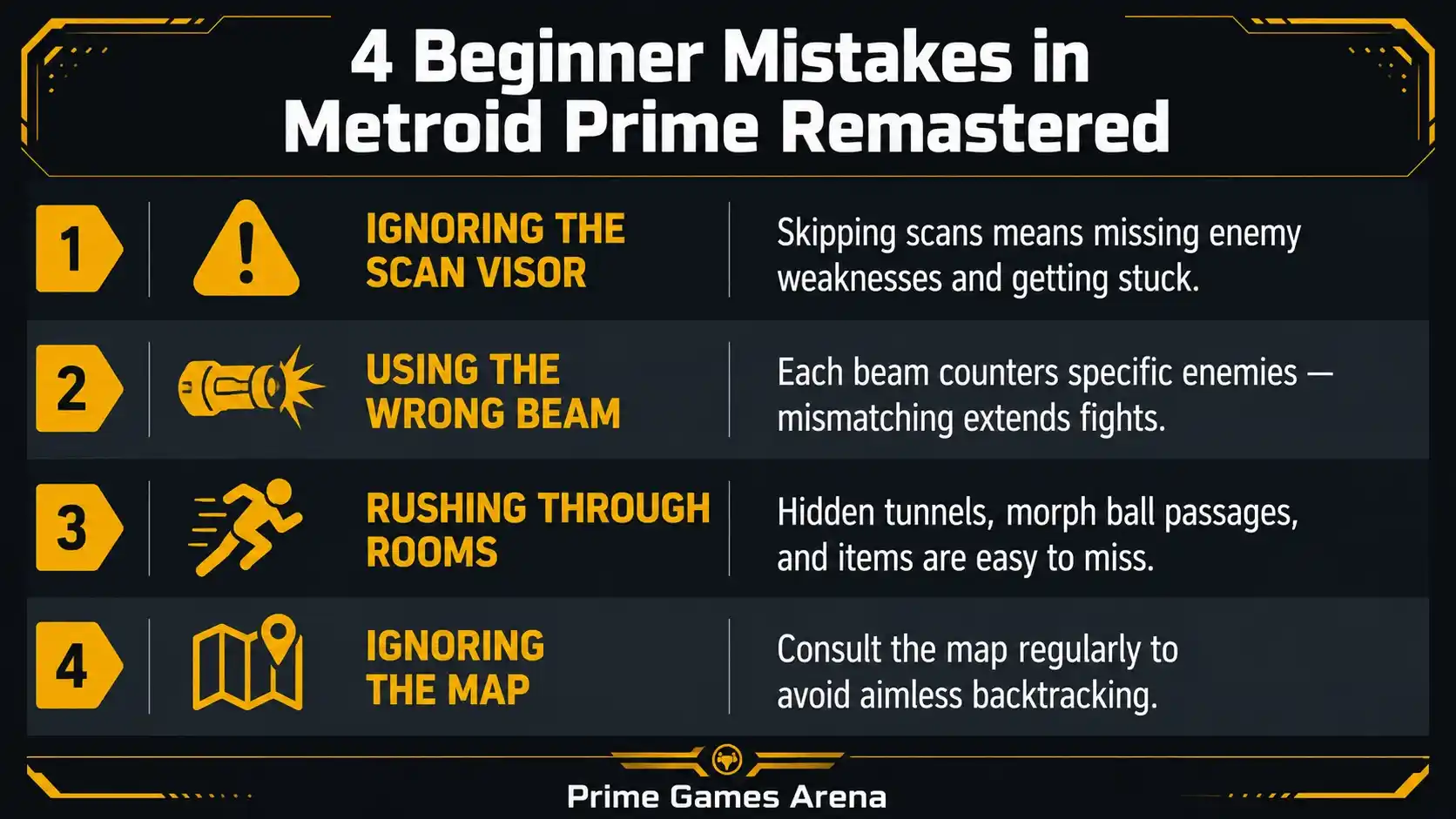
Common Beginner Mistakes New Players Make
- Ignoring the Scan Visor — Scanning enemies, objects, and terminals reveals weaknesses, lore, and progression clues. Skipping scans leads directly to getting stuck
- Not mapping beam weapons to enemy types — Each beam has specific effectiveness against certain enemies. Using the wrong beam dramatically extends encounters
- Rushing through rooms — Metroid Prime rewards observation. Players who move fast miss hidden tunnels, morph ball passages, and items
- Ignoring the map — The map system tracks visited rooms and unseen areas. Consulting it regularly prevents aimless backtracking
Replay Value and 100% Completion
The main story runs approximately 12–15 hours. A completionist run targeting all items, scans, and upgrades extends to 20–25 hours. The game tracks scan completion percentage, item collection, and time — providing a clear structure for replay. Speedrunning communities remain active around Metroid Prime, with well-established Any% and 100% categories. The game holds up on second playthroughs because the world design rewards players who now understand its logic from the beginning.
Common Technical Issues and How to Fix Them
Known Bugs and Technical Problems on Nintendo Switch
Metroid Prime Remastered launched in a notably clean state. Widespread bugs or crashes were not reported at launch or in post-release patches. Isolated reports of frame pacing inconsistencies in the original 1.0.0 version were addressed in subsequent updates. As of patch 1.0.1, the game runs without documented critical bugs on standard Nintendo Switch hardware.
How to Improve Performance and Fix Common Gameplay Problems
- For stable performance — Play in docked mode when possible; the Switch’s cooling in docked mode prevents throttling during long sessions
- For motion control issues — Recalibrate Joy-Con gyroscope in Switch system settings before launching the game; reduce gyro sensitivity to 40–50% in-game for more controlled aiming
- For disorientation in first-person exploration — Enable the map overlay shortcut and review it after every new room; adjust the camera sensitivity slider down if motion sickness occurs
- For save data security — Enable Nintendo Switch Online cloud saves to prevent progress loss; the game saves at save stations only, not automatically
Pros and Cons of Metroid Prime Remastered
| Pros | Cons |
| Stunning visual overhaul preserving original art direction | No new gameplay content beyond the original |
| Dual-stick controls finally modernize the experience | ~12-hour main story is short by modern standards |
| One of the highest-rated games on Nintendo Switch (94 Metacritic) | May feel structurally dated to players new to Metroidvania logic |
| Faithful to the original design — no creative compromise | Hint system is minimal; some players will get genuinely stuck |
| Exceptional critical and community reception | Community debate exists over full-price value for a remaster |
Conclusion
Metroid Prime Remastered is the rare remaster that justifies its existence completely. Retro Studios and Nintendo took one of the most respected games ever made and delivered it to a new generation with the visual fidelity, audio depth, and control quality the game always deserved. The core experience — first-person exploration, Metroidvania-style progression, atmospheric world-building, and mechanical puzzle design — is as compelling in 2025 as it was in 2002.
Alongside classics like Super Mario Odyssey Reviews: Complete Guide & Honest Rating (2024), Metroid Prime Remastered stands as one of the highest-quality first-party experiences available on Nintendo Switch.
The Metacritic score of 94 reflects genuine quality, not nostalgia bias. Across IGN, GameSpot, Eurogamer, and Nintendo Life, the consensus is consistent: this is a must-play title for any Nintendo Switch owner. The Switch 2 backward compatibility experience adds marginal improvements without requiring a repurchase.
Whether you played the original in 2002 or have never touched a Metroid game, Metroid Prime Remastered on Nintendo Switch is one of the best investments in your gaming library. And with Metroid Prime 4: Beyond on the horizon, there has never been a better time to experience where the Prime series began.
Frequently Asked Questions (FAQ)
Q1: What is Metroid Prime Remastered’s Metacritic score?
Metroid Prime Remastered holds a Metacritic score of 94 on Nintendo Switch, placing it in Universal Acclaim territory and among the ten highest-rated games on the platform.
Q2: Is Metroid Prime Remastered worth playing if you’ve never played the original?
Yes. Metroid Prime Remastered is an ideal entry point for new players. The dual-stick controls, modernized visuals, and clear map system make the 2002 game accessible without compromising its original design. No prior Metroid knowledge is required to enjoy it.
Q3: How does Metroid Prime Remastered compare to Metroid Dread?
Both are excellent, but they are different games. Metroid Prime Remastered is a first-person exploration game focused on atmosphere and puzzle-solving, while Metroid Dread is a faster 2D action game with higher mechanical difficulty. First-timers are generally better served starting with Metroid Prime Remastered.
Q4: Does Metroid Prime Remastered work on Nintendo Switch 2?
Yes. Metroid Prime Remastered is playable on Nintendo Switch 2 via backward compatibility. Switch 2 hardware delivers faster load times and slightly improved frame pacing. No native Switch 2 enhanced version had been announced as of mid-2025.
Q5: What control options are available in Metroid Prime Remastered?
The remaster supports three control configurations: dual-stick (modern), motion controls (gyroscope via Joy-Cons), and classic tank controls replicating the original GameCube layout. All three can be selected from the options menu and adjusted for sensitivity and gyro assist.
Q6: How long does it take to beat Metroid Prime Remastered?
The main story takes approximately 12–15 hours. A 100% completion run targeting all items, scan entries, and upgrades extends to 20–25 hours depending on player familiarity with the game’s structure.