Action RPG fans have no shortage of loot-driven adventures in 2026, but Dragonkin: The Banished enters the genre with a few ideas that genuinely stand out. Developed by Eko Software and published by Nacon, the game mixes fast hack ’n’ slash combat with a surprisingly deep build system and a city-building progression layer that separates it from traditional ARPGs.
While it doesn’t completely dethrone giants like Diablo IV or Last Epoch, it delivers enough originality and satisfying combat to make it one of the more interesting mid-budget ARPG releases of the year. If you enjoy in-depth breakdowns of modern games, you can explore more detailed analysis in The Complete Game Reviews Hub, along with comparisons like Is Cyberpunk 2077 Worth It in 2025/2026? and Is Hogwarts Legacy Good?
What Is Dragonkin The Banished? (Game Overview)
Quick Facts at a Glance
| Detail | Info |
| Developer | Eko Software |
| Publisher | Nacon |
| Genre | Action RPG / Hack ’n’ Slash |
| Early Access Release Date | March 6, 2025 (PC/Steam) |
| Full Release Date | March 16, 2026 (PC) / March 19, 2026 (PS5, Xbox Series X|S) |
| Price | ~$39.99 (PS5/Xbox) / ~$20.99 (Steam) |
| Platforms | PC (Steam), PlayStation 5, Xbox Series X|S |
| Co-op | Online Co-op up to 4 players; Local Couch Co-op (2 players) |
| Metacritic Score | Mixed / ~50–70 (varies by outlet) |
| Steam Rating | Mostly Positive (73–75%) |
Setting and Core Premise
Dragonkin: The Banished takes place in a dark fantasy world poisoned by dragon blood corruption. Ancient Dragon Lords have devastated civilization, and humanity survives in isolated strongholds while monstrous creatures roam the wilds.
Players choose from powerful hero classes and gradually hunt the four Ancestral Dragons responsible for the corruption. The central hub city, Montescail, evolves alongside your progress and acts as more than a simple menu area. Vendors, upgrades, crafting systems, and passive bonuses expand as the city develops.
The ultimate goal is simple: become powerful enough to eliminate the dragon threat permanently.
Editions and Pricing
The game is available in multiple editions:
- Standard Edition — Base game with full campaign access
- Blood Scales Edition — Includes cosmetics, bonus items, and additional digital rewards
- Founder/Lord Packs — Steam-exclusive bundles aimed at early supporters
Pricing varies significantly between platforms. PC players get the better deal, with the Steam version launching around $20.99, while console editions cost closer to $39.99.
Dragonkin The Banished Review — My Honest Take
First Impressions and Prologue Experience
The opening hours are surprisingly strong. Instead of forcing players to blindly pick a class, the game begins with a cinematic prologue that temporarily lets you experience all four classes at near endgame strength.
This immediately showcases the combat potential and gives players a taste of the flashy late-game abilities before committing to a main class. It’s a smart design choice that many ARPGs could learn from.
The downside is that the game sets expectations incredibly high early on. Once the full campaign begins, progression temporarily feels slower and less explosive.
Combat and Gameplay Feel
Combat is where Dragonkin: The Banished shines the brightest. If you enjoy RPG progression systems like these, you may also like deeper RPG experiences such as Witcher 3 Next Gen Update, Octopath Traveler II Review, or Metaphor: ReFantazio Review, which all explore different styles of build-driven gameplay.
Abilities feel impactful, enemy packs explode satisfyingly, and visual clarity remains strong even during chaotic fights. That readability is critical in ARPGs where dozens of effects can overwhelm the screen.
The game clearly borrows inspiration from Diablo IV’s dungeon structure and loot loop, but it introduces enough unique mechanics to avoid feeling like a clone.
Still, balancing remains inconsistent. Certain skill combinations can trivialize bosses, while some classes feel noticeably weaker during early progression.
Ancestral Grid — The Signature Build System
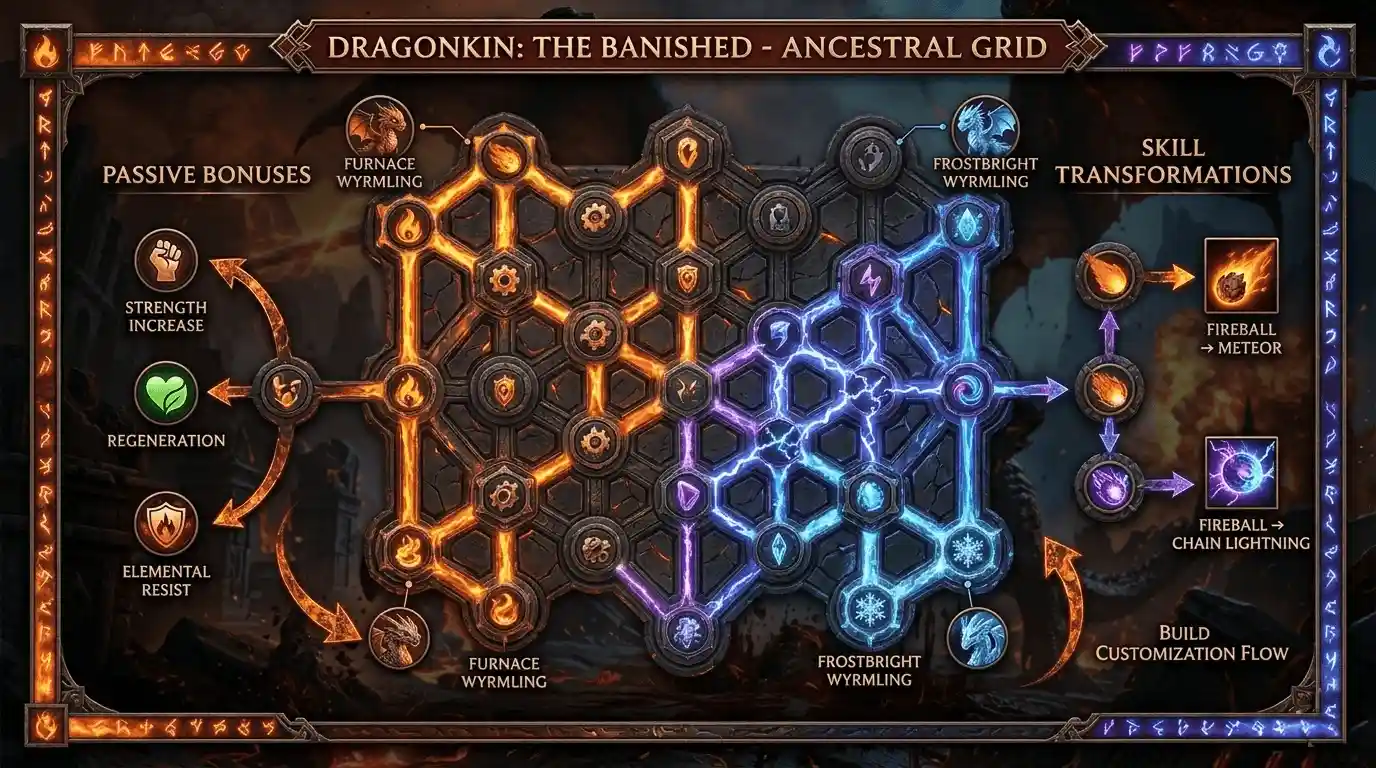
The standout feature is unquestionably the Ancestral Grid.
Instead of traditional skill trees, players arrange fragments on a modular board that creates synergies, passive effects, and skill transformations. The system encourages experimentation because layouts can be rearranged freely without excessive penalties.
This creates far more flexibility than many competing ARPG systems.
Wyrmlings — small dragon companions — add another layer of customization by granting elemental bonuses and autonomous combat skills.
For build-crafters, this system alone may justify playing the game.
City-Building with Montescail
Montescail is more than a decorative hub.
As players progress, the city unlocks:
- New merchants
- Crafting stations
- Passive account bonuses
- Endgame services
- Upgrade systems
The concept is refreshing because it gives progression a visual and mechanical payoff outside combat.
However, early city upgrades can feel slow, occasionally interrupting gameplay momentum.
Story and World-Building
The lore itself is interesting, particularly the themes surrounding dragon corruption and fallen civilizations.
Unfortunately, storytelling execution is uneven.
The game throws many names, factions, and historical details at players rapidly, making the narrative feel dense and occasionally confusing. Environmental storytelling works better than direct dialogue, and emotional character moments rarely land with enough impact.
Players focused primarily on narrative depth may leave disappointed.
Visuals, Audio, and Performance
The environmental variety is excellent.
You’ll travel through:
- Toxic swamps
- Volcanic wastelands
- Frozen mountains
- Corrupted forests
The soundtrack, composed by Daniel Sadowski, delivers over 70 minutes of orchestral fantasy music that fits the world exceptionally well.
Performance is less consistent. Early PC versions suffered from Unreal Engine 5 stuttering, UI quirks, and occasional animation bugs. Patches have improved stability significantly, but technical roughness still appears occasionally.
Dragonkin The Banished PS5 Review — Console-Specific Notes
The PS5 version benefits from a smoother overall launch state compared to early PC builds.
Notable console features include:
- DualSense vibration integration
- Split-screen couch co-op
- Stable controller support
- Improved optimization compared to earlier PC patches
Performance mode generally maintains stable frame rates, though crowded endgame encounters can still produce occasional dips.
Dragonkin The Banished — Pros and Cons
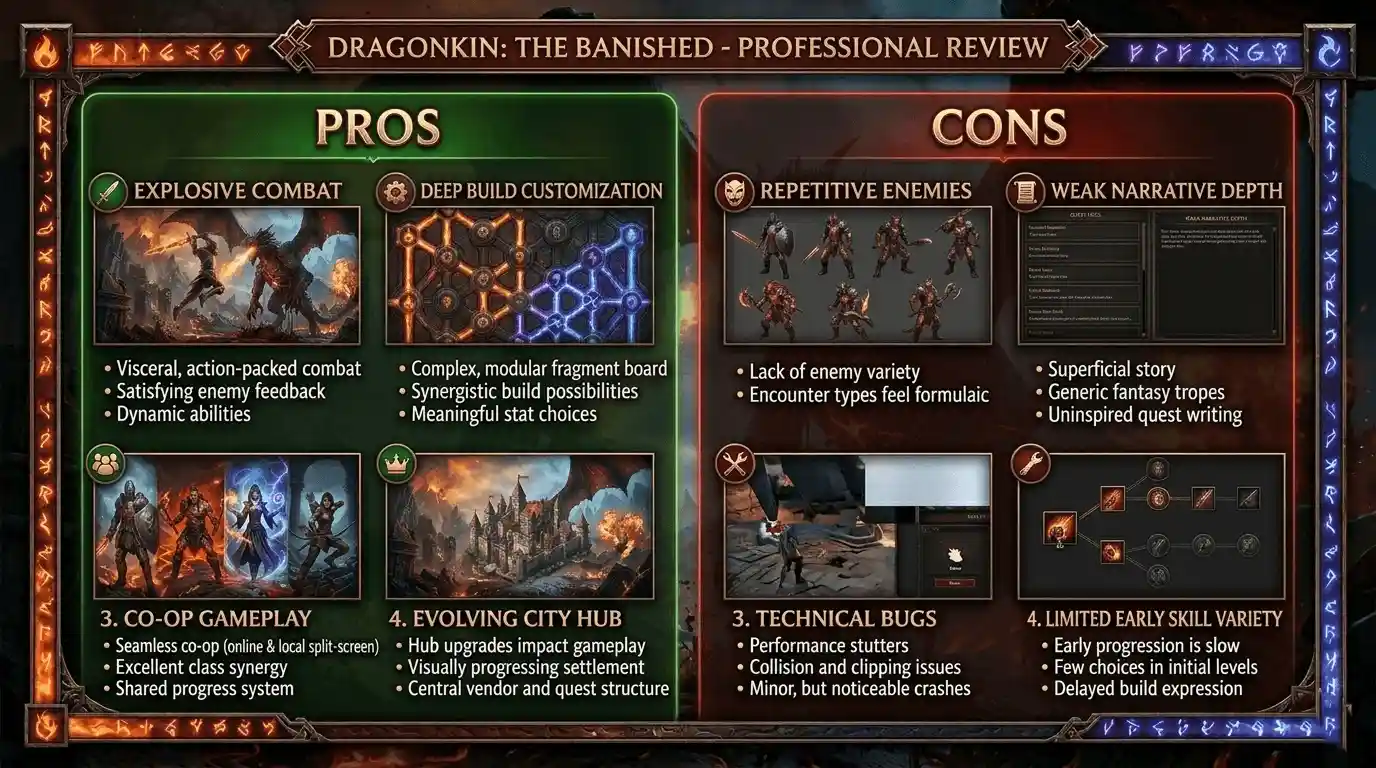
| ✅ Pros | ❌ Cons |
| Excellent Ancestral Grid build system | Convoluted narrative |
| Satisfying combat loop | Gear rewards sometimes feel bland |
| Unique city-building layer | Limited early skill variety |
| Strong co-op support | Repetitive late-game enemies |
| Great value for price | Voice acting quality varies |
| Flexible build experimentation | Minor technical issues remain |
Dragonkin The Banished Classes — Full Breakdown
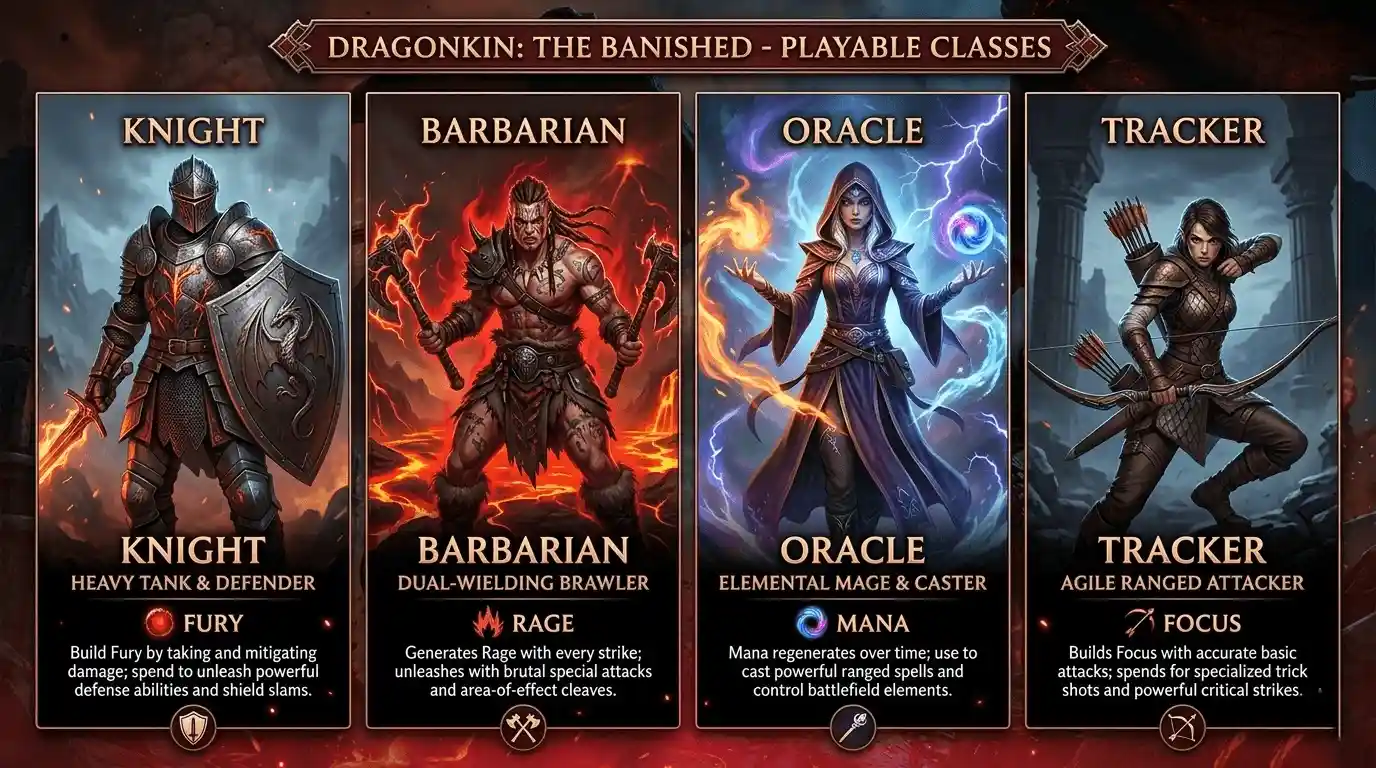
Overview of All Four Hero Classes
| Class | Combat Style | Resource System |
| Knight | Hybrid frontline melee | Energy + Fuel |
| Barbarian | Melee bruiser | Rage |
| Oracle | Elemental ranged caster | Mana |
| Tracker | Mobile ranged rogue | Agility |
Knight — The Hybrid Frontline Tank
The Knight excels at survivability and crowd control. Its hybrid mechanics balance offense and defense effectively, making it ideal for beginners and solo players.
Barbarian — The Melee Bruiser
The Barbarian focuses on relentless aggression and rage-fueled burst damage. It thrives in close combat and clears enemy packs rapidly.
Oracle — The Elemental Caster
The Oracle specializes in ranged elemental destruction and benefits heavily from advanced Ancestral Grid optimization.
This is arguably the strongest late-game class for players who enjoy build experimentation.
Tracker — The Mobile Ranged Rogue
Added during the 2025 Tracker Update, the Tracker emphasizes mobility, kiting, and precision gameplay.
It rewards experienced ARPG players comfortable with fast movement and positioning.
Dragonkin The Banished Builds — Best Strategies Per Class
Oracle Build Guide
For Oracle players, focus heavily on elemental synergy fragments inside the Ancestral Grid.
Recommended priorities include:
- Chain lightning amplification
- AoE elemental spread effects
- Mana regeneration nodes
- Fire/frost hybrid scaling
Pairing offensive Wyrmlings with AoE-focused skills creates devastating Chaos Hunt clears.
Knight Build Guide
The Knight performs best with balanced survivability and sustained DPS.
Key priorities include:
- Defensive fragment clusters
- Fuel regeneration efficiency
- Crowd-control enhancements
- Shield-based retaliation effects
Barbarian Build Guide
Barbarian gameplay revolves around efficient rage generation.
Strong setups include:
- Rage-per-hit fragment chains
- Critical strike amplifiers
- Leap-and-cleave combinations
- Berserk uptime optimization
Tracker Build Guide
Tracker builds thrive on agility scaling and movement bonuses.
Focus on:
- Mobility fragments
- Poison or bleed synergies
- High attack speed
- Kiting-focused Wyrmling support
Dragonkin The Banished Co-Op — How Multiplayer Works
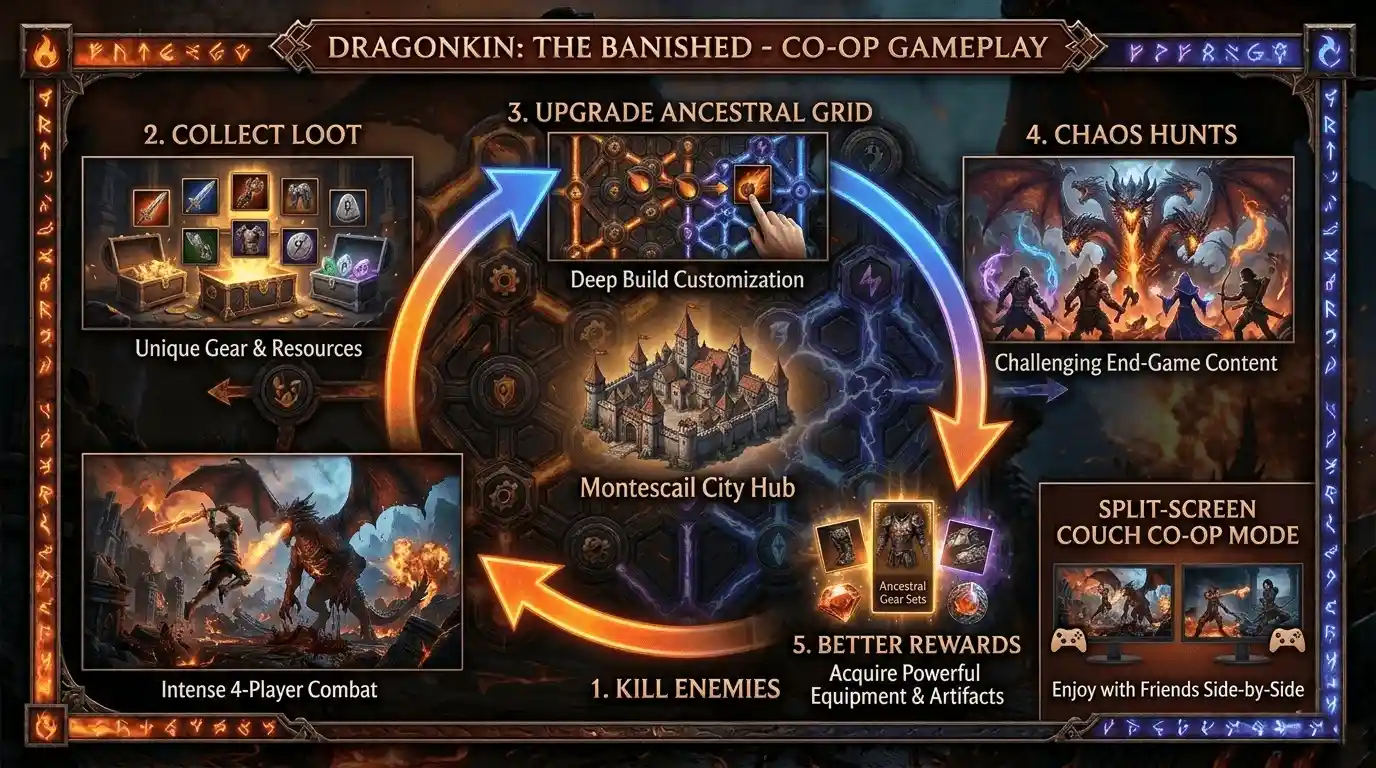
Co-Op Modes Explained
The game fully supports cooperative play across nearly all activities.
Available modes include:
- Online co-op for up to 4 players
- 2-player local split-screen on consoles
- Shared city progression systems
- Multiplayer endgame Chaos Hunts
Montescail can also host up to 16 players simultaneously.
Co-Op Tips and Best Practices
Strong team combinations include:
- Knight + Oracle
- Barbarian + Tracker
- Double frontline with ranged support
Communication matters heavily during higher-difficulty Chaos Hunts, especially when coordinating crowd control and boss mechanics.
Dragonkin The Banished Gameplay — Core Systems Explained
Combat Loop and Progression
The core gameplay loop follows a familiar but addictive structure:
- Kill enemies
- Collect loot
- Upgrade the Ancestral Grid
- Unlock stronger content
- Repeat at higher difficulty
Hunting Boards and Chaos Hunts provide long-term replayability.
Loot and Gear System
Loot includes rarity tiers, upgrade systems, modifiers, and crafting interactions.
However, item excitement remains one of the game’s weaker areas. Compared to genre leaders, legendary drops rarely feel transformative enough.
The built-in loot filter system helps reduce clutter significantly.
Endgame Content Overview
Endgame activities revolve around Hunts and Chaos Hunts.
These modes introduce:
- Difficulty modifiers
- Stronger enemies
- Better rewards
- Scaling boss encounters
- Rare crafting materials
The Ancestral Dragon battles are among the game’s strongest endgame moments.
Dragonkin The Banished Roadmap — What’s Coming Next
Early Access to Full Release Timeline
| Phase | Key Content Added |
| Early Access Launch (Mar 2025) | Knight, Oracle, Barbarian + Chapter 1 |
| Autumn 2025 Update | Tracker class, online multiplayer, new biome |
| Full Release 1.0 (Mar 2026) | Complete campaign, console launch, Chaos Hunt |
Post-Launch Roadmap and Community Updates
The developers have maintained relatively active communication through patches and balance updates.
Planned improvements include:
- Additional endgame content
- Balance changes
- Performance optimization
- Quality-of-life upgrades
Dragonkin The Banished Metacritic Score — What Critics Are Saying
Professional Review Score Summary
| Platform / Outlet | Score / Verdict |
| Metacritic (PC) | Mixed (~50–70 range) |
| Steam User Score | Mostly Positive (73–75%) |
| TheSixthAxis | 7/10 |
| GamingBolt | Positive |
| Thumb Culture (PS5) | Silver Award |
What Players Are Saying (Steam & Reddit)
Common praise includes:
- Strong combat feel
- Deep build customization
- Excellent co-op support
- Fair pricing
Common criticisms include:
- UE5 stuttering
- Slow tutorial pacing
- Weak loot excitement
- Repetitive late-game enemies
Fortunately, player sentiment improved noticeably after post-launch patches.
How Does Dragonkin The Banished Compare to Other ARPGs?
Dragonkin vs. Diablo IV vs. Last Epoch
| Feature | Dragonkin: The Banished | Diablo IV | Last Epoch |
| Build Depth | Ancestral Grid | Paragon Board | Skill Trees |
| Co-op | Up to 4 Players | Up to 4 Players | Up to 4 Players |
| City Building | Yes | No | No |
| Price (PC) | ~$20.99 | ~$69.99 | ~$34.99 |
| Tone | Dark fantasy / dragons | Gothic horror | Time-travel fantasy |
Who Should Play Dragonkin The Banished?
✅ ARPG fans seeking a cheaper alternative to Diablo IV
✅ Players who enjoy experimenting with builds
✅ Co-op groups looking for a shared campaign experience
❌ Narrative-focused players
❌ Players expecting AAA polish
❌ Loot hunters seeking highly complex itemization
About Dragonkin: The Banished
Dragonkin: The Banished is a dark fantasy action RPG developed by Eko Software and published by Nacon. The game combines fast-paced hack-and-slash combat with deep character customization through its unique Ancestral Grid system. Players choose from four hero classes — Knight, Barbarian, Oracle, and Tracker — and battle through a world corrupted by ancient dragon blood.
One of the game’s standout features is Montescail, a living hub city that grows as players progress through the campaign. The game also supports full online co-op for up to four players and local couch co-op on consoles. With flexible builds, dragon companions called Wyrmlings, and replayable endgame activities like Chaos Hunts, Dragonkin: The Banished offers a fresh take on the ARPG genre. While the story and loot systems are not perfect, the satisfying combat and strong build variety make it a solid option for fans of games like Diablo IV and Last Epoch.
Minimum System Requirements
| Component | Minimum |
| OS | Windows 10 64-bit |
| Processor | Intel Core i5-6600 / AMD Ryzen 3 1200 |
| Memory | 8 GB RAM |
| Graphics | NVIDIA GTX 970 / AMD RX 570 |
| DirectX | Version 12 |
| Storage | 60 GB available space |
Recommended System Requirements
| Component | Recommended |
| OS | Windows 10/11 64-bit |
| Processor | Intel Core i7-8700 / AMD Ryzen 5 3600 |
| Memory | 16 GB RAM |
| Graphics | NVIDIA RTX 2060 / AMD RX 6700 XT |
| DirectX | Version 12 |
| Storage | 60 GB SSD available space |
Final Verdict — Is Dragonkin The Banished Worth Buying?
Overall Score Breakdown
| Category | Rating |
| Combat | ⭐⭐⭐⭐ |
| Build System | ⭐⭐⭐⭐½ |
| Story | ⭐⭐½ |
| Co-op Experience | ⭐⭐⭐⭐ |
| Visual Design | ⭐⭐⭐⭐ |
| Value for Money | ⭐⭐⭐⭐ |
| Overall | ⭐⭐⭐½ / 5 |
Should You Buy It Now or Wait?
Buy now if:
- You enjoy ARPG build experimentation
- You have friends for co-op
- You want a budget-friendly hack ’n’ slash game
Wait for a sale if:
- You mainly play solo
- Narrative depth matters heavily to you
Avoid if:
- You expect ultra-polished AAA production values
Overall, Dragonkin: The Banished succeeds because it dares to experiment within a crowded genre. The Ancestral Grid system, flexible co-op structure, and evolving city mechanics give it a unique identity, even if the story and loot systems don’t always reach the same level.
For ARPG fans searching for something fresh without spending full AAA pricing, this is an easy recommendation.
Frequently Asked Questions (FAQ)
What is the Dragonkin The Banished release date?
The full PC release launched on March 16, 2026, while PS5 and Xbox Series X|S versions launched on March 19, 2026.
What is the price of Dragonkin The Banished?
The game costs approximately $20.99 on Steam and around $39.99 on consoles.
Is Dragonkin The Banished available on PS5?
Yes, the PS5 version launched in March 2026 with couch co-op support.
How many players can play co-op?
The game supports up to 4 online players and 2-player local split-screen co-op on consoles.
What are the classes in Dragonkin The Banished?
The four playable classes are:
- Knight
- Barbarian
- Oracle
- Tracker
What is the Blood Scales Edition?
The Blood Scales Edition is a premium version that includes bonus cosmetics and additional digital content.
What is the Metacritic score?
Review scores range from mixed to moderately positive depending on platform and publication.