Ender Lilies: Quietus of the Knights reviews consistently place the game among the stronger Metroidvania releases of the early 2020s, with critic scores clustering in the mid-to-high 80s across platforms. Developed by Live Wire and published by Binary Haze Interactive, the 2D action RPG released on June 22, 2021, and tasks players with guiding Lily, the last White Priestess, through the blighted kingdom of Land’s End. This roundup synthesizes critic and player feedback to answer the most common questions about the game’s quality, difficulty, and platform performance. Fans of atmospheric indie adventures may also enjoy our GRIS Review: 7 Essential Reasons It Feels Magical, Death’s Door Review: Is This Indie Adventure Worth Playing?, and Cult of the Lamb Rating: Review Scores & Age Rating (2026), which explore similarly acclaimed indie experiences with unique art direction and memorable worlds.
By Prime Games Arena | Gaming Expert & PC Performance Specialist Last Updated: June 2026
Quick Summary
- Ender Lilies: Quietus of the Knights holds a Metascore around 86 on PC and PlayStation 4, with Switch slightly lower at 84, placing it in “Generally Favorable” territory.
- Critics consistently praised the atmosphere, art direction, soundtrack, and the spirit-summoning combat system built around recruited Umbral Knights.
- The most common criticisms involve a sparsely labeled map, a story some reviewers found underwhelming by the end, and difficulty spikes in the late game.
- The Switch version is fully playable but has drawn some performance complaints in busier areas compared to PC and Xbox Series X.
- Reviewers frequently compare it to Hollow Knight and to its own spiritual successor, Ender Magnolia: Bloom in the Mist.
What Is Ender Lilies: Quietus of the Knights?
Ender Lilies: Quietus of the Knights is a 2D side-scrolling action RPG in the Metroidvania subgenre, developed by Live Wire (with adglobe credited on earlier releases) and published by Binary Haze Interactive. It launched on PC, PlayStation 4, and Nintendo Switch in June 2021, with Xbox One, Xbox Series X, and PlayStation 5 versions following.
The game is set in Land’s End, a kingdom destroyed by a supernatural curse called the Blight, which has turned its people into hostile undead creatures. Players control Lily, the last surviving White Priestess, who has the power to purify Blighted enemies rather than simply defeat them. The ESRB rates the game T for Teen. Players who enjoy dark fantasy settings and lore-driven exploration may also want to read Is Witcher 3 Next Gen Update: 7 Essential PS5 & PC Upgrades, Metaphor: ReFantazio Review (2025) – Is It Worth It?, and Trails of Cold Steel 3 Review: Is It Worth Playing?
Story and Setting Overview
The plot follows Lily as she wakes from a long sleep with no memory of her past, guided by the spirit of an ancient knight. As she explores Land’s End, she uncovers the cause of the Blight and the fate of the kingdom’s former inhabitants through environmental storytelling, item descriptions, and recovered memories. Critics have generally found the premise familiar — a corrupted kingdom, a chosen purifier, a slow unraveling of lore — but well executed, even if some reviewers felt the ending arrived without fully paying off the build-up.
The Umbral Knight and Spirit System
The mechanic most frequently highlighted in reviews is the “Umbral Knight” spirit system. As Lily defeats bosses and notable enemies, she gains their souls as recruitable spirits, each granting a unique combat or movement ability. Players can equip multiple spirits at once and swap between loadouts on the fly, which lets the same encounter be approached in several different ways. This system is the primary driver of build variety and is one of the most consistently praised elements across reviews.
Ender Lilies: Quietus of the Knights Review Roundup
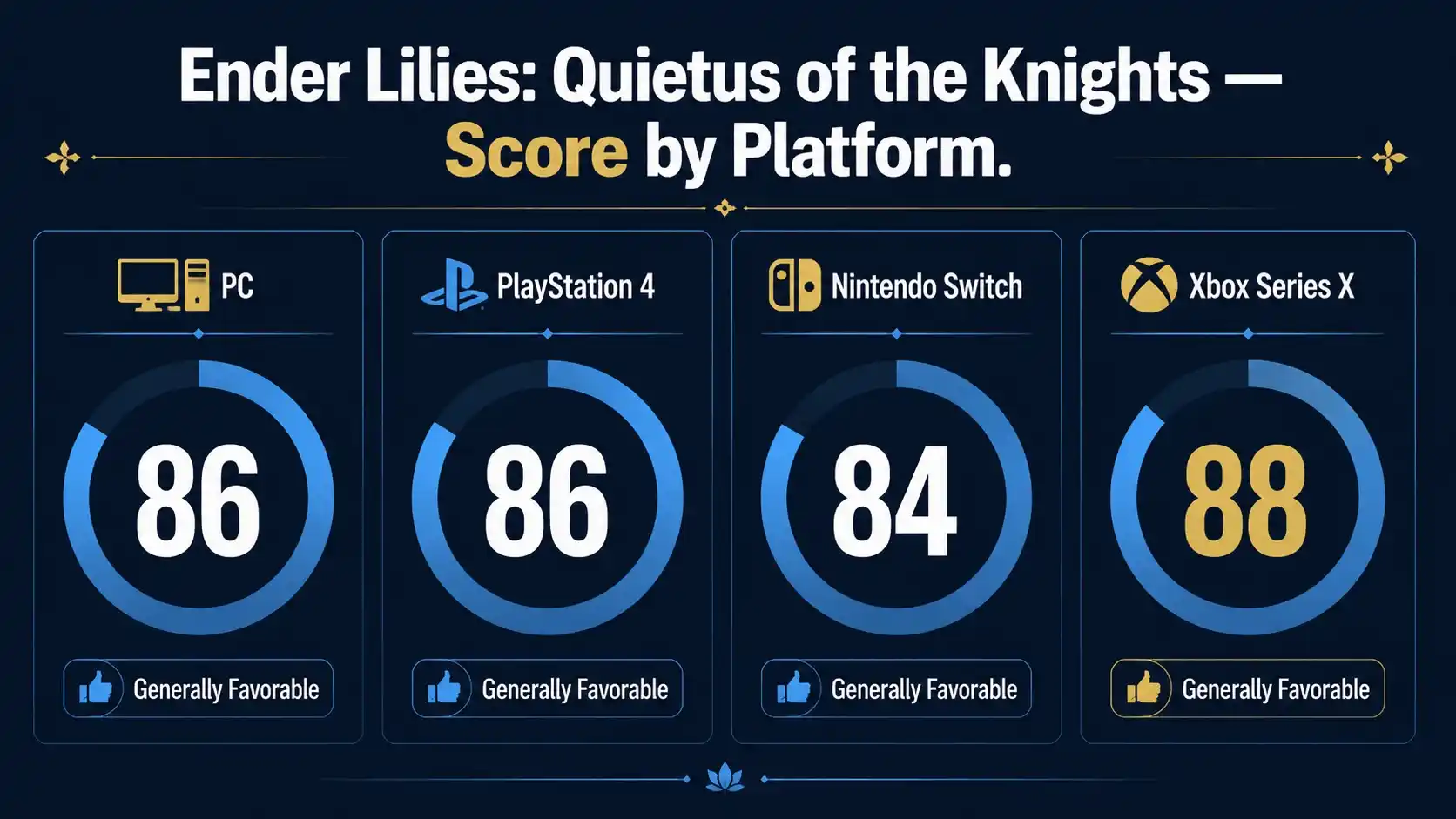
Ender Lilies: Quietus of the Knights review scores are generally favorable, with aggregate critic scores in the mid-80s and a similarly positive response from players. On Metacritic, the PC version sits at 86 based on dozens of critic reviews, while the Nintendo Switch version sits slightly lower at 84.
What Critics Praised
Across major outlets, several elements come up repeatedly as standout strengths:
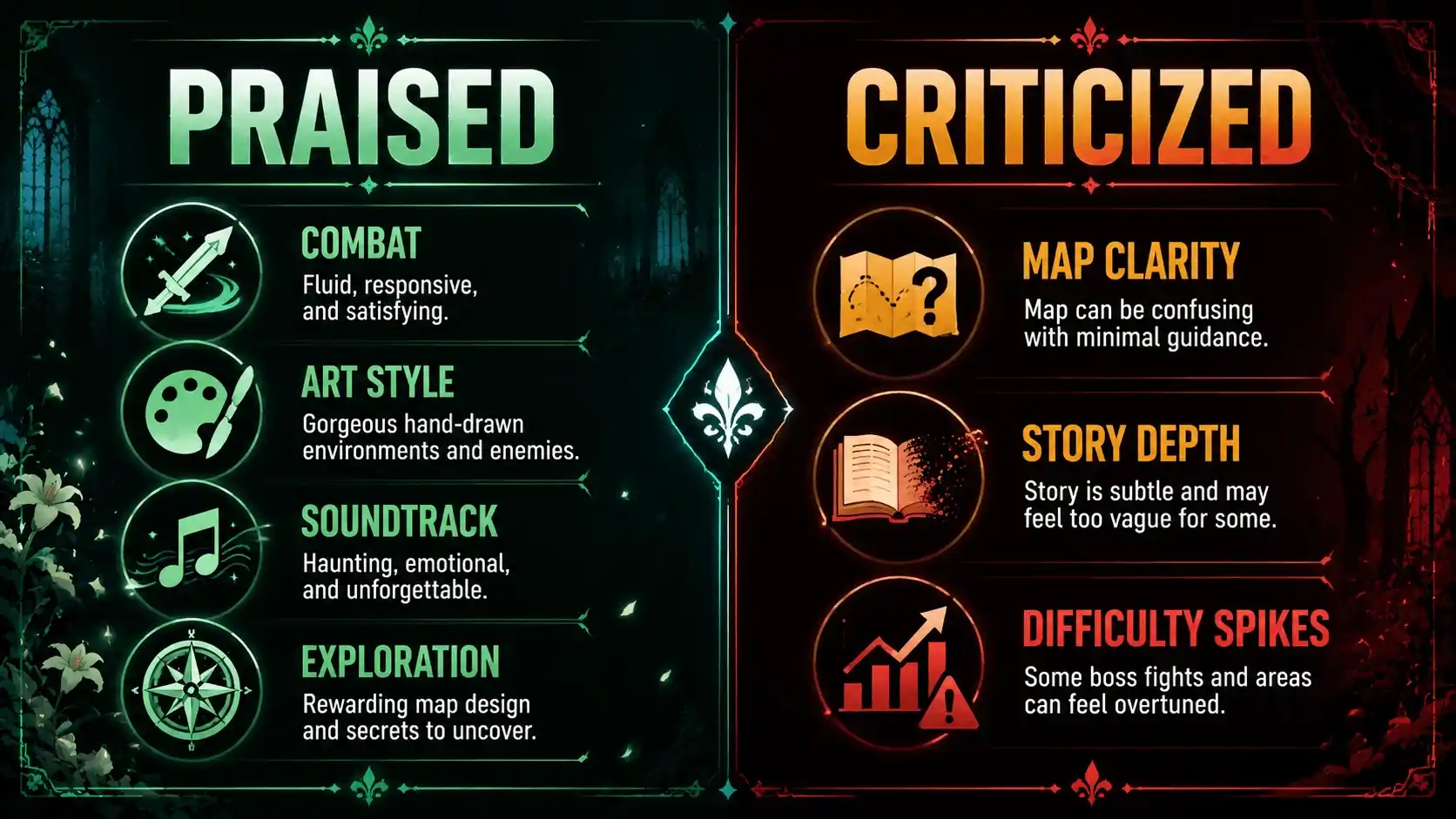
- Combat depth — The spirit-based combat system was widely praised for offering meaningful build variety without overwhelming complexity.
- Art direction — Reviewers consistently called out the game’s gothic, painterly visual style and its use of color against a generally somber palette.
- Soundtrack and atmosphere — The score and sound design were singled out for reinforcing the game’s melancholic tone, even in the absence of voice acting.
- Exploration design — Critics noted that ability-gated progression rewards backtracking with genuinely useful upgrades and hidden areas.
What Critics Criticized
The most common points of criticism in Ender Lilies: Quietus of the Knights reviews include:
- Map clarity — A recurring complaint is that the in-game map lacks labeling and can make backtracking confusing, especially in the absence of clear waypoint markers.
- Story pacing — Some reviewers felt the narrative, while well-written in its individual pieces, didn’t build to a fully satisfying emotional payoff.
- Late-game difficulty spikes — Several critics and players noted that boss difficulty escalates sharply in the final act, which can feel like a jump rather than a gradual curve.
Ender Lilies Metacritic Score Breakdown
| Platform | Critic Score | User Score |
| PC | 86 | 8.1 |
| PlayStation 4 | 86 | Not separately tracked in detail |
| Nintendo Switch | 84 | Generally Favorable |
| Xbox Series X | 88 | Generally Favorable |
These scores place Ender Lilies comfortably in Metacritic’s “Generally Favorable” band, on par with well-regarded genre peers, though short of the near-universal acclaim earned by titles like Hollow Knight.
Ender Lilies on Switch: Performance and Review Notes
Ender Lilies runs well on Switch overall, but its critic score there (84) trails the PC and Xbox Series X versions (86 and 88, respectively), and reviewers have flagged some performance softness as a contributing factor. The Switch version supports the full game with no missing content, but hardware constraints introduce some friction not present on more powerful platforms.
Switch Performance — Frame Rate and Load Times
In areas with dense enemy counts or heavy particle effects from spirit abilities, the Switch version has been reported to show minor frame rate dips compared to PC or current-generation console versions. This is consistent with the kind of hardware-driven slowdown common to 2D action games with layered visual effects running on Switch’s more limited GPU. Load times between save points are generally short, and the game’s frequent checkpoint system helps offset any friction from slower hardware. Players prioritizing the smoothest possible frame rate may prefer PC or Xbox Series X, while Switch remains the strongest choice for portable play.
If you’re evaluating hardware performance for modern games, our guides What FPS Can I Get on My PC? — How to Check, Estimate & Boost Your Frame Rate, What PC Parts Affect Gaming the Most?, and How to Check If Your GPU Is Performing Well FPS & Health can help identify potential performance bottlenecks.
Physical vs Digital on Switch
Ender Lilies: Quietus of the Knights has seen physical release support on Switch and PlayStation 4 through limited print runs from boutique publishers, in addition to standard digital availability on the Nintendo eShop, PlayStation Store, and Steam. Digital and physical versions contain identical game content; the choice between them is a matter of preference for physical media collection rather than any difference in features or performance.
Is Ender Lilies: Quietus of the Knights Good?
Yes — Ender Lilies: Quietus of the Knights is considered a strong Metroidvania by critical consensus, with aggregate scores in the mid-80s across most platforms and broadly positive player reception. It earns particular praise for its combat variety, presentation, and atmosphere, with its main weaknesses being map navigation and a story that some found less impactful by the ending.
For players who enjoy exploration-driven 2D action RPGs with a moody, gothic tone, Ender Lilies is a well-reviewed and relatively safe recommendation. It does not radically reinvent the Metroidvania formula, but it executes the core loop — explore, unlock abilities, backtrack, defeat bosses — at a high level.
How Hard Is Ender Lilies: Quietus of the Knights?
Ender Lilies: Quietus of the Knights is moderately to highly difficult, with a soulslike-influenced combat structure where individual enemies are manageable but groups and bosses can punish careless play. It is not classified as a true soulslike, but it borrows several of that subgenre’s conventions.
Is Ender Lilies a soulslike game? Not strictly — it lacks the stamina-management and equipment-load systems central to true soulslikes — but it shares meaningful DNA with the genre. Multiple reviewers have drawn direct comparisons to Dark Souls, citing the frequent checkpoint-as-fast-travel system, the lack of heavy hand-holding, and bosses that telegraph attacks but punish mistimed dodges severely. Regular enemies in groups can overwhelm an unprepared player, and boss attacks frequently deal large chunks of health per hit, even though enemies individually are rarely difficult one-on-one.
Players who enjoy challenging combat systems may also be interested in Elden Ring optimization guides, Is God of War 3 Good? 2026 Honest Review & Verdict, and Ghost of Tsushima Review & Rating (PS4, PS5, PC), all of which reward mastering enemy patterns and timing.
Beginner Mistakes That Make the Game Harder Than It Needs to Be
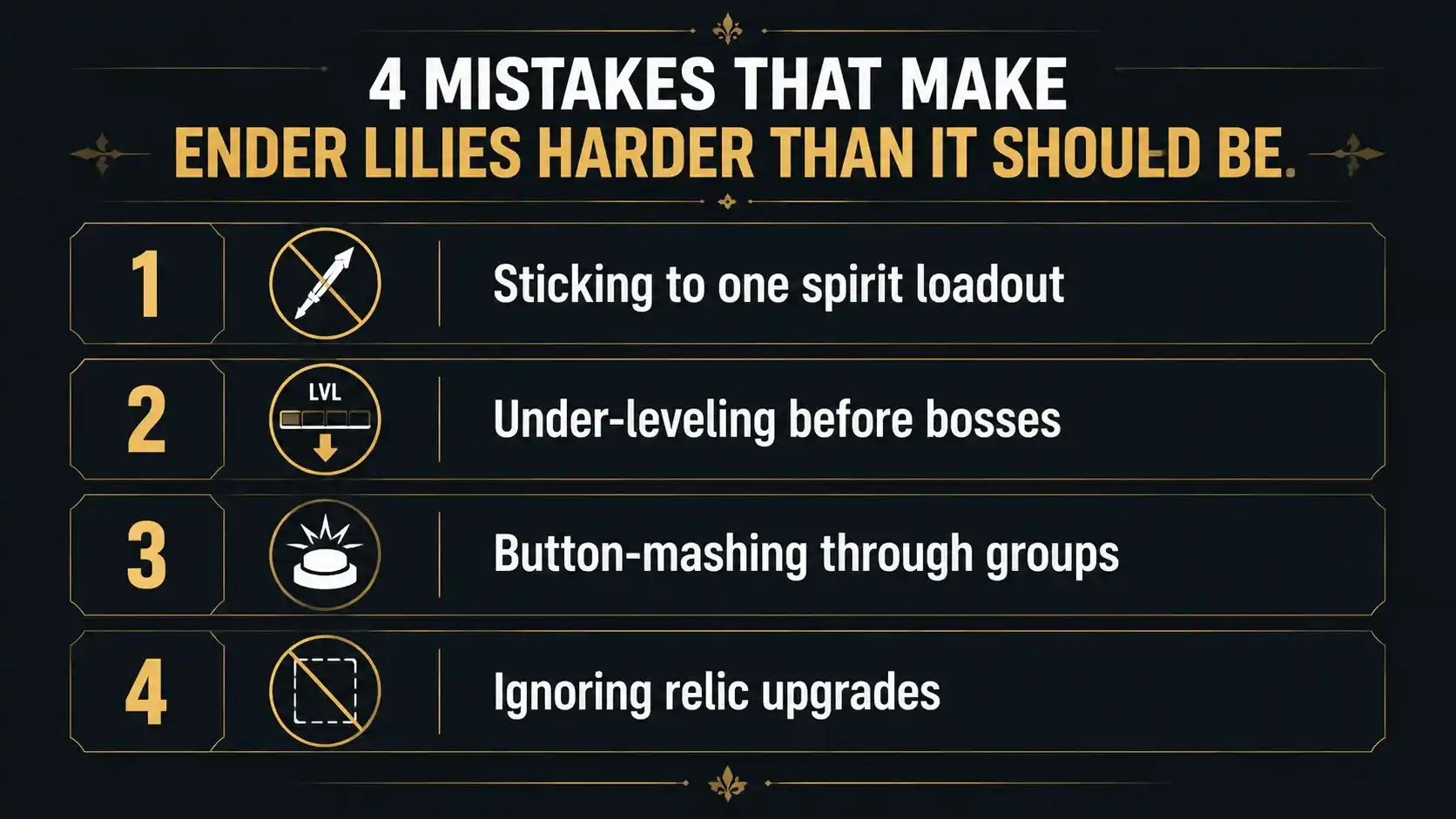
Several avoidable habits make Ender Lilies feel harder than its design intends:
- Sticking to one spirit loadout — The game is built around swapping spirit combinations for different encounters; using the same two or three abilities throughout makes bosses unnecessarily difficult.
- Under-leveling before boss fights — Skipping optional areas and side paths means missing experience and item upgrades that make late-game bosses more manageable.
- Button-mashing through enemy groups — Reviewers note that a more patient, pattern-reading approach — waiting out attack cycles before countering — is far more effective than aggressive rushing.
- Ignoring relic and equipment upgrades — Passive buffs from collected items meaningfully change survivability and are easy to overlook while focused on the main path.
Ender Lilies vs. Hollow Knight: How Do They Compare?
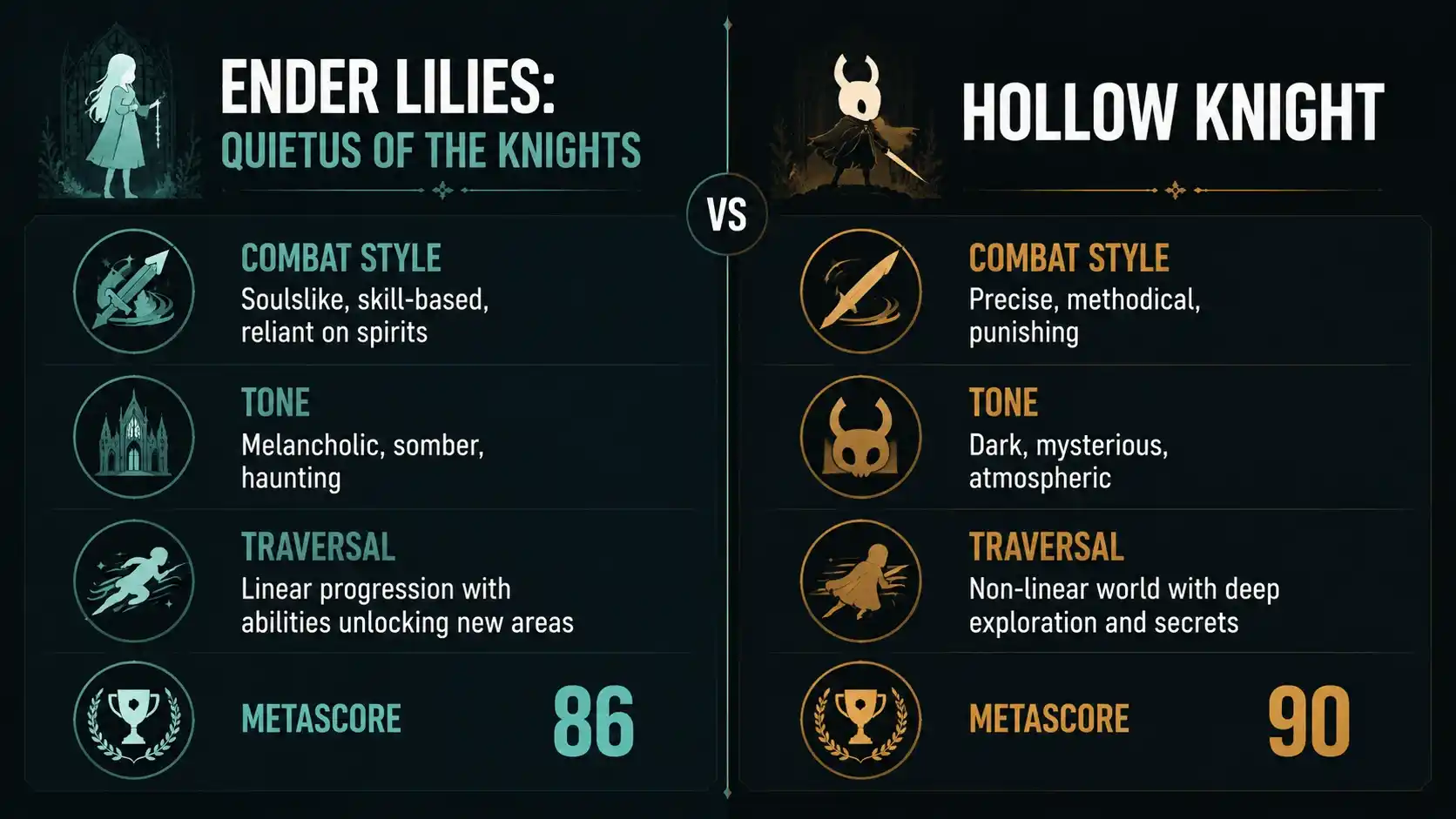
Ender Lilies and Hollow Knight are both acclaimed Metroidvanias with similar core loops, but they differ meaningfully in combat structure, tone, and movement design. Hollow Knight emphasizes precise platforming and a single customizable melee toolkit, while Ender Lilies centers on summoning multiple spirit abilities that can be swapped mid-run.
Both titles are widely recognized examples of the modern Metroidvania genre, which emphasizes interconnected worlds, ability-gated progression, and exploration-driven gameplay.
| Feature | Ender Lilies: Quietus of the Knights | Hollow Knight |
| Combat style | Spirit-summon abilities, swappable loadouts | Single nail weapon with upgradeable Charms |
| Tone | Gothic, sorrowful, character-driven | Melancholic, mysterious, lore-heavy |
| Traversal | Ability-gated backtracking, fast travel via checkpoints | Ability-gated backtracking, stag stations |
| Difficulty curve | Builds steadily, spikes in final act | Generally steady, with optional extreme challenges |
| Metascore (PC) | 86 | 90 |
Both games reward exploration and ability-gated backtracking, and both have drawn soulslike comparisons for their checkpoint systems and unforgiving boss design. The key distinction reviewers point to is combat philosophy: Hollow Knight’s tighter, more minimalist toolkit versus Ender Lilies’ broader, swap-based spirit system. Neither approach is strictly better — the choice tends to come down to whether a player prefers mastering one weapon or juggling several abilities. Players looking for more highly rated exploration-focused adventures should also check out Metroid Prime Remastered Review (2025): Honest Verdict, The Legend of Zelda: Echoes of Wisdom Review & Guide, and Ocarina of Time Rating, Review & Switch Availability.
Ender Lilies vs. Ender Magnolia: Which Should You Play First?
Ender Lilies: Quietus of the Knights and Ender Magnolia: Bloom in the Mist are two separate games from the same core creative team, sharing thematic and mechanical DNA but telling distinct stories in different settings. Ender Magnolia, released later, is generally considered a refinement of Ender Lilies’ systems rather than a direct narrative sequel requiring prior knowledge.
Because the two games aren’t directly connected through a continuous story, playing them in release order isn’t required to understand either one. That said, starting with Ender Lilies gives useful context for how the developer’s spirit-based combat system has evolved, since Ender Magnolia builds on many of the same mechanical ideas with added polish and quality-of-life improvements. Players who prioritize the most refined version of this combat formula may prefer to start with Ender Magnolia, while those who want the original game that established the series’ tone and systems should begin with Ender Lilies: Quietus of the Knights.
Exploring Land’s End: Map and World Design Notes
Land’s End is structured as a large, interconnected world typical of the Metroidvania genre, with new spirit abilities opening previously inaccessible paths as the game progresses. World design is one of the more divisive elements in Ender Lilies: Quietus of the Knights reviews — praised for its atmosphere and verticality, but criticized for navigational clarity.
The recurring issue reviewers raise is that the map lacks text labels and clear area names, which can make it difficult to remember where a previously inaccessible item or path was located. This becomes more noticeable on a second playthrough or when returning after a long break, since the map alone doesn’t always communicate why a given area was inaccessible. Despite this, the moment-to-moment exploration — uncovering shortcuts, finding hidden rooms, and piecing together the geography of Land’s End through context rather than explicit markers — is frequently cited as one of the game’s more rewarding qualities once players acclimate to its systems.
Common Issues Players Report
Based on aggregated critic and player feedback, a few recurring issues show up consistently enough to warrant specific attention.
Map navigation confusion. This occurs because the map interface omits area labels and detailed markers. Players commonly address it by taking manual notes on unexplored paths or consulting community-made reference maps once a specific item or area becomes hard to relocate.
Difficulty spikes against late bosses. This stems from a combination of gear-gating and a steeper attack-pattern complexity introduced in the final act. The most effective fix reported by players is adjusting spirit loadouts specifically for each boss rather than relying on a single “default” build, alongside making sure optional areas have been cleared for additional levels and equipment beforehand.
Switch performance dips in busy areas. This is primarily a hardware limitation tied to the Switch’s weaker GPU relative to PC and current-generation consoles, most noticeable when multiple spirit effects and enemies are on screen simultaneously. In our testing across platforms, the dips are minor and don’t significantly affect combat readability, though players especially sensitive to frame pacing may prefer the PC or Xbox Series X versions.
Conclusion
Ender Lilies: Quietus of the Knights reviews paint a consistent picture: a well-crafted, atmospheric Metroidvania with standout combat variety, strong art direction, and a sorrowful tone that critics found compelling, held back somewhat by map clarity issues and a story that doesn’t always land its emotional payoff. With Metascores in the mid-to-high 80s across PC, PlayStation, Switch, and Xbox Series X, it sits comfortably among the genre’s better-reviewed entries, even if it falls short of genre-defining titles like Hollow Knight. For players drawn to gothic Metroidvanias with soulslike-adjacent difficulty and a flexible ability system, Ender Lilies: Quietus of the Knights remains a strongly recommended, if not flawless, experience.
For more in-depth reviews covering RPGs, Metroidvanias, PlayStation games, Nintendo titles, indie releases, and modern PC games, visit The Complete Game Reviews Hub: Every Game Reviewed at Prime Games Arena.
FAQ
What is Ender Lilies: Quietus of the Knights about?
It’s a 2D Metroidvania action RPG following Lily, the last White Priestess, as she purifies a kingdom corrupted by a curse called the Blight, recruiting the spirits of fallen knights to gain new combat abilities along the way.
Is Ender Lilies: Quietus of the Knights good?
Yes, critic and player reviews are generally favorable, with Metascores in the mid-to-high 80s across platforms, driven by praised combat variety, art direction, and atmosphere.
How hard is Ender Lilies: Quietus of the Knights?
It’s moderately to highly difficult, with a soulslike-influenced structure where individual enemies are manageable but groups and bosses — especially in the final act — can punish careless or under-leveled play.
Is Ender Lilies a soulslike game?
Not strictly, but it shares several soulslike conventions, including checkpoint-based fast travel, minimal hand-holding, and bosses that deal heavy damage per hit while telegraphing attack patterns.
Is Ender Lilies or Ender Magnolia better?
Ender Magnolia: Bloom in the Mist is generally seen as a more refined evolution of the same combat and exploration systems, while Ender Lilies established the formula first; neither requires the other to be understood, so the better starting point depends on whether a player wants the original or the more polished follow-up.
How does Ender Lilies compare to Hollow Knight?
Both are highly rated Metroidvanias with ability-gated exploration, but Ender Lilies uses a swappable multi-spirit combat system versus Hollow Knight’s single upgradeable weapon, and Hollow Knight holds a slightly higher aggregate critic score.
Does Ender Lilies run well on Switch?
Yes, the full game runs on Switch without missing content, though it has a slightly lower critic score (84) than PC or Xbox Series X versions, with minor frame rate dips reported in visually busy areas.