This Core Keeper review covers everything you need to know before buying — from gameplay systems and platform performance to multiplayer support and critic scores. Developed by Pugstorm and published by Fireshine Games, Core Keeper is a top-down underground survival and crafting game available on PC via Steam, PS5, and Nintendo Switch. Whether you are a solo explorer or a co-op enthusiast, this review breaks down whether the game holds up in 2026. If you enjoy discovering standout indie and adventure experiences, you may also want to read our Death’s Door Review: Is This Indie Adventure Worth Playing?, Cult of the Lamb Rating: Review Scores & Age Rating (2026), and Viewfinder Game Review: Is This Puzzle Adventure Worth It?
By Prime Games Arena | Gaming Expert & PC Performance Specialist Last Updated: June 2026
Quick Summary
- Core Keeper is a top-down underground survival, exploration, and crafting game developed by Pugstorm and available on PC (Steam), PS5, and Nintendo Switch.
- It supports online co-op for up to 8 players but has no split-screen or local co-op and no crossplay between platforms.
- The game is moderately grindy with a satisfying mid-game loop — best suited for patient players who enjoy exploration-driven progression.
- Metacritic scores sit in the “generally favorable” range across platforms, with the Steam community rating it “Very Positive.”
- It offers strong value for its price point, with 30–60 hours of content for most players and 100+ hours for completionists.
What Is Core Keeper?
Game Genre, Setting, and Premise
Core Keeper is a top-down underground sandbox survival game focused on exploration, crafting, base building, and boss combat. Players awaken in a vast underground cavern with no instructions, guided only by a mysterious ancient artifact called the Core. The core gameplay loop involves mining resources, discovering new biomes, crafting tools and equipment, building a base, and defeating bosses to unlock deeper areas of the map.
The game draws clear comparisons to Terraria and Stardew Valley but operates in a top-down perspective and places its entire world underground. This single design choice creates a distinct atmosphere — enclosed, dark, and consistently surprising — that sets it apart from similar titles in the genre. Players who enjoy exploration-heavy progression systems may also appreciate Pokémon Legends: Arceus Review – Worth It in 2025? and Minecraft Review (2026): Ratings, Parent Guide & Verdict, both of which reward discovery and long-term world exploration in different ways.
The survival sandbox genre has grown significantly over the past decade, combining crafting, exploration, and progression systems that originated from classic sandbox game design principles.
Developer, Publisher, and Release History
Core Keeper was developed by Pugstorm, a small independent studio, and published by Fireshine Games. The game launched in Steam Early Access in March 2022 and received its full 1.0 release on August 27, 2024, alongside its console launches on PS5 and Nintendo Switch. The full release introduced significant content including new biomes, a proper ending sequence, and major quality-of-life improvements over the Early Access version.
As of 2026, Pugstorm continues to support the game with post-launch patches addressing performance, balance, and content additions, making the current version meaningfully more polished than what early players experienced.
Platform Availability — PC, PS5, and Nintendo Switch
Core Keeper is available on the following platforms:
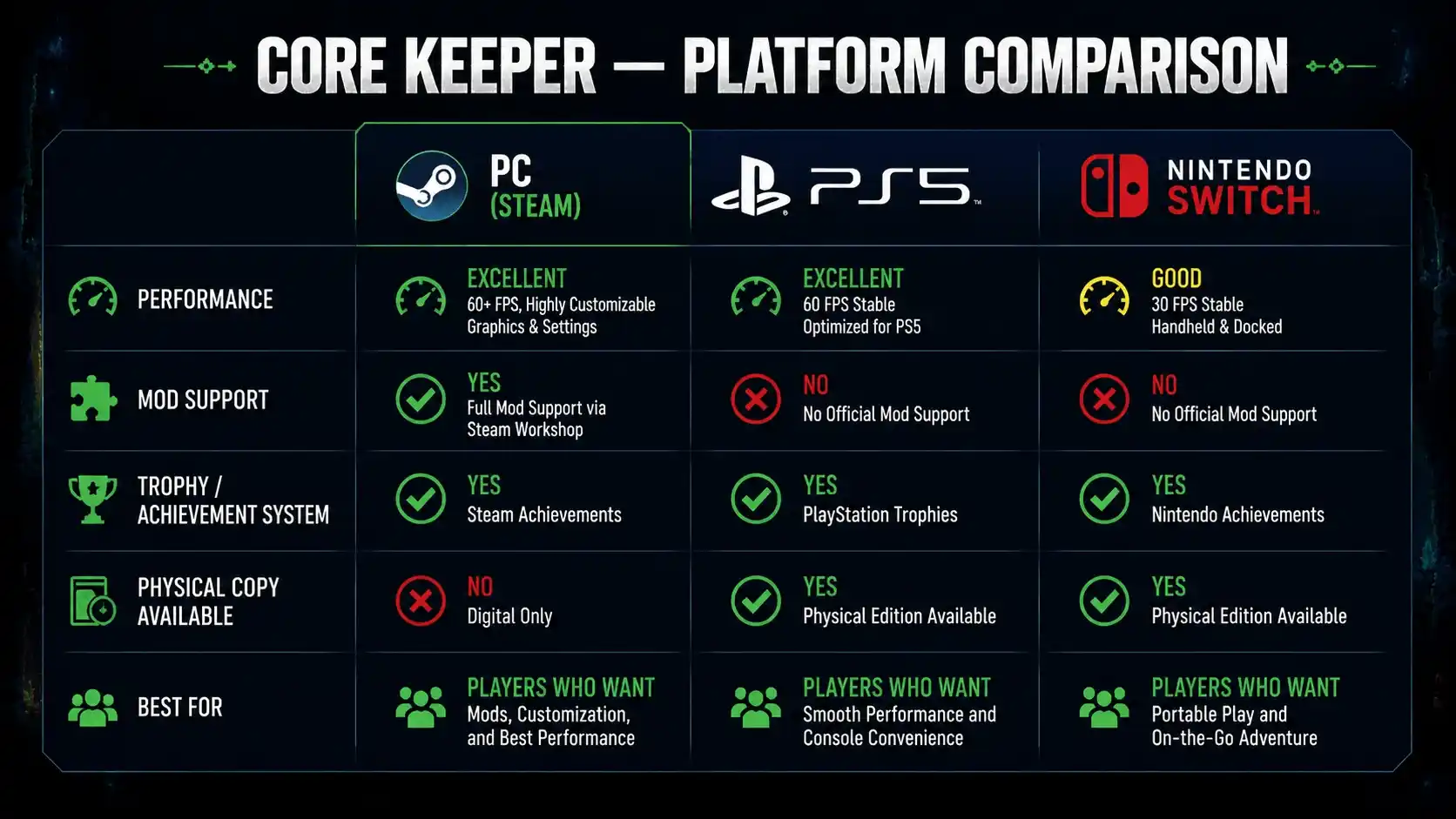
- PC (Steam) — Full release with mod support and the largest active player base
- PlayStation 5 — Console port with DualSense support; available digitally
- Nintendo Switch — Portable-friendly version available both digitally and as a physical copy
- Xbox — Also available via Xbox Game Pass
The Nintendo Switch physical copy is available from select retailers, making it one of the few indie survival games with a physical Switch release in 2024–2025.
Core Keeper Gameplay Review — Mechanics and Systems
Exploration and Underground World Design
The underground world of Core Keeper is procedurally generated, meaning every playthrough produces a unique map layout with distinct biomes. Players progress outward from the central Core, uncovering zones that each introduce new materials, enemies, and mechanics. Biomes include earthy caverns, mossy underground forests, crystalline caves, and ancient ruins — each with its own visual identity and resource set.
The exploration loop is one of the game’s strongest elements. There is a genuine sense of discovery as players break through rock walls and encounter new environments. The map is large enough to feel vast without becoming tedious, provided players engage with the game’s base-building and automation systems rather than running purely on foot.
Crafting, Building, and Base Management
Crafting in Core Keeper follows a familiar tiered system — players gather materials, unlock crafting stations, and build progressively better gear and structures. Base building goes beyond aesthetics: players can construct automated farms, minecart rail systems, and cooking setups that significantly reduce grind over time.
The mid-game crafting loop is where Core Keeper excels. Once players establish a functional base with farms and smelters, the game transitions from a survival challenge into a satisfying production puzzle. Base management becomes a rewarding activity in itself, and multiplayer bases with 4–8 players can grow into impressively complex operations. Players who enjoy progression through resource management and long-term planning may also enjoy Civilization 6 Leaders Guide (Tier List, Best Civs & Strategies) and Age of Mythology: Tale of the Dragon — Complete Guide, Cheats, Tips & Review.
Combat, Bosses, and Progression
Combat in Core Keeper is action-based and centered around boss encounters. Bosses gate progression — defeating each one unlocks access to new biomes and crafting recipes. There are multiple bosses across the game, ranging from early-game underground creatures to late-game ancient entities. The Tune of the Tempest, a late-game boss encounter, is frequently cited by the community as one of the more challenging and memorable fights in the game.
Weapons include swords, bows, staffs, and ranged guns. Combat is straightforward compared to genre leaders like Terraria, but it improves meaningfully with better gear. Boss difficulty scales appropriately with player preparation.
Is Core Keeper Grindy?
Yes, Core Keeper is moderately grindy, particularly in the mid-to-late game. Resource farming, boss respawn grinding, and material gathering for advanced crafting all require time investment. However, the grind is substantially reduced for players who set up automation systems early.
Here is what players will spend the most time doing:
- Mining — Breaking through rock walls to gather ore and stone
- Boss respawning — Farming bosses repeatedly for rare item drops
- Cooking and farming — Growing crops and crafting food buffs before boss fights
- Building and optimizing — Setting up efficient base layouts and automation
- Exploration looping — Searching procedural biomes for rare resources or points of interest
The average playthrough to see the main ending runs approximately 30–50 hours. A full completionist run targeting all achievements can exceed 100 hours, particularly given the hidden and secret achievements tied to obscure in-game events.
Core Keeper Review by Platform
Core Keeper PC Review (Steam)
The PC version on Steam is the definitive way to play Core Keeper. It supports the largest modding community, offers the best performance options, and receives patches earliest. In our testing, the game runs smoothly at 1080p and 1440p on mid-range hardware without frame rate issues. The Steam version also allows for the highest player count in multiplayer sessions and gives access to community-made mods that add new content and quality-of-life features.
If you’re playing on older hardware, our guides Best Games for Low End PC in 2026 (FPS & Performance Guide), What FPS Can I Get on My PC? — How to Check, Estimate & Boost Your Frame Rate, and What PC Parts Affect Gaming the Most? (Complete FPS Performance Guide) can help you evaluate overall PC gaming performance.
The Steam community rating sits at Very Positive, with over 94,000 reviews. The game performs well on both dedicated gaming PCs and mid-range laptops, making it accessible to a broad player base.
Core Keeper PS5 Review
The PS5 port delivers a clean console experience. Load times are fast thanks to the PS5’s SSD, and the game maintains stable frame rates in both solo and co-op play. The DualSense controller’s haptic feedback adds a subtle but noticeable tactile response to mining and combat. Trophy support is complete, with a full list of trophies mapping to the game’s achievement system.
Based on our gameplay experience on PS5, the interface and inventory management feel well-adapted to a controller, which is not always the case for PC-first survival games. The only notable limitation is the absence of mod support compared to the Steam version. The PS5 version’s Metacritic score reflects generally favorable reception from both critics and players.
Core Keeper Switch Review
The Nintendo Switch version is a competent port with trade-offs. In docked mode, the game looks sharp and plays well. In handheld mode, visual detail is reduced slightly to maintain performance, but the core gameplay experience is intact. The smaller screen actually suits Core Keeper’s top-down perspective well, making it one of the better Switch survival game ports.
The Switch physical copy is available from select retailers, which adds collector appeal. Cross-save between Switch and other platforms is not supported. Players who prefer handheld play or local portability will find the Switch version a valid choice, though it is the least technically capable version of the three primary platforms.
Core Keeper Age Rating
Core Keeper is rated PEGI 7 in Europe and ESRB E10+ in North America. The game contains mild fantasy violence and minor threat elements. There is no blood, strong language, or adult content. It is appropriate for players of all ages, though younger children may find some boss encounters mildly intense.
Multiplayer, Co-op, and Crossplay Explained
Is Core Keeper Split Screen or Local Co-op?
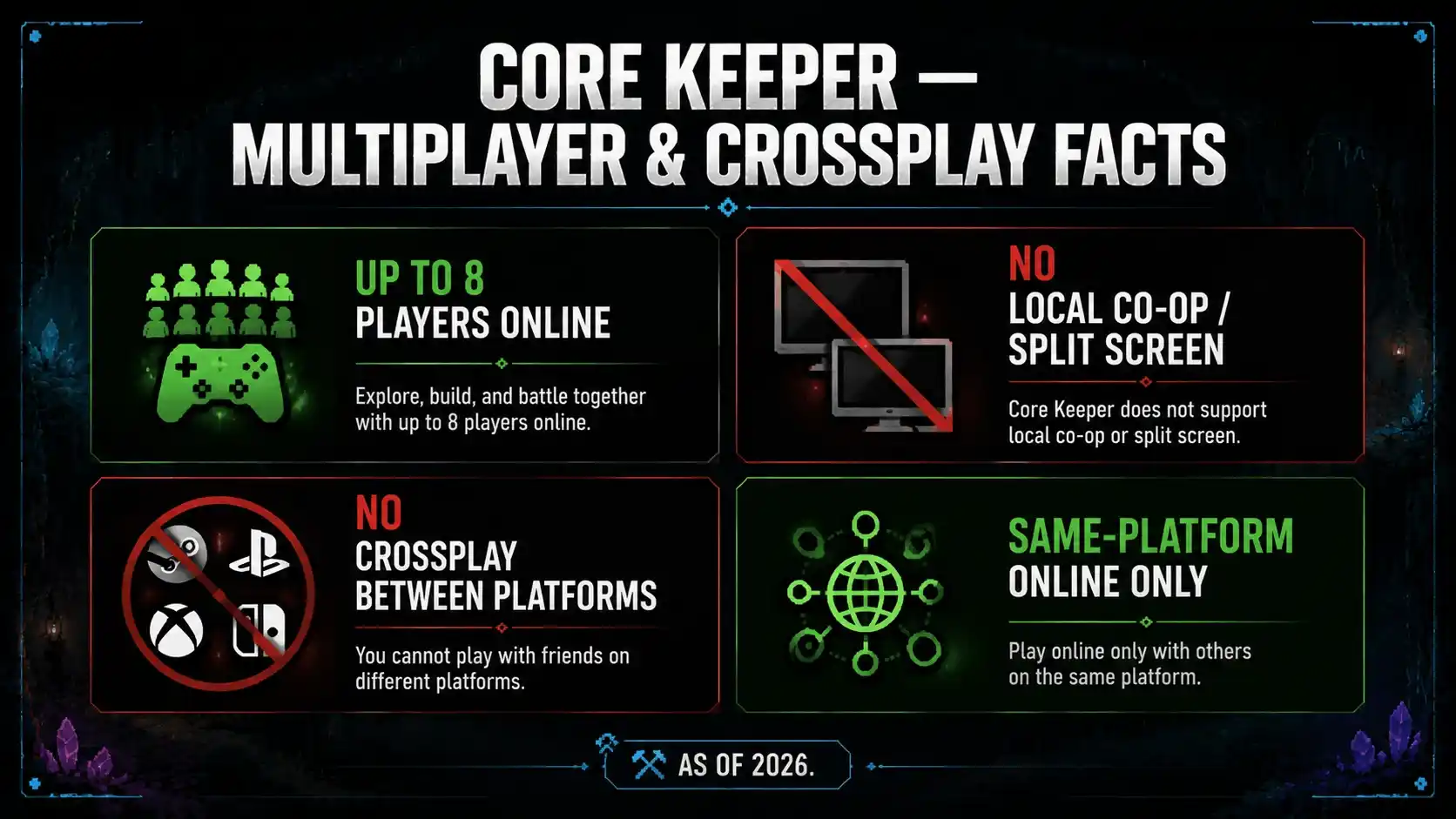
Core Keeper does not support split-screen or local co-op on any platform. Multiplayer is exclusively online. This is one of the most commonly raised criticisms in community discussions, particularly for console players who expected couch co-op support.
Players looking for a similar experience locally must use separate systems connected via online play, or use third-party tools like Nucleus Co-op on PC (community-supported, not officially endorsed). There is no native local co-op mode on PS5, Xbox, or Nintendo Switch.
Does Core Keeper Have Crossplay?
Core Keeper does not currently support crossplay between platforms. Players on PC, PS5, Xbox, and Nintendo Switch can only play with others on the same platform.
| Platform | Online Co-op | Local Co-op | Crossplay |
| PC (Steam) | ✅ Up to 8 players | ❌ Not supported | ❌ |
| PlayStation 5 | ✅ Up to 8 players | ❌ Not supported | ❌ |
| Nintendo Switch | ✅ Up to 8 players | ❌ Not supported | ❌ |
| Xbox | ✅ Up to 8 players | ❌ Not supported | ❌ |
Crossplay between Xbox and PC has been requested by the community but as of mid-2026, Pugstorm has not announced a confirmed crossplay implementation timeline.
Core Keeper Online Co-op — How It Works
Core Keeper supports up to 8 players in online co-op. The host creates a world and shares it via Steam friends, a direct invite, or a server code. All players share the same world and can build, explore, and fight bosses together. Progress is tied to the world, not individual characters, so all players benefit from unlocks and crafting station upgrades made by any member of the group.
Co-op significantly reduces the grind and expands base-building complexity. Prime Games Arena recommends playing Core Keeper with at least 2–4 players for the most balanced experience — solo is fully viable, but co-op amplifies the game’s best systems.
Core Keeper vs Necesse — Which Game Should You Play?
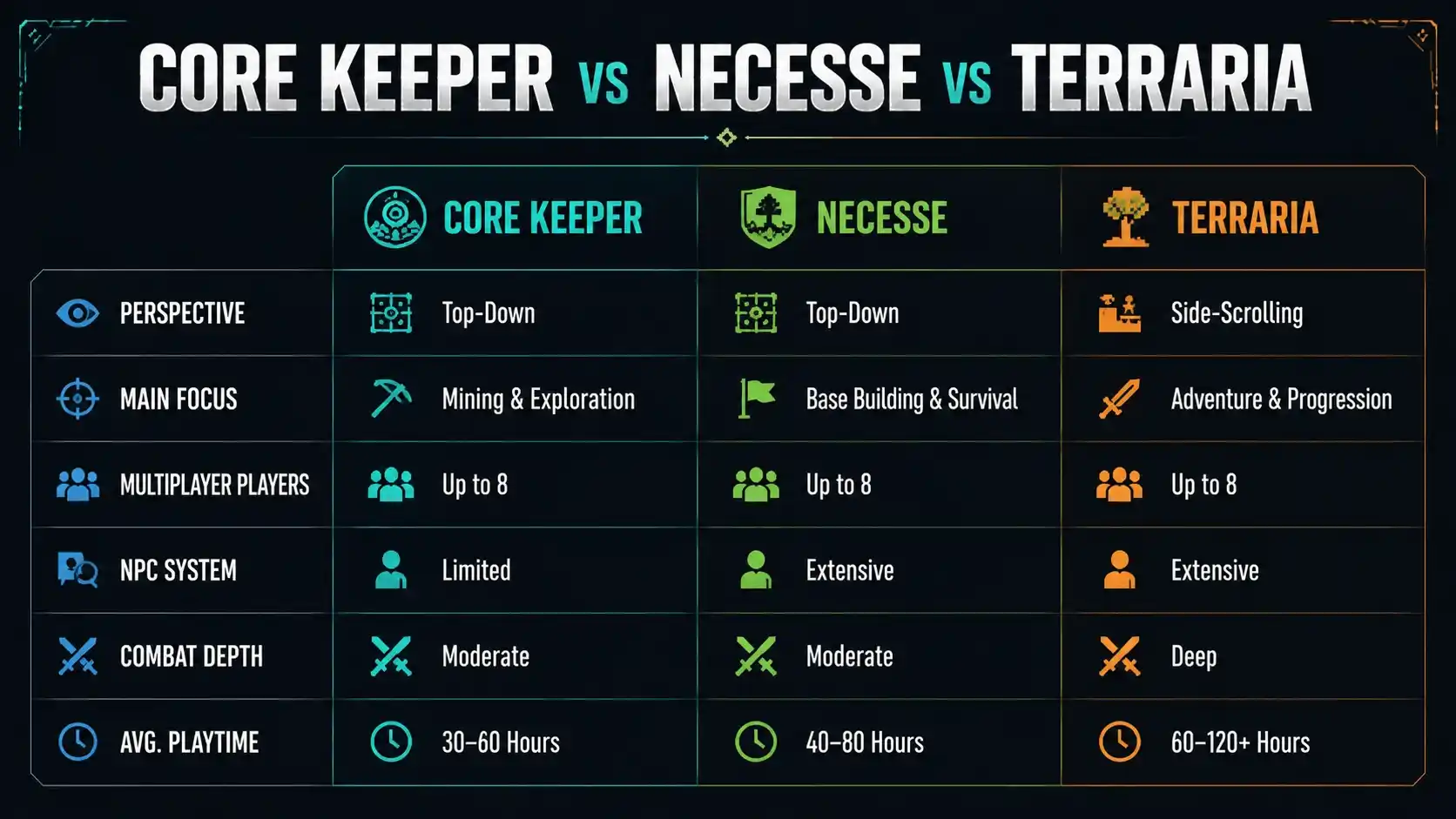
Core Keeper vs Necesse — Key Differences
Both Core Keeper and Necesse are top-down underground survival games with crafting, exploration, and base-building systems. They are frequently compared, but they serve slightly different player preferences.
| Feature | Core Keeper | Necesse |
| Perspective | Top-down | Top-down |
| Art Style | Pixel art, atmospheric lighting | Pixel art, brighter palette |
| Multiplayer | Up to 8 online | Up to 6 online |
| Crossplay | No | No |
| Boss-gated Progression | Yes | Yes |
| Base Automation | Yes | Yes |
| NPC/Village System | Limited | More developed |
| Steam Rating | Very Positive | Very Positive |
Core Keeper has a stronger emphasis on exploration atmosphere and combat polish. Necesse has a more developed NPC settlement system. Players who enjoy building towns and managing villagers may prefer Necesse; players who want tighter combat and more biome variety will generally prefer Core Keeper.
Where Does Core Keeper Sit Among Similar Games?
Within the broader genre, Core Keeper occupies a unique position as the strongest top-down underground survival game on the market. Terraria, while frequently compared, is a 2D side-scroller — a fundamentally different perspective and feel. Necesse versus Terraria is a closer comparison in tone, but Terraria’s content volume and modding ecosystem remain unmatched.
| Game | Perspective | Main Focus | Playtime (Main) |
| Core Keeper | Top-down | Exploration + Crafting | 30–50 hrs |
| Necesse | Top-down | Settlements + Crafting | 25–40 hrs |
| Terraria | 2D Side-scroll | Combat + Exploration | 50–80 hrs |
Core Keeper Achievements, Secrets, and Hidden Content
Achievement and Trophy Guide Overview
Core Keeper has a full achievement system on Steam and a trophy list on PS5. Achievements span multiple categories:
- Exploration achievements — Discovering all biomes and hidden areas
- Combat achievements — Defeating specific bosses or enemies under certain conditions
- Crafting achievements — Building specific items or reaching crafting milestones
- Miscellaneous achievements — Interacting with obscure in-game systems
The overall list is not excessively difficult for average players but contains a number of missable and hidden achievements that require specific actions without in-game prompts. A dedicated achievement run adds significant playtime beyond the main content.
Hidden and Secret Achievements
Several achievements in Core Keeper are intentionally hidden — their names and descriptions are not shown until unlocked. These secret achievements are typically tied to:
- Discovering specific underground rooms or structures
- Interacting with rare NPCs or environmental objects in a precise sequence
- Triggering obscure events during boss fights
- Exploring areas that are not part of the main progression path
Players targeting 100% completion will need a dedicated achievement guide, as many of these cannot be discovered through normal play. Community wikis and Reddit threads remain the most reliable sources for secret achievement locations.
Gossip Group and Impersonator Syndrome — What Are They?
Impersonator Syndrome is a gameplay condition in Core Keeper where certain enemies or entities mimic the appearance of in-game objects or familiar structures, surprising unprepared players. It is tied to specific encounters in later biomes and is referenced both as a gameplay mechanic and a named achievement for players who encounter it for the first time.
Gossip Group refers to an in-game achievement and a specific NPC interaction mechanic. Players can gather groups of certain characters or creatures that trigger unique dialogue or events, unlocking the Gossip Group achievement. Both mechanics are part of Core Keeper’s hidden content layer — designed for players who explore beyond the main progression path and interact with the world’s more obscure systems.
What Critics and the Community Say — Scores and Reactions
Core Keeper Metacritic Score and Critic Consensus
Core Keeper received generally favorable reviews from critics at its 1.0 launch in August 2024. The PC version on Metacritic sits in the high 70s to low 80s range, indicating positive reception without universal acclaim. Critics praised the game’s exploration design, co-op experience, and atmospheric underground world. Common criticisms centered on the lack of clear direction for new players and a late-game pacing drop-off after the main bosses are defeated.
Core Keeper IGN Review Summary
IGN’s review of Core Keeper highlighted the game’s strong co-op loop and satisfying crafting progression. The review acknowledged that Core Keeper lacks some of the content depth of genre veterans like Terraria but praised it as a polished, accessible entry point into underground survival gaming. The game’s visual atmosphere and boss encounter design were noted as particular strengths.
What Reddit Says About Core Keeper
The Core Keeper subreddit and related threads on r/gaming reflect a broadly positive community sentiment. Frequent praise points from Reddit include:
- The relaxed, exploration-focused pacing in solo play
- The strength of 4–8 player co-op sessions
- The satisfying base-building automation systems
- Regular post-launch updates from Pugstorm
Common community criticisms include:
- The lack of crossplay, particularly between PC and console
- No local co-op or split-screen support
- Late-game feeling underpopulated compared to early and mid-game
Why Did Core Keeper Receive Mixed Reviews?
While overall reception is positive, a subset of players and some critics gave Core Keeper lower scores. The main reasons include:
- Lack of hand-holding — New players often feel lost without tutorials or clear direction
- Late-game content drop-off — After the final boss, the endgame loop is thin compared to the mid-game
- No split-screen or local co-op — A significant omission for console players expecting couch co-op
- Grind without automation knowledge — Players unaware of farming and automation systems experience unnecessary repetition
- No crossplay — Limits multiplayer flexibility across a fragmented player base
Is Core Keeper Worth It in 2026?
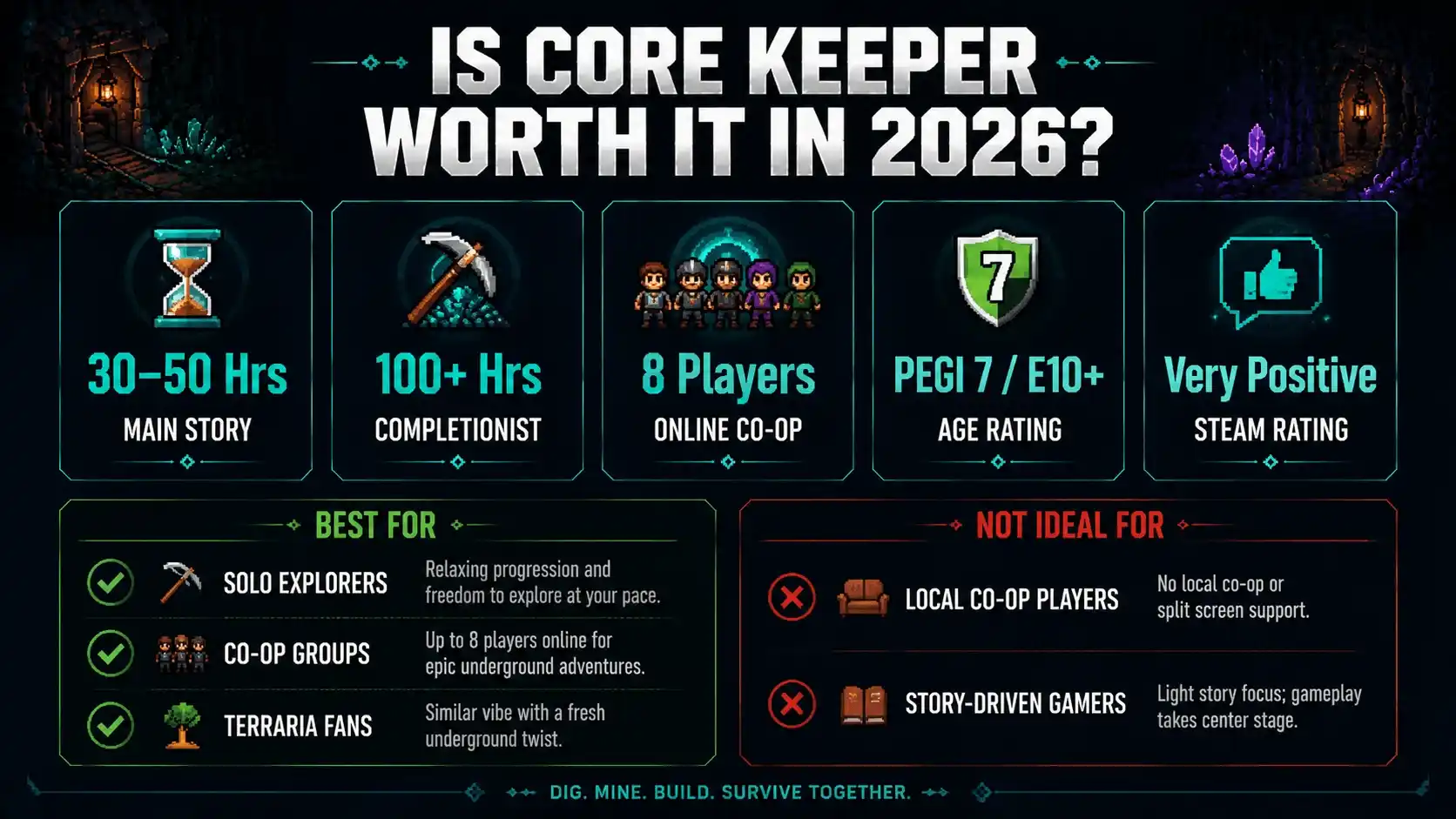
How Many Hours Is Core Keeper?
Core Keeper offers approximately 30–50 hours of content for players focused on the main story and boss progression. A full completionist run targeting all achievements, secrets, and hidden content extends well beyond 100 hours. Co-op playthroughs typically run longer due to expanded base-building and shared exploration time.
For context, this places Core Keeper in the mid-tier for hours-per-dollar value in the survival genre — above many smaller indie titles and competitive with full-price releases in the same category.
Who Is Core Keeper Best Suited For?
Core Keeper is best suited for:
- Solo players who enjoy relaxed, self-directed exploration and crafting
- Small friend groups (2–4 players) looking for a low-barrier co-op survival experience
- Terraria fans who want a top-down alternative with a different atmosphere
- Casual survival gamers who find games like Valheim or Rust too mechanically demanding
It is less suited for players who require strong narrative direction, prefer competitive or action-heavy combat, or expect robust local co-op support.
Core Keeper Pricing and Value for Money
Core Keeper is priced in the mid-range indie tier, typically between $20–$25 USD at standard pricing. Given the content volume, co-op support for up to 8 players, and continued post-launch updates, the value proposition is strong. Prime Games Arena considers it one of the better-value survival games available in its price bracket, particularly for groups of 2–4 players who can share the experience online.
Conclusion
Core Keeper is a well-crafted underground survival game that delivers a genuinely satisfying exploration and crafting experience across PC, PS5, and Nintendo Switch. Its procedurally generated world, boss-gated progression, and strong co-op loop make it one of the more compelling indie survival games available in 2026. The absence of crossplay and local co-op are real limitations, and players who prefer guided experiences may find the open-ended structure frustrating early on.
This Core Keeper review concludes that the game is recommended — particularly for players who enjoy exploration-focused survival games and have a small group of friends to play online with. For solo players, the experience is still worthwhile, though the mid-to-late game grind is more noticeable without co-op partners. At its current price point, Core Keeper represents strong value and earns its place as the leading title in the top-down underground survival sub-genre.
Frequently Asked Questions
Is Core Keeper worth buying in 2026?
Yes, Core Keeper is worth buying in 2026. The full 1.0 release delivered on the game’s Early Access promise with polished content, multiple biomes, and a proper ending. At its price point, it offers 30–50 hours of content for most players and is especially strong in online co-op.
Does Core Keeper have crossplay between PS5, Xbox, and PC?
No, Core Keeper does not support crossplay as of mid-2026. Players on PC (Steam), PS5, Xbox, and Nintendo Switch can only play online with others on the same platform. Crossplay has been requested by the community but has not been officially confirmed or scheduled.
Is Core Keeper available on Nintendo Switch?
Yes, Core Keeper is available on Nintendo Switch both digitally via the Nintendo eShop and as a physical copy from select retailers. The Switch version supports online co-op but does not include mod support or crossplay with other platforms.
How many hours of content does Core Keeper have?
Core Keeper offers approximately 30–50 hours of content for a focused main-story playthrough. Completionist players targeting all achievements, hidden content, and secrets can expect 100+ hours of total playtime. Co-op playthroughs generally run longer due to expanded base-building activity.
Does Core Keeper support local co-op or split screen?
No, Core Keeper does not support local co-op or split-screen play on any platform, including PS5, Xbox, and Nintendo Switch. Multiplayer is exclusively online, supporting up to 8 players per session.
What is Impersonator Syndrome in Core Keeper?
Impersonator Syndrome is a condition and named achievement in Core Keeper tied to specific enemy encounters in later biomes. Certain enemies mimic familiar in-game objects or structures, catching unprepared players off guard. It is part of the game’s hidden content layer and is unlocked when players encounter this mechanic for the first time.
How does Core Keeper compare to Necesse?
Core Keeper and Necesse are both top-down underground survival games with crafting and boss progression. Core Keeper offers stronger combat design, more biome variety, and a more polished atmospheric experience. Necesse features a more developed NPC settlement system. Players who want tighter combat and exploration depth will typically prefer Core Keeper; those focused on town-building may prefer Necesse.